


2M.Arch, Sustainable Constructions, Faculty of Architecture, KIT Karlsruhe, Karlsruhe, Germany
3PhD, Nanyang Technological University, School of Mechanical and Aerospace Engineering, School of Materials Science and Engineering, 639798, Singapore
4Sustainable Constructions, Faculty of Architecture, KIT Karlsruhe, Karlsruhe, Germany
For instance, deforestation is a major modern-day plague in Southeast Asia. Southeast Asia is home to more than 600 million people. Due to the increasing human population, governments have taken measures to clean more rainforest in order to create urban space. The rainforest trees are known to be suitable for a variety of purposes in forms of lumber products for applications in the construction industry. Southeast Asian countries are now faced with the problem of depletion of their natural forest resources to meet global demands for wood-based products. Although deforestation to create urban space seems an inevitable solution to the growing demand for housing and infrastructure,mitigation of deforestation caused by construction demand alternative materials and technologies needs to be explored and introduced to the building and construction sector. Development of novel and green composite materials from mycelium have been introduced recently and could potentially revolutionize the construction sector. Indeed, in the quest for new materials, mycelium-bound composites would enable a shift towards activating the urban waste resources and binding them to make a sustainable replacement to some of the traditional construction materials. Mycelium-bound composite materials are a new form of advanced biocomposites which are developed based on fungal growth of at least one species of commercially cultivated edible mushrooms on different organic and inorganic substances. Typically, these substrates are sourced from food and agricultural waste and by-products that are crushed and compacted into a porous block. During the development and growth of the fungus on to the substrate, it develops a mycelium that consists of thread-like hyphae forming a tight interconnected network[8]. Fungal mycelium therefore acts as a binder around the substrate material. Mycelium-bound composites are proved to be affordable, environmentally friendly and recyclable for a wide range of applications within the building and construction sector [9,10].
Mycelium-bound composites have numerous advantages over other traditional synthetic composites, namely lower cost, lower density and lower energy consumption. Furthermore,they also have shown lower environmental impact and CO2 footprint compared to apparently environmental-friendly composites such as bioplastics or wood composites [11-13]. Mycelium-bound materials are natural and fully compostable and therefore they can support the transition towards a circular bioeconomy, where the value of the materials is maintained throughout the economy and the generation of waste as by-products is reduced to a minimum. Mycelium-bound materials have only been recently introduced in the construction industry; therefore, the information regarding their applications is very limited. They have been used in a variety of applications ranging from nonstructural to semi-structural applications replacing traditional plastic films and sheets, synthetic foams and plastics, paneling, furniture, and decking thus paving the way for alternative environmentally sustainable construction materials [14-17].
However, there are various limitations in the current applications of mycelium-bound biocomposites in the construction industry. The low mechanical properties combined with highwater absorption and lack of universal standard test methods for evaluating their properties have triggered interest and effort of many academic and commercial entities to push forward the research and development in various fields of applications. Although there have been many existing developments toward the large-scale processing of mycelium-bound composites, many of these processes are under confidential agreements and knowhow, thereby not directly accessible to the public who should benefit directly of such an opportunity to participate to a circular bioeconomy. The aim of this short review is thus to summarize extricable paste out of mycelium materials to develop a higher degree of freedom in design using 3D printing technologies [27]. Mycelium-bound materials have been recently introduced for applications in selected industries, such as packaging [28,29], home appliances [30], and construction [27,31-37]. However, its application in the paper and textile industry [38,39] dates back to the mid-1950s [40]. A recent review study on the application of leather-like mycelium materials, includes comprehensive information on the influence of environmentally responsible materials on the fashion industry [41]. While traditional leather and its alternatives are mainly produced from animals or synthetic materials, mycelium based leather alternatives are fabricated through upcycling agricultural and forestry byproduct in to chitinous biopolymer resembling leather in both the aesthetic texture and its properties. In the majority of these studies, mycelium species of filamentous fungi, such as Ganoderma lucidum (G. lucidum, a medicinal mushroom commercially known as reishi, and Pleurotusostreatus (P. ostreatus), a common edible species of pearl oyster mushroom, have been used for the development of mycelium-bound composite materials. Utilizing biologic growth rather than energy intensive processes to convert low-cost by-products to high-value mycelium-bound material, which is biodegradable, makes it an attractive alternative to synthetic materials. Mycelium-bound composite material production is environmentally sustainable with low costs for production and disposal at the end of the lifecycle [42].
Companies that are currently designing and commercializing mycelium-bound composites are still few. MycoWorks[43], Mycotech[44], and NEFFA [45] are examples of such companies focusing on the fashion industry. Ecovative Design [46] is focusing on the packaging industry, and MOGU [47] is focusing on acoustic panels and flooring for the construction industry.
Mycelium-bound composites in construction industry:
Studies conducted to characterize mycelium-bound composite materials for applications in the construction industry have generally compared the material to petrochemical foams [10]. The applications in the construction industry have been primarily limited to thermal insulators [34,48-50] and acoustic dampers [35,36]. The material has also shown great fire-retardant properties, making it safer for use in construction applications [13,34]. Given all the ecological advantages of mycelium-bound materials, the question remains as to why it has not been widely applied for structural and semi-structural applications. This may have to do with the low structural strength and waterresistant properties of the material. One recent study showed that mechanical properties and water uptake of mycelium-bound materials could be adjusted by varying production methods, fungal species, and substrate type [51]. The use of good structural geometry would be another innovative way to overcome structural limitations [31,32,37].
Mycelium-bound composite materials properties:
Physical and mechanical properties
Mechanical Properties:
Mycelium-bound materials haven’t been widely studied as structural or semi-structural elements mainly due to their low strength. When building with materials that are weak in tension and bending, good geometry is essential for maintaining equilibrium through contact only - that is, through compression. One recent study focused on enhancement of the mycelium-bound material’s microstructure mainly to increase its compressive strength and elastic modulus in order to withstand the compressive forces developed within the structure[31,32,37]. In general, information regarding engineering characteristics of mycelium-bound materials is very limited, this could be due to the fact that mycelium-bound materials have been mainly exhibited in art galleries and museums. Mycelium-bound materials as construction elements come in two different forms, i) light-weight bricks, and ii) dense boards produced by cold or hot pressing the mycelium-bound elements. Table 1 summarizes the available information about the mechanical properties of light-weight Mycelium-bound bricks. Reported numbers in Table 1 are density and compressive strength, because improvements made in compressive properties of mycelium-bound materials would increase the potential of applying these materials in the construction industry to replace bricks [31,32,37]. As reported in Table 1, it was observed that changing the growth substrate could significantly increase the yield compressive strength of the material from 0.05 to 1.1 MPa and from 0.02 to 0.15 MPa in G. lucidum and P. ostreatusstrains respectively [31,37,52]. Beside changing substrate, one study showed that hybridization of myceliumbound materials with a natural binding agent such as latex could also potentially improve the compressive strength of the composite from 0.18 to 0.34 MPa [53]. On the other hand, it was observed that densification of the material under stress could increase the ultimate compressive strength of the material to 6.4 MPa and 1.02 MPa in G. lucidum and P. ostreatusstrains respectively. In the case of G. lucidum the ultimate compressive strength reported is close to compressive strength of 8.6-17.2 MPa for clay or shale bricks [31,37,52]. These promising findings shows the potential for further enhancement of the material properties through varying growth parameters and techniques.
Table 2 summarizes engineering properties of dense mycelium-bound boards. Values reported in table 2 are; Density, flexural strength and tensile strength. In the case of dense mycelium-bound materials, information regarding their fabrication process and
Growth substrate |
Density (kg/m3) |
Elastic Modulus in compression (MPa) |
Yield compressive Strength (MPa) |
Average Ultimate Compressive Stress (MPa) at (X% deformation) when material fails |
Cotton carpel a[28,50] |
66.5-224 |
N.A. |
N.A. |
0.07 c (N.A.) |
Red-oak sawdust a[50] |
318 |
N.A. |
0.05 |
0.5 (>16%) |
Woodchip and sawdust of Chinese albiziaa[31,37] |
420 |
4.00 |
0.17 d |
1.2 (31%) |
Sugarcane and dried waste of cassava root a[31,37] |
470 |
21.10 |
1.1d |
6.4 (50.6%) |
Wheat straw b[52] |
277 |
N.A. |
0.02 e |
0.07 (N.A.) |
White oak sawdust b[52] |
552 |
N.A. |
0.15 e |
1.02 (N.A.) |
Cotton seed hull b[53] |
181 |
N.A. |
0.18 f |
N.A. |
Cotton seed hull and 5% latex b [53] |
225 |
N.A. |
0.34 f |
N.A. |
aMycelium of G. lucidum |
||||
In general, cold pressing and hot pressing the myceliumbound materials to create a dense panel would significantly increase the material mechanical properties due to densification and porosity reduction in the composite. Hot pressing would lead to substantial improvements in mechanical performance compared to cold pressing, this is linked to evaporation of water and flow of steam through cell-membrane and hollow pores which would result in a higher compaction and bound between fibers and mycelium [54].
As can be observed in Table 2, hot-pressing the P. osteratus composite grown on rapeseed straw and cotton seed hull would significantly increase the tensile, flexural and elastic modulus of the materials compared to the cold pressed (20) composites. In the case of P. osteratuscomposite grown on cotton seed hull, an increase of 0.03 to 0.13 MPa in tensile strength and 6 to 35 MPa in elastic modulus in tensile was observed. Flexural strength and elastic modulus in flexural were also increased from 0.24 to 0.64 MPa and from 12 to 34 MPa respectively. In the event of P. osteratus composite grown on rapeseed straw, an increase of 0.03 to 0.24 MPa in tensile strength and 9 to 97 MPa in elastic modulus in tensile were observed. Flexural strength and elastic modulus in flexural were also increased from 0.21 to 0.87 MPa
Material a |
Density (kg/m3) |
Tensile strength (MPa) |
Elastic modulus in Tensile (MPa) |
Flexural strength (MPa) |
Elastic modulus in Flexural (MPa) |
MycoBoard™ reported by Jones et. al. as evocative design product [22] |
801 |
N.A. |
N.A. |
15 |
2640 |
Hot-pressed Mycelium-bound wood particles [15] |
600 |
N.A. |
N.A. |
1.5 |
220 |
Hot-pressed Hybrid Mycelium-bound wood particles with 2.5% wt cellulose Nanofibrilsb[15] |
600 |
N.A. |
N.A. |
3.5 |
575 |
Cold-pressed Mycelium-bound cotton c[51] |
240 |
0.03 |
6 |
0.24 |
12 |
Hot-pressed Mycelium-bound cotton c[51] |
350 |
0.13 |
35 |
0.64 |
34 |
Cold-pressed Mycelium-bound rapeseed straw c[51] |
240 |
0.03 |
9 |
0.21 |
15 |
Hot-pressed Mycelium-bound rapeseed straw c[51] |
390 |
0.24 |
97 |
0.87 |
72 |
ainformation about the type of fungi is not available |
|||||
Till now, MycoBoard™ produced by Ecovative Design has the highest properties close to standard particle board, however not much of information regarding the production process is available due to IP restriction.
Physical Properties:
Mycelium-bound composite materials either in the form of light-weight foams or dense boards have shown different physical properties when exposed to water and moisture, fire as well as sound and heat[13,15,17,51]. Mycelium-bound materials are developed through a biological process, where moisture plays an important function within the substrate as this is necessary for fungal mycelium to grow and function. After the substrate colonization takes place, most of the moisture should be reduced when the mycelium structure takes its shape and form. The required moisture for this biological process to take place is largely dependent on the type of the substrate and the fungal mycelium species used for the process[9,11,14-16,37,55]. However, exposure to moisture can decrease the performance of mycelium-bound composites. As mentioned in different studies moisture can reduce the mechanical performance of the mycelium-bound composite materials specially their tensile and compressive strength. Therefore, water uptake of final myceliumbased composite material remains a challenge when it comes to long-term durability and performance when used as construction material[9,27,51,56]
With regards to fire performance and thermal degradation of mycelium-bound composite materials, only a few studies have investigated their behavior when exposed to fire. Some studies have shown that mycelium-bound foams and lightweight mycelium-bound composites display similar ignition time in comparison to polystyrene foam commonly used in buildings [13,57]. Some studies have also shown that the ignition time of mycelium-bound composite material is shorter than particleboard [13,17]. Several other studies have shown that mycelium-bound composite materials do not display any inherent fire-retardantcharacteristics. Even though the main components of mycelium are chitosan and hydrophobins (a type of proteins that can create a hydrophobic coating on the surface of mycelium) have shown to have fire retardancy characteristics but their effect on fire retardancy within the mycelium-bound composite materials have proven to be insufficient [58,59]. One way to enhance the fire retardancy of mycelium-bound composite materials is through incorporating substrates with high content of natural phenolic polymers and naturally occurring silica (SiO2) which are found largely in many agricultural by-products or forest residues such as rice hulls or bamboo fibers and leaves. These types of substrates have shown to enhance the performance of mycelium-bound composite materials in fire [57].
Mycelium-bound composite materials have shown relatively good performance as thermal and acoustic insulation products. Mycelium-bound composite materials depending on the type of substrates can have low densities and thus lower thermal conductivities which makes them great thermal insulation materials. Studies have shown that mycelium-bound materials containing straw and hemp fibers can have low densities (in the range of 60–100 kg/m3) and thermal conductivities (in the range of 0.04–0.09 W/m∙K) [55,60,61]. Therefore, they can be a great substitute for conventional thermal insulation products, such as glass wool polystyrene foams. Furthermore various studies have demonstrated the direct correlation between density and thermal conductivity [62,63]. The lower density of lightweight mycelium-bound materials is the result of large dry air particles with low thermal conductivity within the matrix of the composite which results in better thermal insulation properties. In terms of acoustic performance, mycelium-bound composites in the lightweight forms have shown excellent properties. Studies have shown that mycelium-bound lightweight materials outperform cork and some other traditional materials used commonly as noise barriers [35,64]. Mycelium-bound composite materials produced on agricultural waste and by-products such as rice hulls, straws and hemp can provide great acoustic absorption with 70–75% noise absorption [64]. These studies have shown that the type of substrate has a significant impact on the acoustic absorption of mycelium-bound composite materials. For instance, among various agricultural by-products rice straw, hemp, flax, and sorghum fiber have proven to be very effective in enhancing the noise absorption properties of the myceliumbound materials. The great acoustic performance of myceliumbound composite materials can be associated to the porous and fibrous texture. This makes mycelium-bound composite material an affordable and sustainable alternative to conventional sound insulation materials currently used within the building and construction sectors.
From exhibition to commercialization:
Only a few pioneer research centers and companies around the world have the know-hows and the capability to produce mycelium-bound materials for applications in the construction and building industry. The research on applying myceliumbound composites for applications as elements of a structure dates back to 2009 when Ganoderma lucidum and sawdust were employed to create the ‘Mycotectural Alpha’ teahouse by San Francisco-based artist and mycologist Phil Ross from the company MycoWorks commissioned by Düsseldorf Kunsthalle for their 25th anniversary [65]. To show the biocompatibility of the mycelium bricks, the Mycotectural Alpha was boiled and then served to museum guests as herbal tea. The second most prominent application of mycelium-based bricks goes back to 2014 when the mycelium based brick structure known as ‘Hy-Fi’ opened at the courtyard of the Museum of Modern Art (MoMA) space in New York [66]. The tower was designed by David Benjamin from New York based architects; The Living in collaboration with Ecovative Design. ‘Hy-Fi’ exceeded 12m in height and was made with more than 10,000 mycelium-based bricks.Ecovative Design is currently specialized in developing mycelium-based packaging and Mushroom Leather only.
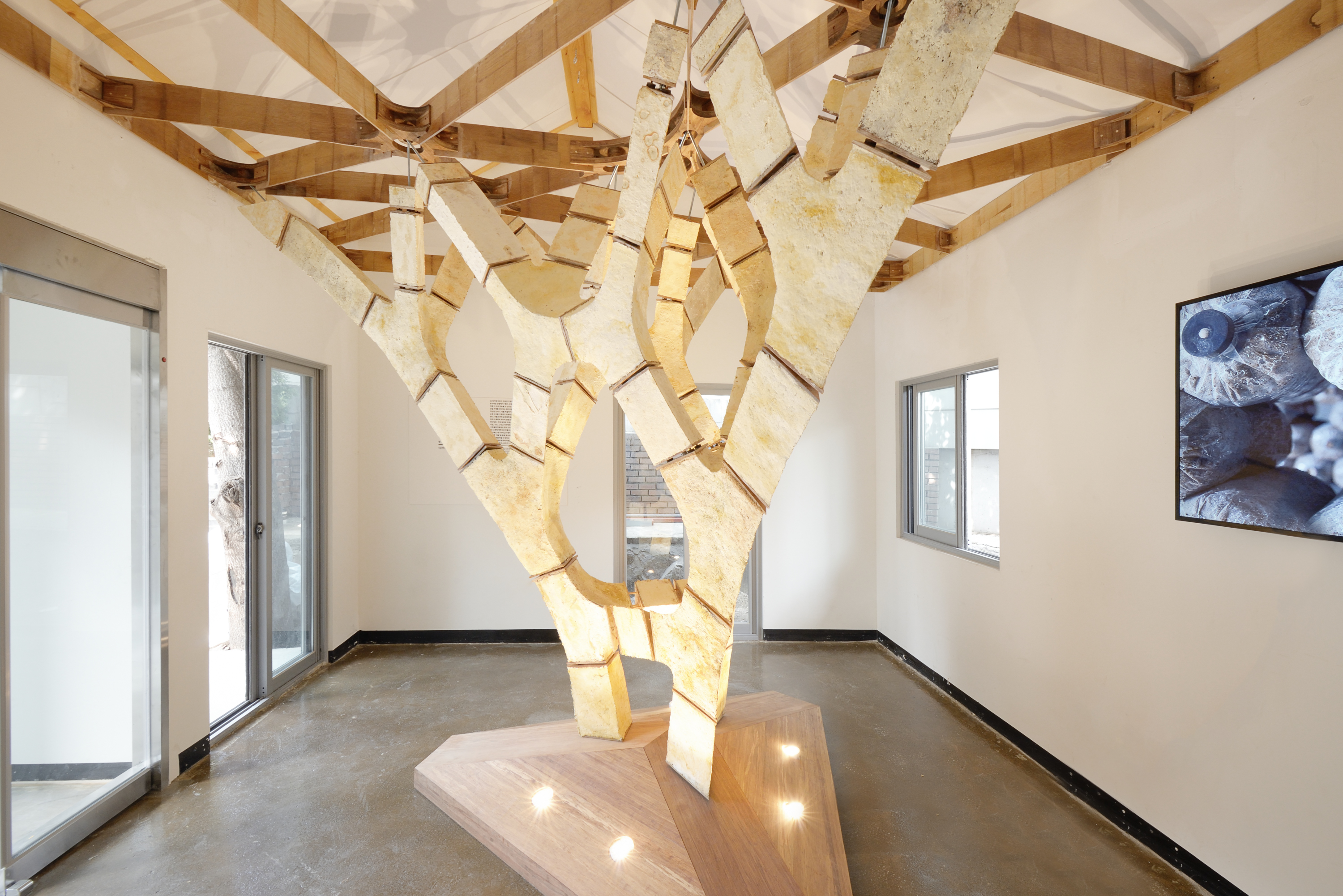
A recent collaboration between Karlsruhe Institute of Technology (KIT), Swiss Federal Institute of Technology (ETH) Zürich, Future Cities Laboratory in Singapore and Mycotech from Indonesia have resulted in ‘MycoTree’ exhibition which was showcased at the ‘Beyond Mining – Urban Growth’ exhibition at the Seoul Biennale of Architecture and Urbanism in 2017 in Seoul [37]. ‘MycoTree’ resembled a tree which had pillars consisting of triangular shaped mycelium-bound composite blocks, which were grown in digitally fabricated molds. The top of the tree was covered with novel bamboo-based composite slates developed by the research team. The blocks and the slates were attached by dowels and the mycelium-bound blocks were bearing the load (Figure 2a). The team has also showcase a second version of MycoTree named ‘MycoTree 2.0’, a load-bearing structure out of mycelium-bound composite blocks and bamboo slates as part of the exhibition ‘Human beings, Nature, Technology’ which was opened in FUTURIUM in Berlin in 2019 [32]. In the second version of ‘MycoTree’ the researchers have improved the myceliumbound composite blocks by using a new technology to transform the lightweight mycelium-bound materials into dense composite boards with improved mechanical properties (Figure 2b).
In 2019, Italian architect Carlo Ratti in collaboration with mycology researchers at the ‘Grown.bio’ lab in the Netherlands, unveiled arched architectural structures made of myceliumbound materials, which was showcased at Milan design week[67]. The structure, consisting of 60 4-meter-high archescalled ‘the circular garden,’ was grown on-site over six weeks and was returned to nature as a fully biodegradable structure at the end of the exhibition.

In recent years many investigation and research studies have been carried out on mycelium-bound composite materials for applications in packaging and fashion industries. The use of mycelium-bound composite materials in the construction industry has been mainly limited to small-scale prototypes and exhibition installations. Mycelium-bound composite materials
Research and development into Mycelium-bound composite materials can provide the construction industry with a novel yet low energy material as an environmentally friendly alternative to synthetic construction materials for applications as acoustic and thermal insulation, paneling, drywalls as well as in door panels and window frames. Further research is necessary to enhance the mechanical properties of mycelium-bound composite materials to make them suitable for semi-structural or loadbearing applications. Furthermore, it is shown that the relatively low mechanical properties, high water absorption and lack of standard methods for production, evaluation and investigation of properties have restricted the extensive application of mycelium-bound composite materials specially in the building and construction sector. However, in recent years the extensive research and development on mycelium-bound composite materials and characterization of their physical and mechanical properties have proven that it is possible to reuse agricultural by-products and wastes and turn them into environmentally sustainable alternatives to synthetic construction materials. Mycelium-bound composite materials have the potential to transform the future of construction industry by introducing a paradigm shift on the way we produce our future construction materials based on the concept of circular bioeconomy.
- Hebel DE, JavadianA, HeiselF, SchlesierK, GriebelD, WielopolskiM. Process-controlled optimization of the tensile strength of bamboo fiber composites for structural applications. Composites Part B: Engineering. 2014;67:125-131. doi: 10.1016/j.compositesb.2014.06.032
- Javadian, Alireza. Composite Bamboo and its Application as Reinforcement in Structural Concrete. ETH Zurich. 2017. doi: 10.3929/ethz-b-000185002
- JavadianA, SmithIF, HebelDE. Application of Sustainable Bamboo-Based Composite Reinforcement in Structural-Concrete Beams: Design and Evaluation. Materials. 2020;13(3):696.doi:10.3390/ma13030696
- JavadianA,SmithIF, SaeidiN, HebelDE. Mechanical properties of bamboo through measurement of culm physical properties for composite fabrication of structural concrete reinforcement. Frontiers in Materials. 2019. doi: 10.3389/fmats.2019.00015
- JavadianA, WielopolskiM, Smith IF, HebelDE. Bond-behavior study of newly developed bamboo-composite reinforcement in concrete. Construction and Building Materials. 2016;122:110-117. doi: 10.1016/j.conbuildmat.2016.06.084
- RahmanN, ShingLW, SimonL, PhilippM, Alireza J, LingCS, et al.Enhanced bamboo composite with protective coating for structural concrete application. Energy Procedia. 2017;143:167-172. doi: 10.1016/j.egypro.2017.12.666
- HebelDE, HeiselF. Cultivated Building Materials. In Proceedings of Proceedings of the 2nd International Conference on Flexible Formwork. Bath, UK. pp:368-378.
- Bartnicki-Garcia S, Cell wall chemistry, morphogenesis, and taxonomy of fungi. Annu. Rev. Microbiol. 1968;22:87-108.doi: 10.1146/annurev.mi.22.100168.000511
- IslamM, TudrynG, BucinellR, SchadlerL, PicuR. Morphology and mechanics of fungal mycelium. Scientific reports. 2017;7: 1-12.
- JonesM, MautnerA, LuencoS, BismarckA, John S. Engineered mycelium composite construction materials from fungal biorefineries: A critical review. Materials & Design. 2020;187:108397.doi: 10.1016/j.matdes.2019.108397
- Haneef M, CeseracciuL, Canale C, Bayer IS, Heredia-Guerrero JA, Athanassiou A. Advanced materials from fungal mycelium: fabrication and tuning of physical properties. Scientific reports. 2017;7:1-11.
- AbhijithR, Ashok A, RejeeshC. Sustainable packaging applications from mycelium to substitute polystyrene: a review. Materials Today: Proceedings. 2018; 5(1): 2139-2145.doi: 10.1016/j.matpr.2017.09.211
- JonesM, Bhat T, KandareE, Thomas A, JosephP. DekiwadiaC, etal. Thermal degradation and fire properties of fungal mycelium and mycelium-biomass composite materials. Scientific reports. 2018;8:1-10.
- JonesM, HuynhT, John S. Inherent species characteristic influence and growth performance assessment for mycelium composite applications. Advanced Materials Letters. 2018;9(1):71-80.
- Sun W, TajvidiM, HuntCG, McIntyreG, GardnerDJ. Fully bio-based hybrid composites made of wood, fungal mycelium and cellulose nanofibrils. Scientific reports. 2019;9:1-12.
- Jones MP, Lawrie AC, HuynhTT, MorrisonPD, Mautner A, BismarckA, et al. Agricultural by-product suitability for the production of chitinous composites and nanofibers utilising Trametes versicolor and Polyporus brumalis mycelial growth. Process Biochemistry. 2019;80:95-102. doi: 10.1016/j.procbio.2019.01.018
- JonesM, BhatT, WangCH, MoinuddinK, John S. Thermal degradation and fire reaction properties of mycelium composites. In Proceedings of Proceedings of the 21st International Conference on Composite Materials, Xi’an, China.2017;20-25
- Lieff J. Are Fungus the Dominant Life Form. 2016.
- Nagy LG, VargaT, CserneticsÁ, Virágh M. Fungi took a unique evolutionary route to multicellularity: Seven key challenges for fungal multicellular life. Fungal Biology Reviews. 2020. doi: 10.1016/j.fbr.2020.07.002
- LewRR. How does a hypha grow? The biophysics of pressurized growth in fungi. Nature Reviews Microbiology. 2011;9: 509-518.
- HaneefM, CeseracciuL, Canale C, Bayer IS, Guerrero JA,et al.Advanced materials from fungal mycelium: fabrication and tuning of physical properties. Scientific reports. 2017;7:
- JonesM, Huynh T, Dekiwadia C, Daver F, John S. Mycelium composites: a review of engineering characteristics and growth kinetics. Journal of Bionanoscience. 2017;11:241-257. doi: 10.1166/jbns.2017.1440
- RinaudoM. Chitin and chitosan: properties and applications. Progress in polymer science. 2006;31:603-632. doi: 10.1016/j.progpolymsci.2006.06.001
- Ruiz-HerreraJ. Fungal cell wall: tructure, synthesis, and assembly; CRC press. 1991.
- SmithML, Bruhn JN, Anderson JB. The fungus Armillaria bulbosa is among the largest and oldest living organisms. Nature. 1992;356:428-431.doi: 10.1038/356428a0
- StametsP. Mycelium running: how mushrooms can help save the world; Random House Digital, Inc. 2005.
- SohE, Chew ZY, Saeidi N, Javadian A, HebelD, Le Ferrand H. Development of an Extrudable paste to build mycelium-bound composites. Materials & Design. 2020;109058. doi: 10.1016/j.matdes.2020.109058
- HoltG, McintyreG, Flagg D, BayerE, Wanjura J, Pelletier M. Fungal mycelium and cotton plant materials in the manufacture of biodegradable molded packaging material: Evaluation study of select blends of cotton byproducts. Journal of Biobased Materials and Bioenergy. 2012;6(4):431-439.doi:10.1166/jbmb.2012.1241
- Dell. Innovative Materials: Mushroom Packaging. Availabe online: (accessed on 13 Sep).
- KlarenbeekE. Mycelium Chair. The Design Journal. 2014.
- HeiselF, Lee J, Schlesier K, Rippmann M, Saeidi N, Javadian A,etal. Design, Cultivation and Application of Load-Bearing Mycelium Components: The MycoTree at the 2017 Seoul Biennale of Architecture and Urbanism. IJSED 2018;6:296-303.doi: 10.20533/ijsed.2046.3707.2017.0039
- HeiselF, Hebel DE. Pioneering Construction Materials through Prototypological Research. Biomimetics 2019;4:56. doi:10.3390/biomimetics4030056
- SaportaS, Yang F, Clark M. Design and Delivery of Structural Material Innovations. In Proceedings of Structures Congress. 2015;1253-1265.
- Palumbo FernándezM. Contribution to the development of new bio-based thermal insulation materials made from vegetal pith and natural binders: hygrothermal performance, fire reaction and mould growth resistance. 2015;
- PelletierM, Holt G, Wanjura J, BayerE, McIntyre G. An evaluation study of mycelium based acoustic absorbers grown on agricultural by-product substrates. Industrial Crops and Products. 2013;51:480-485.doi: 10.1016/j.indcrop.2013.09.008
- PelletierM, Holt G, Wanjura J, Lara A, Carillo A, McIntyre G, etal. An evaluation study of pressure-compressed acoustic absorbers grown on agricultural by-products. Industrial crops and products. 2017;95:342-347.doi: 10.1016/j.indcrop.2016.10.042
- Heisel F, Schlesier K, Lee J, Rippmann M, Saeidi N, Javadian A,et al. Design of a load-bearing mycelium structure through informed structural engineering. In Proceedings of World Congress on Sustainable Technologies (WCST-2017).
- JohnsonMA, Carlson JA. Mycelial paper: A potential resource recovery process? Biotechnol. Bioeng. 1978;20: 1063-1084.doi: 10.1002/bit.260200708
- Silverman J, Cao H, Cobb K. Development of Mushroom Mycelium Composites for Footwear Products. Clothing and Textiles Research Journal. 2020;38:119-133.doi:10.1177/0887302X19890006
- Van Horn WM, Shema BF, ShockleyWH, Conkey JH. Sheets comprising filaments of fungi. Google Patents. 1957.
- JonesM, Gandia A, JohnS, BismarckA. Leather-like material biofabrication using fungi. Nature Sustainability. 2020;1-8.
- Jiang L, Walczyk D, Mooney L, Putney S. Manufacturing of mycelium-based biocomposites. In Proceedings of Proceedings of the International SAMPE Technical Conference.1944-1955.
- MycoWorks. 13 Sep.
- Mycotech lab. 13 Sep. 45. NEFFA.13 Sep
- Ecovative Design. 13 Sep.
- Mogu. 13 Sep
- TravagliniS, Dharan CKH, Ross PG. Mycology matrix sandwich composites flexural characterization. In Proceedings of Proceedings of the American Society for Composites. 2013;8-10.
- TravagliniS, Dharan CKH, Ross PG. Thermal properties of mycology materials. In Proceedings of American Society of Composites-30th Technical Conference.2015.
- Travaglini S, Noble J, RossPG, Dharan CKH. Mycology matrix composites. In Proceedings of Proceedings of the American Society for Composites–28th Technical Conference, State College, PA, Sept. 1-20.
- AppelsFV, Camere S, MontaltiM, KaranaE, Jansen KM, Dijksterhuis J,etal. Fabrication factors influencing mechanical, moisture-and water-related properties of mycelium-based composites. Materials & Design. 2019;161:64-71. doi: 10.1016/j.matdes.2018.11.027
- GhazvinianA, Farrokhsiar P, Vieira F, Pecchia J, Gursoy B. Mycelium-Based Bio-Composites For Architecture: Assessing the Effects of Cultivation Factors on Compressive Strength. In Proceedings of The eCAADe and SIGraDi Conference, University of Porto, Portugal.2019.
- HeJ, Cheng CM, Su DG, Zhong MF. Study on the mechanical properties of the latex-mycelium composite. In Proceedings of Applied Mechanics and Materials. 2014; 415-420.doi: 10.4028/www.scientific.net/AMM.507.415
- CarvalhoLM, Costa CA. Modeling and simulation of the hot-pressing process in the production of medium density fiberboard (MDF). Chemical Engineering Communications. 1998,170(1):1-21.doi: 10.1080/00986449808912732
- ElsackerE, Vandelook S, Brancart J, Peeters E, De Laet L. Mechanical, physical and chemical characterisation of mycelium-based composites with different types of lignocellulosic substrates. PloS one. 2019;14:e0213954.doi:10.1371/journal.pone.0213954
- . Cerimi K, Akkaya KC, Pohl C, SchmidtB, NeubauerP. Fungi as source for new bio-based materials: a patent review. Fungal biology and biotechnology. 2019;6:17.
- JonesM, BhatT, HuynhT, Kandare E, YuenR, Wang CH,et al. Waste‐derived low‐cost mycelium composite construction materials with improved fire safety. Fire and Materials. 2018;42:816-825.doi:10.1002/fam.2637
- HuS, SongL, PanH, Hu Y. Effect of a novel chitosan-based flame retardant on thermal and flammability properties of polyvinyl alcohol. Journal of Thermal Analysis and Calorimetry. 2013;112: 859-864. doi:10.1007/s10973-012-2686-7.
- El-Tahlawy K. Chitosan phosphate: A new way for production of eco-friendly flame-retardant cotton textiles. The Journal of The Textile Institute. 2008;99:185-191. doi:10.1080/00405000701584311
- AsdrubaliF, D'AlessandroF, Schiavoni S. A review of unconventional sustainable building insulation materials. Sustainable Materials and Technologies. 2015;4:1-17.doi:10.1016/j.susmat.2015.05.002
- Holt GA, McIntyreG, Flagg D, Bayer E, Wanjura JD, Pelletier G. Fungal Mycelium and Cotton Plant Materials in the Manufacture of Biodegradable Molded Packaging Material: Evaluation Study of Select Blends of Cotton Byproducts. Journal of Biobased Materials and Bioenergy. 2012;6:431-439. doi:10.1166/jbmb.2012.1241
- ChikhiM, Agoudjil B, Boudenne A, Gherabli A. Experimental investigation of new biocomposite with low cost for thermal insulation. Energy and Buildings. 2013;66:267-273.
- GonçalvesM, Bergmann C. Thermal insulators made with rice husk ashes: Production and correlation between properties and microstructure. Construction and Building Materials. 2007;21:2059-2065.doi:10.1016/j.conbuildmat.2006.05.057
- Pelletier MG, HoltGA, Wanjura JD, GreethamL, McIntyre G, BayerE, et al. Acoustic evaluation of mycological biopolymer, an all-natural closed cell foam alternative. Industrial Crops and Products. 2019;139:111533.doi:10.1016/j.indcrop.2019.111533
- KaranaE, Blauwhoff D, HultinkEJ, Camere S. When the material grows: A case study on designing (with) mycelium-based materials. International Journal of Design. 2018;12(2).
- VallasT, CourardL. Using nature in architecture: Building a living house with mycelium and trees. Frontiers of Architectural Research. 2017;6:318-328.doi:10.1016/j.foar.2017.05.003
- Franchino R, FrettolosoC, Pisacane N. BIM Technology and Material Innovation. The Environmental Dimension. AGATHÓN| International Journal of Architecture, Art and Design. 2019;5:41-50.doi:10.19229/2464-9309/552019

