Research article
Open Access
Assessing Farmers’ Perception towards the Effectiveness
of Sustainable Land Management Practices in the
Teleyayen Sub-Watershed of the Northeastern
Highlands of Ethiopia
Alem-meta Assefa Agidew1 and K. N. Singh2
1 Department of Geography and Environmental Studies, Wollo University, P.O. Box 1145, Dessie, Ethiopia,
2Department of Geography and Environmental Studies, Addis Ababa University, P.O. Box 1176, Addis Ababa
*Corresponding author: Department of Geography and Environmental Studies, Wollo University, P.O. Box 1145, Dessie, Ethiopia; E-mail:
@
Received: February 26, 2019; Accepted: March 11, 2019; Published: March 13, 2019
Citation: Assefa Agidew, Singh KN (2019) Assessing Farmers’ Perception towards the Effectiveness of Sustainable Land Management Practices in the Teleyayen Sub-Watershed of the Northeastern Highlands of Ethiopia. Int J Hort Agric 4(1): 1-8. DOI:
10.15226/2572-3154/4/1/00125
The main objective of sustainable land management practice is
to integrate people’s coexistence with nature over the long-term, so
that the provisioning of supporting services of ecosystems. Hence,
understanding farmer’s perception on the effectiveness of sustainable
land management is vital. Data were collected using a survey
questionnaire, focus group discussions, key informant interviews, and
field observations. Independent-sample t-test, chi-square, percentage,
mean and standard deviation were employed to analyze the data. The
result of the study indicated that land tenure security problem (32.6%)
is one of the major factors affecting farmers land management practices,
followed by unaffordable price of fertilizer (27%), lack of assistance
from development agents (15.8%), lack of credit access (14%), and
negative perception towards land management practices (10.7%). Sixtyfive
percent of the focus group discussion participants also reported
that the sustainable land management practices conducted in their
area is not effective because of farmers’ reluctance to participate in soil
and water conservation practices, lack of incentives, poverty, and lack
of awareness about the long-term benefits of such practices. Moreover,
the chi-square results of gender of the household head (X2=8.716), land
tenure security (X2=6.595), and educational status of the household
head (X2=11.738), found to be significant in explaining the correlation
between farmers’ perception and the effectiveness of sustainable
land management practices. Therefore, exploring farmers’ perception
towards the effectiveness of sustainable land management practices is
helpful because it would improve the quality of the environment so that
farmlands will remain productive for a long period of time.
Keywords: Ethiopia; Farmers’ perception; Land degradation;
Sustainable land management;
Abbreviations
FGD Focus Group Discussion
ha Hectare
SLM Sustainable Land Management
SWC Soil and Water Conservation
Background
Sub-Saharan Africa is particularly vulnerable to threats of
natural resource degradation and poverty. This is due to various
factors including a high population growth rate and increasing
population pressure, reliance on agriculture that is vulnerable to
environmental change, fragile natural resources and ecosystems,
high rates of erosion and land degradation, and both low yields
and high post-harvest yield losses. On top of this can be added
sensitivity to climate variability and long-term climate change.
In Sub-Saharan Africa concerted efforts to deal with land
degradation through Sustainable Land Management (SLM)
practices must address water scarcity, soil fertility, organic matter
and biodiversity. SLM seeks to increase production through both
traditional and innovative systems, and to improve resilience to
the various environmental threats.
The Ethiopian economy has its foundation in the agricultural
sector. This sector continues to be a fundamental instrument
for poverty alleviation, food security, and fueling economic
growth. However, the sector continues to be undermined by land
degradation in the form of depletion of soil organic matter, soil
erosion, and lack of adequate plant-nutrient supply [1]. There
is evidence that these problems are getting worse in many
parts of the country, particularly in the highlands. Furthermore,
climate change is anticipated to accelerate land degradation in
Ethiopia. Over the last few decades, as a cumulative effect of land
degradation, increasing population pressure, and low agricultural
productivity, Ethiopia has become increasingly dependent on
food aid. In most parts of the densely populated highlands, cereal
yields average less than one metric ton per hectare [2]. Such low
agricultural productivity, compounded by recurrent problems of
famine, contributes to extreme poverty and food insecurity.
Therefore, in order to increase production from the land,
water use efficiency and productivity need to be improved. This
can be achieved through the application of SLM practices such
as by reducing high water loss through runoff and unperceived
evaporation from unprotected soil, harvesting water, improving
infiltration, and maximizing water storage - as well as by upgrading
irrigation and managing surplus water. The first priority must be
given to improving water use efficiency in rain fed agriculture;
here lies the greatest potential for improved yields with all the
associated benefits. For irrigated agriculture, conveyance and
distribution efficiency are key water-saving strategies.
Efforts of understanding how farmers perceive land
degradation have been numerous and diverse. In Ethiopia,
adoption of soil conservation technologies was found to be
affected by farmers’ age, farm size and other factors including
perceptions on technology profitability [3]. Another study in
Ethiopia, farmers’ negative attitude towards terraces was found
to be contributed by their perception of terraces harboring
rodents, reducing cultivation space and making of oxidization
difficult [4]. In Kenya farmers’ perceptions on the dangers
of soil erosion were found to have a rational basis, but their
assessment and behaviors were found to be incompatible with
technical accords [5]. In Tanzania significant differences were
observed between farmers and extension staffs in the way the
two people perceived soil degradation [6]. Thus, to increase land
productivity it is essential to follow and combine the principles
of SLM practices like improving water use efficiency and water
productivity, increasing soil fertility, managing vegetation and
attending to the micro-climate. These synergies can more than
double productivity and yields in small-scale agriculture. Further
increases in productivity can also be achieved by intensification
and/or diversification of production. The purpose of this study
was, therefore, to investigate the degree of farmers’ perception
towards SLM practices taking the Teleyayen sub-watershed as a
case study. The objective of this study was, therefore, to assess
farmers’ perception towards the effectiveness of SLM practices in
the Teleyayen sub-watershed.
Materials and methods
The study area
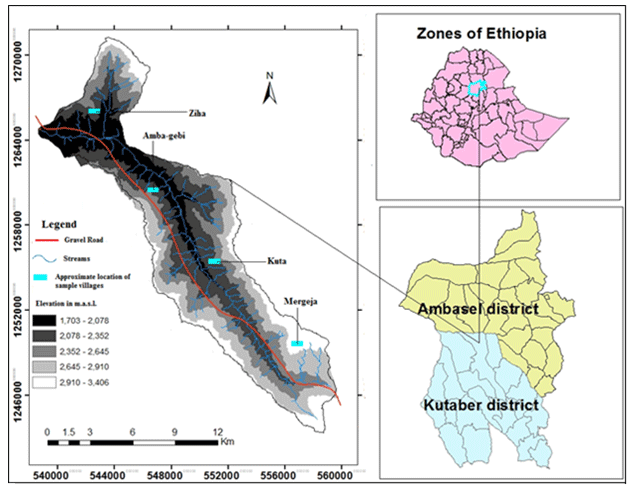
The study area is located in Kutaber and Ambasel districts
of Amhara Regional State of Ethiopia. Its geographical location
extends from 11014’30’’N and 11029’30’’N latitude and
39021’0’’E and 39033’0’’E longitude (Figure. 1). The total area
of the sub-watershed is about 152 square kilometers. The study
area is inhabited by 20,296 people distributed within the subwatershed.
Its elevation ranges from 1,703 to 3,406 meters above
mean sea level.
The land is highly degraded and the area is deforested in
terms of indigenous trees but does have eucalyptus plantations in
some areas. Topographically, the sub-watershed is characterized
by a mountainous and highly dissected terrain with steep slopes
and the rest are hilly (Figure. 2). It is drained by the headwaters of
the Teleyayen River and its tributaries which flow to the Beshillo
River, which forms part of the upper Abay (Blue Nile) basin.
Figure 1:Location Map of the study area
Figure 2:Slope of the Teleyayen sub-watershed
According to the local system, the country is classified into
5 agro-ecological zones, namely Wurch, Dega, Weyna-Dega, Kolla
and Berha [7]. Wollo area has three distinct seasons namely
winter, spring and summer. Winter is a dry season from October
to January [8]. Spring is the small rainy season that occurs
between mid-February and mid-May, while summer is the main
rainy season that extends from mid-June to mid-September [8].
The mean annual temperature and mean annual rainfall ranges
from 140C to 200C and from 680 mm to 1200 mm respectively
[9]. Based on the moisture index, the climate of Wollo is classified
as dry with arid to dry sub-humid conditions. According to the
traditional climatic zones of the country, the study area stretches
over the Upper-highland (Moist-wurch), Highland (Moist-dega),
and Midland (Moist-weyna-dega) agro-ecological zones sharing
1%, 62% and 37% respectively (Figure. 3).
Figure 3:Agro-ecological zones of the study area
The mean annual temperature of the sub-watershed is about
160C and the average annual total rainfall is 1,133 mm (Figure.
4). More than 58% of the total rain falls in two months of July and
August (summer season); while 18% falls in the spring season
(March, April and May); and less than 5% of the total occurs
during the dry months of December, January, and February
(winter season).
Figure 4:Min, max, and mean annual temperature (2006-2015) and
mean monthly rainfall (2004-2013) of the study area
The major source of livelihoods for the local population is
rain-fed agriculture. It is characterized by smallholder mixed
farming systems where crop production and livestock rearing
are simultaneously practiced. Land and livestock are therefore
the most important assets of the people, with which they
lead a sedentary life. Livestock provide the draught power
and household members the labor that is needed for farming
operation. Land is a scarce resource due to high population
pressure and degradation. Most of the agricultural production
is used for the farm household’s own consumption. The major
crops grown in the area include Eragrostis tef, Triticum vulgare,
Hordeum vulgaris, Avena sativa, Vicia faba, Pisum sativum,
Solanum tuberosum, Zea mays, Sorghum spp., Piper nigrum and
Allium cepa. Spring rains are used for growing Triticum vulgare,
Hordeum vulgaris and pulses between January and April. Also,
some villages in the lowland take advantage of spring rains
to cultivate Eragrostis tef. Spring rains are also important for
farmers in the mid-highland for growing long maturing varieties
of Eragrostis tef, Sorghum spp. and Zea mays. Crop production is,
therefore, the major source of income to the households. Incomes
from off-farm employment include petty trading, weaving, and
pottery.
Sampling technique and methods of data collection
The data of this study was collected both from primary
and secondary sources. The primary data were collected
from a household questionnaire survey, FGD, key informant
interview, and field observations. The questions included in the
questionnaire were both closed ended and open ended types. The
questionnaire was administered during January and February,
2016. This period was chosen mainly because it is an ideal time
when farmers have completed their harvesting activities and
started the natural resource development program work at the
watershed level, which is carried out yearly by government led
support. Hence, it is easy to interview the sample farm households
and collect the required data. Secondary data were also collected
from books, journals and internet sources. The sample farm
household heads were drawn through a multi-stage sampling
technique. The sampling technique involves three stages. In the
first stage, the names of eight kebeles (six from Kutaber and two
from Ambasel district) were obtained from each respective kebele
administrators and then four sample kebeles (three from Kutaber
and one from Ambasel district) were selected purposively. The
reason for the selection of these kebeles is based on their agroecological
zones and accessibility. In the second stage, four sample
villages, one from each sample kebele, were selected randomly.
In the third stage, the numbers of all farm households from each
selected sample villages were listed. Finally, 172 male-headed
and 43 female-headed a total of 215 sample farm households of
the study were selected randomly from the four sample villages in
a proportional-to-size of each agro-climatic zone (Table 1). These
sample farm households were determined using the following
formula provided by Yamane (1967) cited in [10].
Table 1: Distribution of sample farm households by district and village level
District |
Kebele |
Village |
Total households |
|
Sample farm households |
AEZ |
Male |
Female |
Total |
Male |
Female |
Total |
Kutaber |
Doshign |
Mergeja |
19 |
9 |
28 |
1 |
1 |
|
Moist-wurch |
|
|
|
|
|
|
|
|
2 |
|
Ambasel |
Teregma |
Ziha |
123 |
28 |
151 |
63 |
14 |
77 |
Moist-dega |
Kutaber |
Asecha |
Kuta |
81 |
23 |
104 |
44 |
12 |
56 |
Moist-dega |
Kutaber |
Amba-Gebi |
Amba-gebi |
146 |
36 |
182 |
64 |
16 |
80 |
Moist-weyna-dega |
Total |
369 |
96 |
465 |
172 |
43 |
215 |
|
Where, n is the sample size
N is the population size
e is the level of precision (5%).
Based on the above formula, the total sample households
were calculated as follow:
n = 465/1+465*0.0025 = 215
Methods of data analysis
Data used for the study were analyzed, summarized and
presented via quantitative and qualitative methods of data analysis.
Statistical package for social sciences (SPSS-IBM) software,
version 21 was used to analyze both inferential and descriptive
data. Thus, using descriptive statistics like independent-sample
t-test, chi-square, percentage, mean and standard deviation,
we compared and contrasted different categories of sample
units with respect to the desired characteristics. Data collected
using FGD and key informant interview were also analyzed in
percentage and mean.
Results and discussion
Farmers’ perception of soil erosion as a problem in the
study area
Farmers’ awareness about the problem and causes of soil
erosion as well as its consequences will help to encourage them
to invest in SLM practices. According to [11], perception of soil
erosion as a threat to crop production and sustainable agriculture
is the most important determinant factor for adoption of
conservation measures, and he further states that understanding
and recognition of soil erosion as a problem in own farm plots,
and its causes and impacts on crop yields is the first step towards
searching for and adoption of remedial measures. Therefore,
farmers were asked about their perception on soil erosion
problems prevailed in the study area. Yet, there were various
reasons that motivated them; their perception was found to be
encouraging. A large percentage of respondents (80%) agreed
that erosion had threatened their farmlands, while (20%) of them
felt nothing. Respondents who have not experienced any form of
erosion are those whose farmlands are found on gentle slopes.
These farmers explained that even though the risk of erosion is
less, the shortage of farmland discourages them to produce more.
About 70% of sample households perceived the soil erosion
problem as severe, 15% as moderate, 10% as minor, and 5% no
risk. However, in general although farmers are aware of erosion
problems, their understanding of its severity is limited mostly
to observable resultants of erosion on their farmlands like gully
formation.
In order to understand farmers’ perception towards the role
of SLM practices to mitigate land degradation in the Teleyayen
sub-watershed, farmers were also asked to indicate what they
had noted regarding the short-term and long-term impacts of
land degradation on their agricultural productivity. Accordingly,
54.9%, 34%, and 11.1% of them reported that the role of SLM
practices to mitigate land degradation is high, intermediate, and
low respectively.
Statistical summary of descriptive statistics
Independent-sample t-test was used to indicate the mean
differences between farmers who perceived and not-perceived
the effectiveness of SLM practices for farmland improvements.
Hence, the t-values of 7 continuous variables were calculated
and out of these only the two variables mean differences were
found to be significant (Table 2). These variables were age of the
household heads and agricultural extension services provided
to farmers. The result of the variable age of the household heads
indicated that there is significant difference between the mean
age of household heads who perceived and who do not perceived
the practices. This means household heads who perceived the
effectiveness of the SLM practices have an average age of 44.47
years and who do not perceive have an average age of 40.3
years. Likewise, there is significant difference between the mean
of frequency of extension services provided for farmers who
perceived (3.95) and who do not perceived (2.60).
Chi-square analysis was also conducted in order to know the
correlation between farmers’ perception and the effectiveness
of SLM practices in the study area. Subsequently, out of the
7 variables included in the analysis, three were found to be
significant. These variables were gender of the household head,
land tenure security, and educational status of the household
heads (Table 3).
Table 2: Summary of bio-physical characteristics of the study area
Characteristics |
Value and unit of measurement |
Mean annual total rainfall |
1,133 mm |
Mean annual temperature |
16oC |
Distance from capital (Addis Ababa) |
441 km |
Mean altitude |
2554.5 m.a.s.l. |
Mean farm plot distance from homesteads |
1.3 km |
Agro-ecological zone |
Moist-weyna-dega, moist-dega, and moist-wurch |
Major soil types |
Leptosols, eutric cambisols, and eutric regosols |
Rainfall regime |
Bimodal (spring and summer) |
Dominant livestock types |
Cattle, sheep, goats, camels, pack animals and poultry |
Table 3: Mean differences of continuous variables on farmers’ perception
Variable |
Perceived (N=185) |
Not-perceived (N=30) |
Total sample (N=215) |
t-value |
Sig. (2-tailed) |
Mean |
S.D |
Mean |
S.D |
Mean |
S.D |
Age (years) |
44.47 |
12.36 |
40.3 |
9.65 |
42.38 |
11.01 |
-1.761** |
0.08 |
Agricultural labor force |
2.22 |
0.98 |
2 |
0.74 |
2.11 |
0.86 |
-1.153 |
0.25 |
Agricultural extension services |
3.95 |
1.5 |
2.6 |
1.1 |
3.3 |
1.3 |
-4.600* |
0 |
Farm plot distance (km) |
1.3 |
0.46 |
1.23 |
0.43 |
1.26 |
0.44 |
-0.772 |
0.441 |
|
|
|
|
|
|
|
|
|
Family size |
4.26 |
1.26 |
4.33 |
1.53 |
4.29 |
1.39 |
0.266 |
0.791 |
|
|
|
|
|
|
|
|
|
Farm size (ha) |
1.07 |
0.27 |
1.1 |
0.3 |
1.08 |
0.28 |
0.391 |
0.696 |
Livestock holding (TLU) |
3.34 |
1.58 |
3.46 |
1.75 |
3.4 |
1.66 |
0.381 |
0.704 |
Education status of the household head: The educational
status of the household heads revealed that 72.6% of the
households are illiterate. Among these households 76.8%
perceived the effectiveness of SLM practice while 46.7% do not
perceived. The chi-square result (X2=11.738) of this variable was
found to be statistically significant at the 95% level of confidence.
Hence, there is a significant relation between education status of
the household heads and their perception about the effectiveness
of SLM practices. This indicates that educated farmers perceived
the importance of SLM practices for better productivity than their
counterparts.
Gender of the household head: The statistical analysis of
gender of the household heads indicated that 76.8% and 23.2%
of male-headed and female-headed households were perceived
the effectiveness of SLM practices respectively. The chi-square
result (X2=8.716) of this variable was statistically significant at
the 95% level of significance. This means there is a significant
correlation between gender of the household heads and their
perception towards the effectiveness of SLM practices.
Land tenure security: It refers to the right of individuals
and groups of people to effective protection by their government
against forcible evictions [12]. Chi-square statistical tool was
used to know the relation between the farm households land
tenure security and their perception towards the effectiveness
of SLM practices. Thus, the analysis of the study showed that
the chi-square result (X2=6.595) of this variable was found to
be statistically significant at the 95% level of confidence. Hence,
there is a significant association between land tenure security
and farmers’ perception towards the effectiveness of SLM
practices. This result suggests that farmers’ perception towards
SLM practices is good if there is land tenure security.
Bio-physical conditions and soil erosion occurrences
in the Teleyayen sub-watershed
Land use changes, rapid population growth, poverty, climate
change variability and lack of livelihood diversification are usually
having the power to change the bio-physical characteristics of an
area. The bio-physical attributes of this area includes soil types
and distributions, temperature, rainfall, agro-ecological zones,
and livestock types. In this regard, Table 4 presents the major biophysical
attributes of the study area.
Table 4: Summary of discrete variables of the study
Variable |
Perceived (N = 185) |
Not-perceived (N = 30) |
Chi-square value
|
Asymp. sig (2-sided) |
Number |
% |
Number |
% |
Education status of the HH head |
Literate |
43 |
23.2 |
16 |
53.3 |
11.738* |
0.001 |
Illiterate |
142 |
76.8 |
14 |
46.7 |
|
|
Gender of the HH head |
Male |
142 |
76.8 |
30 |
100 |
8.716* |
0.003 |
Female |
43 |
23.2 |
0 |
0 |
|
|
Access to credit service |
Yes |
143 |
77.3 |
23 |
76.7 |
0.006 |
0.939 |
No |
42 |
22.7 |
7 |
23.3 |
|
|
Access to off-farm income |
Yes |
32 |
17.3 |
7 |
23.3 |
0.633 |
0.426 |
No |
153 |
82.7 |
23 |
76.7 |
|
|
Rainfall reliability |
Yes |
9 |
4.9 |
1 |
3.3 |
0.137 |
0.712 |
No |
176 |
95.1 |
29 |
96.7 |
|
|
Soil erosion incidence |
Yes |
180 |
97.3 |
29 |
96.7 |
0.038 |
0.846 |
No |
5 |
2.7 |
1 |
3.3 |
|
|
Land tenure security |
Yes |
60 |
32.4 |
17 |
56.7 |
6.595* |
0.01 |
No |
125 |
67.6 |
13 |
43.3 |
|
|
Biophysical conditions and land use methods influence
watershed degradation owing to both natural and anthropogenic
factors [13], as people continue to interact with the environment
for their livelihood strategies. The survey analysis revealed that
decline in crop productivity, loss of top soil and the occurrence of
rills and gullies are the major indicators of soil erosion mentioned
by farmers. As indicated in Table 5, a majority of the respondents
(65.1%) reported that decline in crop productivity is the major
indicator for the existence of soil erosion on their farmlands
followed by the occurrence of rills and gullies (17.7%), and loss
of top soil (14.8%).
Table 5: Farmers’ response for indicators of soil erosion on their farmlands
Indicators |
Frequency |
Percent |
Decline in crop productivity |
140 |
65.1 |
Loss of top soil |
31 |
14.8 |
Rills and gully occurrence |
38 |
17.7 |
Results obtained from focus group discussions
Focus groups are an effective ways to understand farmer’s
perception towards SLM practices. The selection of participants
was made based on their specific characteristics like gender,
farming experience, and age. Afterwards, two focus group
discussions were formed for key informants. The key informants
include kebele administrators, elders, and natural resource
experts; each group of 8 persons is a mixture of both male and
female. As a result 65% of the participants reported that the
SLM practices conducted in their area is not effective because of
farmers’ reluctance to participate in soil and water conservation
(SWC) practices, lack of incentives, poverty, and lack of awareness
about the long-term benefits of such practices. On the other hand,
35% of them reported lack of adequate support from agricultural
extension workers and recurrent drought occurrence, as the
major obstacles for the implementation of SLM practices.
Farmers’ responses for factors affecting their land
management practices
The survey result of the study showed that land tenure
security problem (32.6%), is one of the major factors affecting
farmers land management practices, followed by unaffordable
price of fertilizer (27%), lack of assistance from development
agents (15.8%), lack of credit access (14%), and negative
perception towards land management practices (10.7%)
(Figure.5). The result of the interview conducted with the key
informants also indicated that the local community contributes
to land degradation through cutting of trees for charcoal and
firewood selling and non-maintenance of the remaining soil
conservation structures which had constructed before.
Figure 5:Farmers response for factors affecting their land management
practices
Farmers’ perception about landholding sizes of the
study area
The results of descriptive statistics indicated that 95.8% of the
respondents were indicated that the landholding size they owned
is unsatisfactory to support their households. Only 4.2% of them
reported as satisfactory (Figure. 6). Therefore, this indicates the
seriousness of the lack of farmland in the study area. This result
suggests the need of livelihood diversification and population
growth checking.
Figure 6:Farmers perception about landholding size
Conclusions
This study investigated farmers’ perception towards the
effectiveness of SLM practices in the Teleyayen sub-watershed. A
large percentage of respondents (80%) agreed that erosion had
threatened their farmlands, while (20%) of them felt nothing.
Specifically, about 70% of the households perceived the problem
as severe, 15% as moderate, 10% as minor, and 5% no risk.
Farmers were also asked about the short-term and long-term
impacts of land degradation on their agricultural productivity.
Accordingly, 54.9%, 34%, and 11.1% of them reported that
the role of SLM practices to mitigate land degradation is high,
intermediate, and low respectively. Independent-sample t-test
was used to know the mean differences between farmers who
perceived and not-perceived the effectiveness of SLM practices
for farmland improvements. Hence, the t-values of 7 continuous
variables were calculated and out of these the mean differences
of the two variables, namely age of the household head and
agricultural extension services provided to farmers were found
to be significant. Moreover, the chi-square analysis of the study
revealed that three variables were significant in explaining the
correlation between farmers’ perception and the effectiveness
of SLM practices. These variables were gender of the household
head, land tenure security, and educational status of the
household heads.
On the other hand, results obtained from FGDs confirmed
that farmers’ reluctance to participate in SWC practices, lack
of incentives, poverty, and lack of awareness about the longterm
benefits of SLM practices, are the major reasons for the
ineffectiveness of the SLM practice carried out in the study
area. Furthermore, 35% of them reported that lack of adequate
support from agricultural extension workers, and recurrent
drought occurrence are the major obstacles for the successful
implementation of SLM practices.
Acknowledgements
The authors would like to thank farmers’ and development
agent workers who took part in the survey.
Authors’ contributions
Alem-meta Assefa Agidew has contributed in designing of
the study, collection of data, analysis and interpretation of data
and he wrote the manuscript. Dr. K. N. Singh also contributed in
reviewing and writing the draft manuscript as well as editing the
manuscript. Both authors read and approved the final manuscript.
- Pender J, Place F, Ehui S. Strategies for Sustainable Land Management in the East Africa Highlands (Washington, DC: International Food Policy Research Institute). 2006.
- Pender J, Gebremedhin B. Determinants of Agricultural and Land Management Practices and Impacts on Crop Production and Household Income in the Highlands of Tigray, Ethiopia’. Journal of African Economies. 2007;17(3):395-450.
- Skole D, Tucker C. Tropical deforestation and habitat fragmentation in the Amazon. Satellite data from 1978 to 1998. Science. 1993;260(5116):1905-1910.
- Bustos-Griffin E, Hallman GJ, Griffin RL. Current and potential trade in horticultural products irradiated for phytosanitary puporses. Radiation Physics & Chemistry. 2012;81(8):1203-1207.
- McKinney ML. Urbanization, Biodiversity and Conservation: The impacts of urbanization on native species are poorly studied, but educating a highly urbanized human population about these impacts can greatly improve species conservation in all ecosystems. BioScience. 2002;52(10):883-890.
- Dejene A, Shishira EK, Yanda PZ, Johensen FH. Land degradation in Tanzania: Perception from the village. World Bank Technical Paper. 1997.
- Hurni H. Agro-ecological belts of Ethiopia: Explanatory notes on three maps at a scale of 1:1,000,000. Research report, Soil Conservation Research Program. Addis Ababa, Ethiopia. 1998;3-20.
- NMSA (National Meteorological Services Agency of Ethiopia). Climatic and agro-ecology resources of Ethiopia, Addis Ababa, Ethiopia. 1996;1(1):0-137.
- Gonfa L. Climatic classification of Ethiopia. Addis Ababa, Ethiopia. 1996;15-58.
- Israel GD. Sampling: The Evidence of Extension Program Impact. Program Evaluation and Organizational Development, IFAS, University of Florida. 1992.
- Bewket W. Land cover dynamics since the 1950s in Chemoga watershed, Blue Nile Basin, Ethiopia. Mountain Research & Development. 2002;22(3):263–269.
- United Nations Human Settlement Program (UN-Habitat). Enhancing Urban Safety and Security: Global Report on Human Settlements. 2007.
- Maitima J, Reid RS, Gachimbi LN, Majule A, Lyaruu H and Pomery D, et al. A methodological guide on how to identify trends and linkages in land use, biodiversity and land degradation. 2004.