


Research Article
Open Access
Novel Synthesis and Characterization of
2-Aminobenzimidazole Derivative
R Sriram1, R Sapthagiri1, A Ravi2*
1Research Scholars, PG & Research Department of Chemistry, Government Arts College, Tiruvannamalai-606603, Tamil Nadu, India
2Assistant professor, PG & Research Department of Chemistry, Government Arts College, Tiruvannamalai-606603, Tamil Nadu, India
2Assistant professor, PG & Research Department of Chemistry, Government Arts College, Tiruvannamalai-606603, Tamil Nadu, India
*Corresponding author: A Ravi, Assistant professor, PG & Research Department of Chemistry, Government Arts College, Tiruvannamalai-606603,
Tamil Nadu, India, E-mail: draravitvm@gmail.com
Received: June 30, 2015; Accepted: July 14, 2015; Published: July 30, 2015
Citation: Sriram R, Sapthagiri R, Ravi A (2015) Novel Synthesis and Characterization of 2-Aminobenzimidazole Derivative. SOJ Mater
Sci Eng 3(2): 1-4.
AbstractTop
An efficient method for the synthesis of 2-aminobenzimidazole
derivative using iodoacetic acid mediated cyclization of thiourea.
This method is also applicable to the synthesis of more challenging
derivative such as 7-(methanesulphonaminomethyl)-N-(1-(3-
(trifluoromethyl) phenyl) ethyl)-1H-benzo[d]imidazol-2-amine. The
method was simpler and giving high yield of the target molecule.
Keywords: 3-methylbenzene-1,2-diamine; 1-(3-(trifluoromethyl) phenyl)ethanamine; NBS; Raney nickel; Methanesulphonylchloride; Iodoacetic acid; N-((2-(1-(3-(trifluoromethyl)phenyl)ethylamino)- 1H-benzo[d]imidazol-4-yl) methyl) methanesulfonamide
Keywords: 3-methylbenzene-1,2-diamine; 1-(3-(trifluoromethyl) phenyl)ethanamine; NBS; Raney nickel; Methanesulphonylchloride; Iodoacetic acid; N-((2-(1-(3-(trifluoromethyl)phenyl)ethylamino)- 1H-benzo[d]imidazol-4-yl) methyl) methanesulfonamide
Introduction
Generally benzimidazole derivatives in numerous categories
of therapeutic agent such as antimicrobial, antiviral, anti
inflammatory, antioxidant, anticancer, anticoagulant, liquid
level modulator, antidiabetics etc., various substituted around
the benzimidazole nucleus have provided a wide biological
activities. Important of this nucleus we are synthesized novel
2-aminobenzimidazole such as like N-((2-(1-(3-(trifluoromethyl)
phenyl) ethylamino)-1H-benzo[d]imidazol-4-yl) methyl)
methanesulfonamide. Aminobenzimidazoles are interesting
heterocycles that are found in natural products as well as drugs
and number of biologically active molecules [1]. The synthesis
of 2-aminobenzimidazole involves the cyclodesulfurization of
a pre-formed thiourea. The reported desulfurization agents
was mercury(II) oxide [2], mercury(II) chloride [3], copper(I)
chloride [4], methyl iodide [5], tosyl chloride [6], dicyclohexyl
carbodiimide [7], PhI(OAc)2 [8] and polymer supported
carbodiimide [9] etc., the reported method was frequently
required heating and long reaction time. Furthermore formation
of urea side product can pose significant challenges during
purification. The variety of 2-aminobenzimidazole derivatives
synthesized from diverse isothiocyanates (electron donating and
electron withdrawing) groups was well tolerating the reaction.
We recognized that this process could be considerably simplified by using iodoaceic acid as a cyclodesulfurization agent and using ethanol solvent to provide desired product at 60°C, 3 hours without formation of side product with high yield.
We recognized that this process could be considerably simplified by using iodoaceic acid as a cyclodesulfurization agent and using ethanol solvent to provide desired product at 60°C, 3 hours without formation of side product with high yield.
Experimental
The chemicals of 3-methylbenzene-1,2-diamine, 1-(3-(trifluoromethyl)
phenyl) ethanamine, NBS, methanesulphonylchloride,
iodoacetic acid, thionyl chloride were obtained from Avra
chemicals and Raney nickel was purchased from Aldrich. Silica
gel (TLC and Column grade) were purchased from Merck.
FTIR spectra (KBr pellets) were measured using Alpha Bruker FTIR instrument scanning with the entire region of 4000 - 400 cm-1 with typical resolution of 1.0 cm-1. The NMR spectra of the compounds have been recorded on Bruker AV400 spectrometer operating at 400 MHz for recording 1H NMR spectra in CDCl3 as solvent using TMS as internal standard. Mass spectra have been recorded on SHIMADZU spectrometer using chemical ionization technique.
FTIR spectra (KBr pellets) were measured using Alpha Bruker FTIR instrument scanning with the entire region of 4000 - 400 cm-1 with typical resolution of 1.0 cm-1. The NMR spectra of the compounds have been recorded on Bruker AV400 spectrometer operating at 400 MHz for recording 1H NMR spectra in CDCl3 as solvent using TMS as internal standard. Mass spectra have been recorded on SHIMADZU spectrometer using chemical ionization technique.
Synthesis
Preparation of 7-(methanesulphonaminomethyl)-N-(1-
(3-(trifluoromethyl)phenyl)ethyl)-1H-benzo[d]imidazol-
2-amine: To a solution of N-(2,3-diaminobenzyl)methanesulfonamide
(1) (3g, 0.0139mmol, 1eq), 1-(trifluoromethyl)-3-(1-
isothiocyanatoethyl)benzene (2) (3.2g, 0.0139 mmol, 1eq) and
iodoacetic acid (1.7g, 0.0139mmol, 1eq) in 30 mL of anhydrous
ethanol was added at 0°C. The reaction mixture was heated at
60°C and stirred for 3 hrs. TLC was indicated absence of N-(2,3-
diaminobenzyl)methanesulfonamide. The residue was diluted
with water and then extracted with Dichloro methane (30 ml*
3times). The combined organic layer washed with brine solution
and dried with anhydrous sodium sulphate and filtered,
concentrated in vacuum to afford crude product. The crude was
purified by (60-120mesh silica gel) chromatography column using
chloroform, ethanol as eluvent (90:10) to get pure desired
product as ethyl 7-(methanesulphonaminomethyl)-N-(1-(3-
(trifluoromethyl)phenyl)ethyl)-1H-benzo[d]imidazol-2-amine
(3) (3.5g,) with 92% yield.
Results and Discussion
Spectral details of 7-(methanesulphonaminomethyl)-N-
(1-(3-(trifluoromethyl) phenyl)ethyl)-1H-benzo[d]imidazol-
2-amine IR (film): 3332 (NH), 3365 (NH) and Aromatic C-H
(2966) cm-1 Mass (m/z): Calculated M.W: 413.0, Observed M.W:
414.0 (M+1 (Figure 1)
1H NMR (300 MHz, DMSO –d6): δ = 10.94 (s, 1H -NH), 7.81 (s, 1H -NH), 7.74(s, 1H, -NH) 7.57(s, 1H, Ar-H), 7.53(d, 1H, J = 9 Hz, Ar-H), 7.315-7.575(m, 2H, Ar-H), 7.03(d,1H, J = 7.5Hz, Ar- H),6.92(d, 1H, J = 6.9Hz, Ar-H), 6.84 -6.83(d, 1H, J = 5.7Hz, Ar-H), 5.06 (m, 1H, Ali-CH),4.33(broad s, 2H, -CH2), 2.75(s, 3H, -CH3), 1.50(d, 3H, J = 6.9Hz, -CH3) (Figure 2).
13C NMR (100.6MHz, DMSO d-6): δ = 169.0, 155.1, 147.7, 130.7, 129.7, 129.5, 129.2, 126.1, 123.8, 122.8, 120.3, 113.6, 106.3, 72.0, 59.0, 51.7, 42.5, 23.9 (Figure 3) Figure (1-3) revealed the Mass, 1H NMR and 13C NMR spectra of 7-(methanesulphonaminomethyl)-N-(1-(3-(trifluoromethyl) phenyl)ethyl)-1H-benzo[d]imidazol-2-amine (3) respectively using compound 1 and 2 with ethanol as solvent in the presence of iodoacetic acid has been shown in the scheme 1.
1H NMR (300 MHz, DMSO –d6): δ = 10.94 (s, 1H -NH), 7.81 (s, 1H -NH), 7.74(s, 1H, -NH) 7.57(s, 1H, Ar-H), 7.53(d, 1H, J = 9 Hz, Ar-H), 7.315-7.575(m, 2H, Ar-H), 7.03(d,1H, J = 7.5Hz, Ar- H),6.92(d, 1H, J = 6.9Hz, Ar-H), 6.84 -6.83(d, 1H, J = 5.7Hz, Ar-H), 5.06 (m, 1H, Ali-CH),4.33(broad s, 2H, -CH2), 2.75(s, 3H, -CH3), 1.50(d, 3H, J = 6.9Hz, -CH3) (Figure 2).
13C NMR (100.6MHz, DMSO d-6): δ = 169.0, 155.1, 147.7, 130.7, 129.7, 129.5, 129.2, 126.1, 123.8, 122.8, 120.3, 113.6, 106.3, 72.0, 59.0, 51.7, 42.5, 23.9 (Figure 3) Figure (1-3) revealed the Mass, 1H NMR and 13C NMR spectra of 7-(methanesulphonaminomethyl)-N-(1-(3-(trifluoromethyl) phenyl)ethyl)-1H-benzo[d]imidazol-2-amine (3) respectively using compound 1 and 2 with ethanol as solvent in the presence of iodoacetic acid has been shown in the scheme 1.

Figure 1: MASS Spectrum of the Compound.

Figure 2: 1H NMR Spectrum of the Compound.
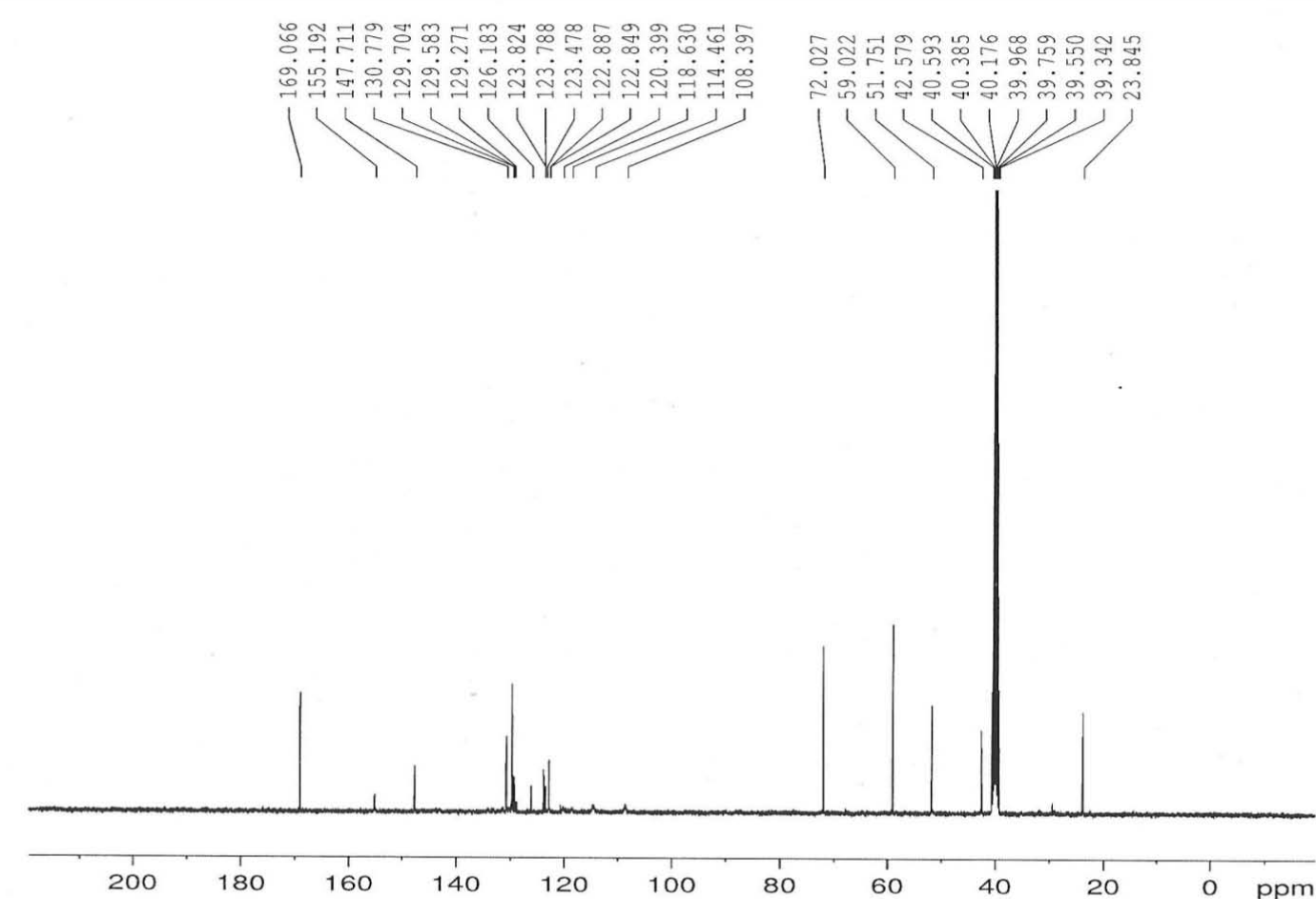
Figure 3: 13C NMR Spectrum of the Compound.

Scheme 1: Spectrum of compound 3.
FTIR spectra of compound 3 have been provided a preliminary
idea for the formation of product. According to the FTIR, the
presence of peak at 3480 cm-1 has clearly noticed the utilization
of starting materials transforms into the product. Further, the
corresponding peaks at 3332, 3365 and 2966 cm-1 have been
related to aliphatic N-H, benzimidazole ring N-H, C-H aromatic
stretching in the compound 3. The concerned mass of the
compound 3 is in good agreement with the observed (414.0 m/z)
and calculated value (413.0 m/z) were shown in Figure 1 Proton
NMR strongly empowered for the formation of the product by
its δ value. In proton NMR the three exchangeable –NH protons
showing peaks at δ(ppm) = 10.94 (s, 1H), 7.81 (s, 1H), 7.74(s,
1H,). Four aromatic doublet protons gives peak at δ=7.03(d,1H, J=
7.5Hz, Ar-H), 6.92(d, 1H, J = 6.9Hz, Ar-H), 6.82(d, 1H, J = 5.7Hz, Ar-
H), aromatic multiplet protons provide peak at δ=7.315-7.575(m,
2H, Ar-H), methane proton appeared at 5.06 (m, 1H, Ali-CH)
sulphonamide methylene protons showing peak at 4.33(broad
s, 2H, -CH2), and two methyl proton indicate peak at 2.75(s, 3H,
-CH3), 1.50(d, 3H, J = 6.9Hz, -CH3) ppm. Also 13C NMR spectra were provide peaks at d = 169.0ppm which shows impurity
peak of iodoacetic acid carbonyl carbon, aromatic carbons are
absorbed the range of δ = 155.1, 147.7, 130.7, 129.7, 129.5, 129.2,
126.1, 123.8, 122.8, 120.3, 113.6, 106.3, 72.0. Methine carbon,
sulphonamide methylene and methyl, aliphatic methyl group
carbon gives peaks at 59.0, 51.7, 42.5, 23.9 respectively. These
values confirmed to the number of carbon atoms present in the
compound
Conclusion
In the present work 7-(methanesulphonaminomethyl)-N-
(1-(3-(trifluoromethyl)phenyl)ethyl)-1H-benzo[d]imidazol-2-
amine (3) were synthesized successfully from the condensation
between compound 1 and 2 in the presence of iodoacetic acid. Most
of the researcher have been synthesized 2-aminobenzimidazole
derivatives by using hazardous catalyst like mercury(II)oxide,
mercury(II)chloride, copper(I) chloride, methyl iodide etc.,
which involves long time reaction and significant challenges
during purification of the products. we have been synthesized the 2-aminobenzimidazole derivatives considerably simplified
method used by iodoacetic acid as a cyclode sulfirization agent
and using ethanol as solvent to provide desired product at 60°C,
3 hours without formation of side product with high yield.
In our scheme synthesis of compound 1 was involved 6 steps. The first step was protection of diamine followed by bromination and Di BOC amination, BOC deprotection, sulfonation using methane sulfonyl chloride and deprotection of diamine using raney nickel to get key intermediate 1 and 2 was synthesized using amine and thiophosgene. The chemical structures of compound 3 have been confirmed using various spectral techniques viz., FTIR, Mass, 1H-NMR and 13C spectra and were found to be in agreement with the chemical structures expected.
In literature survey variety of 2-aminobenzimidazole derivatives were reported using 3,4-substituted diamines and para trifluoro substituted isothiocynates as a key starting material. These derivatives show wide range of biological activity. So in our work we are synthesized various novel 2,3 substituted diamine derivative like compound (1) and various meta trifluoro substituted isothiocynates like compound (2). By using those key intermediates we are synthesized various substituted 2-aminobenzimidazole like N-((2-(1-(3-(trifluoromethyl) phenyl) ethylamino)-1Hbenzo[ d]imidazol-4-yl)methyl)methanesulfonamide(3) which can possibly be further modified to research better potency than the reference drugs.
In our scheme synthesis of compound 1 was involved 6 steps. The first step was protection of diamine followed by bromination and Di BOC amination, BOC deprotection, sulfonation using methane sulfonyl chloride and deprotection of diamine using raney nickel to get key intermediate 1 and 2 was synthesized using amine and thiophosgene. The chemical structures of compound 3 have been confirmed using various spectral techniques viz., FTIR, Mass, 1H-NMR and 13C spectra and were found to be in agreement with the chemical structures expected.
In literature survey variety of 2-aminobenzimidazole derivatives were reported using 3,4-substituted diamines and para trifluoro substituted isothiocynates as a key starting material. These derivatives show wide range of biological activity. So in our work we are synthesized various novel 2,3 substituted diamine derivative like compound (1) and various meta trifluoro substituted isothiocynates like compound (2). By using those key intermediates we are synthesized various substituted 2-aminobenzimidazole like N-((2-(1-(3-(trifluoromethyl) phenyl) ethylamino)-1Hbenzo[ d]imidazol-4-yl)methyl)methanesulfonamide(3) which can possibly be further modified to research better potency than the reference drugs.
ReferencesTop
- Beaulieu C, Wang Z, Denis D, Greig G, Lamontagne S, O'Neill G, et al. Benzimidazoles as new potent and selective DP antagonists for the treatment of allergic rhinitis. Bioorg Med Chem Lett. 2004;14(12):3195-9.
- a. Kling A, Backfisch G, Delzer J, Geneste H, Graef C, Hornberger W, et al. Design and synthesis of 1,5- and 2,5-substituted tetrahydrobenzazepinones as novel potent and selective integrin alphaVbeta3 antagonists. Bioorg Med Chem. 2003;11(7):1319-41.
- b. Snow RJ, Cardozo MG, Morwick TM, Busacca CA, Dong Y, Eckner RJ, et al. Discovery of 2-phenylamino-imidazo[4,5-h]isoquinolin- 9-ones: a new class of inhibitors of lck kinase. J Med Chem. 2002;45(16):3394-405.
- c. Janssens F, Torremans J, Janssen M, Stokbroekx RA, Luyckx M, Janssen PA. New antihistaminic N-heterocyclic 4-piperidinamines. 1. Synthesis and antihistaminic activity of N-(4-piperidinyl)-1Hbenzimidazol- 2-amines. J Med Chem. 1985;28(12):1925-33.
- Perkins JJ, Zartman AE, Meissner RS. Synthesis of 2-(alkylamino) benzimidazoles. Tetrahedron Lett. 1999;40:1103-1106.
- Omar AM, Ragab MS, Farghaly AM, Barghash AM. The cyclodesulphurization of thio-compounds. Part 12: A new simple method for the synthesis of N-alpha-substituted benzimidazoles from thiourea derivatives. Pharmazie. 1976;31(6):348-50.
- Wang X, Zhang L, Zu Y, Krishnamurthy D, Senanayake CH. A practical synthesis of 2-(N-substituted)-amiobenzimidazoles utilizing CuClpromoted intramolecular cyclization of N-(2-aminoaryl)thioureas. Tetahedron Lett. 2004;45:7167-7170.
- Mohsen A, Omar ME. The Cyclodesulfurization of Thio Compounds; VII. A New Facile Synthesis of N α-Substituted Benzimidazoles. Synthesis. 1974;41-42.
- Heinelt U, Schultheis D, Jager S, Lindenmaier M, Pollex A, Beckmann HSG. A convenient method for the synthesis of 2-amino substituted aza-heterocycles from N, Na2-disubstituted thioureas using TsCl/ NaOH. Tetrahedron Lett. 2004;60:9883-9888.
- Omar AMME, Habib NS, Abolwafa OM. The Cyclodesulfurization of Thio Compounds; XVI. Dicyclohexylcarbodiimide as an Efficient Cyclodesulfurizing Agent in the Synthesis of Heterocyclic Compounds from Various Thio Compounds. synthesis. 1977:864-865.
- Ghosh H, Yell R, Nath J, Patel BK. Desulfurization Mediated by Hypervalent Iodine(III): A Novel Strategy for the Construction of Heterocycles. Eur. J.Org. Chem. 2008;36:6189.
- Victor Cee J, Nicholas SD. Tetrahedron Lett. 2006;47(22):3747-3750.

