


Research Article
Open Access
Larvicidal Activity of Artocarpus Altilis against
Culex Quinquefasciatus
Famuyiwa Funmilayo Gladys* and Kolawole Ester Bukola
Department of Pharmacognosy, Faculty of Pharmacy, Obafemi Awolowo University, Ile-Ife, 220282, Nigeria.
*Corresponding author: FAMUYIWA Funmilayo Gladys PhD, Lecturer 1, Department of Pharmacognosy, Faculty of Pharmacy, Obafemi Awolowo University,
Ile-Ife, 220282, Nigeria; E-mail:
@
Received: January 24, 2019; Accepted: February 11, 2019; Published: February 21, 2019
Citation: Famuyiwa and Kolawole (2019) Larvicidal Activity of Artocarpus Altilis against Culex Quinquefasciatus. Int J Plant Stu. 2(1): 1-4.
AbstractTop
Artocarpus altilis is an evergreen, flowering tree in the family
Moraceae. Its parts have antmalaria and insect repellent activities. The
methanol extract of the stem bark and the wood was reported to have
moderate to low activity respectively against the fourth instar larvae of
Aedes aegypti. In this study, the methanol extract of the leaf, root, stem
bark, root bark, flower, fruit and wood of A. altilis was tested against
the fourth instar larvae of Culex Quinquefasciatus mosquito. This
was with a view to determining the most active morphological part
from which eco-friendly and potent larvicidal compound(s) could be
isolated. The flower (LC50 2.19 ± 0.16mg/mL at 48h) and the root (LC50
2.18 ± 0.09mg/mL at 48h) extracts had the highest larvicidal activity.
The root extract was partitioned into n-hexane and ethylacetate and
the resulting fractions tested. The ethylacetate fraction (LC50 1.01 ±
0.03mg/mL at 48h) was the most active.
Keywords: Artocarpus altilis; partitioned fraction; filariasis; Culex Quinquefasciatus; Moraceae; larvicidal activity;
Keywords: Artocarpus altilis; partitioned fraction; filariasis; Culex Quinquefasciatus; Moraceae; larvicidal activity;
IntroductionTop
Artocarpus altilis commonly known as breadfruit is an
evergreen, flowering tree in the family Moraceae [1]. The leaves
are thick and leathery with a glossy dark-green colour on the
dorsal side. The underside is dull with an elevated midrib and
main veins [2]. The wood is gold in colour, resistant to termites
and shipworms, so it is used as timber for structures and outrigger
canoes. Breadfruit tree bears a multitude of monoexious flowers.
The fruits are mostly round, oval, or oblong in shape. The seeds
are brown in colour, shiny, round or ovoid in shape and irregularly
compressed. It is a multipurpose agroforestry tree crop which is
primarily used for its nutritious, starchy fruit as rich source of
carbohydrates, calcium and phosphorus [3]. The different parts
are used for the treatment of tongue thrush, skin infections,
sciatica, diarrhoea, low blood pressure and asthma [4, 5]. It has
been reported as having potential as an insect repellent [6].
Anti-inflammatory, antifungal, antidiabetic, immunomodulatory,
antitubercular, antiplasmodial, antihypertensive, antibacterial,
anti-cholinergic, chelating, toxicity to cancer cells and anthelmintic
activities had been reported for the plant [7-14]. Many compounds
like morin, moracin, dihydromorin, cynomacurin, cyclomorusin,
artocarpin, artocarpetin, cycloartinone, cyclogeracommunin,
and cyclocommunol and cycloartenyl acetate had been isolated
from the plant [15, 16]. The methanol extract of the fruit showed
poor insecticidal and larvicidal activity against Bruchus pisorum,
Tribolium castaneum and Sitophilus oryzae [17]. The methanol
extracts of the stem bark and wood was reported to have moderate
to low larvicidal activity respectively against A. aegypti [18].
Fatty acids were suggested to be responsible for the mosquito
deterrence of the hydrodistillate of the dried male inflorescences
against adult A. aegypti females [19]. This paper reports the
larvicidal activity of the various morphological parts of A. altilis
against Culex Quinquefasciatus the vector of filariasis. This was
with a view to determining the most active morphological part
from which eco-friendly and potent larvicidal compound(s) could
be isolated.
MethodsTop
Plant Collection and Preparation
The leaves, root, stem bark, root bark, flowers, fruits and wood
of A. altilis (Parkinson) Forsberg (Moraceae) were collected on a
farm land along link road, Obafemi Awolowo University Hospital,
Ile-Ife, Osun state. The plant was authenticated by Mr Ogunlowo
of the Herbarium of the Department of Pharmacognosy, Obafemi
Awolowo University, Ile-Ife, Osun state. Voucher specimen was
deposited under the reference number FPI 2177. The collected
morphological parts were cut into smaller pieces. The leaf and
flower were air dried while the root, root bark, wood and stem
bark were oven dried at 40oC. They were separately blended in a
grinding machine. The fresh fruit was pounded in a mortar with a
pestle. Each of the plant parts was extracted in methanol at room
temperature for 3 days, with agitation. The extract was filtered
and concentrated in vacuo at 350C. This was repeated twice. The
combined extract for each plant part was kept and later used for
larvicidal activity testing against C. Quinquefasciatus.
Larvicidal Activity of the Extracts
Each of the resulting extracts was subjected to larvicidal
activity testing according to World Health Organisation, 2005
guidelines with slight modifications. Stock solutions (25 mg/mL)
of the extracts prepared by solubilising the extracts in Tween
80 were thereafter serially diluted to obtain 25 mL of different
concentrations (0–5 mg/mL) of the test agents. Twenty five
larvae were introduced into each cup and each concentration
was replicated five times. The negative control contained distilled
water and Tween 80 and Endosulphan, a commercial insecticide,
was used as the positive control. The number of surviving larvae
in each cup was counted after 24 and 48 hours of exposure.
Average percentage mortality for each concentration was
calculated from which the LC50 and LC90 values were determined
[18]. No mortality was observed with the negative control.
Partitioning of the Root Extract
The methanol extract of the root (AAR, 9.48 g) was
suspended in water and successively partitioned into n-hexane
and ethylacetate; and concentrated in vacuo to give their
corresponding n-hexane (AAR1, 1.2 g), ethylacetate (AAR2,1.5 g )
and aqueous (AAR3, 6.38g) fractions.
Larvicidal Activity of the Partitioned Fractions
Stock solutions (12.5 mg/mL) of each of the partitioned
fractions AAR1-AAR3 prepared by solubilising them in Tween
80 were thereafter serially diluted to obtain 25 mL of different
concentrations (0–2.5 mg/mL) of the test agents. These were
used for the assay as given for the extracts.
ResultsTop
Presented in figures
DiscussionTop
The various morphological parts of A. altilis were screened
for activity against the fourth instar larvae of C. Quinquefasciatus
the vector of filariasis and many other debilitating diseases.
During the test period, the methanol extract of the various
parts demonstrated varying degrees of activity against the test
organism. At both 24 and 48 h, the root and flower extracts had
the highest activity (Figure 1 and 2). The high activity of the
flower corroborated an earlier report of mosquito deterrence of
the hydrodistillate of the dried male inflorescences against adult
A. aegypti females [19]. The leaf, wood and fruit extracts were
moderately active while the stem and root barks were inactive
as shown in Figs. 1 and 2 [20]. However none of the extracts had
comparable activity to the positive control used. The order of
activity was Endo > root = flower > wood > leaf = fruit > stem
bark > root bark at 24hours. At 48h, there was a significant
improvement in activity of all the extracts most especially the
fruit and leaf. The order of activity was Endo > root = flower >
wood = leaf = fruit > stem bark > root bark. The activity of the
wood extract (LC50, LC90 3.83 ± 0.08, 6.6 ± 0.07 mg/mL at 24
hours) of this study against C. Quinquefasciatus was significantly
better than that reported against A. aegypti (LC50, LC90 6.38 ± 0.29,
10.33 ± 0.22 mg/mL at 24 hours) by Adebajo et al., 2014. This
could be due to a higher susceptibility of the test organism used
in this study.
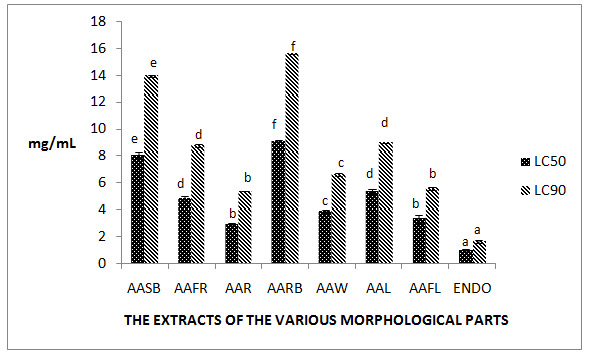
Figure 1:The Larvicidal Activity of the Methanol Extract of the Various
Morphological Parts after 24 hours.
AASB: stem bark extract; AAFR: fruit extract; AAR: root extract; AARB: root bark extract; AAW: wood extract; AAL: leaf extract; AAFL: flower extract; ENDO: Endosulphan, the positive control. LC50 and LC90: Values ± SEM of five experiments.
AASB: stem bark extract; AAFR: fruit extract; AAR: root extract; AARB: root bark extract; AAW: wood extract; AAL: leaf extract; AAFL: flower extract; ENDO: Endosulphan, the positive control. LC50 and LC90: Values ± SEM of five experiments.

Figure 2:The Larvicidal Activity of the Methanol Extract of the Various
Morphological Parts after 48 hours.
AASB: stem bark extract; AAFR: fruit extract; AAR: root extract; AARB: root bark extract; AAW: wood extract; AAL: leaf extract; AAFL: flower extract; ENDO: Endosulphan, the positive control. LC50 and LC90: Values ± SEM of five experiments.
AASB: stem bark extract; AAFR: fruit extract; AAR: root extract; AARB: root bark extract; AAW: wood extract; AAL: leaf extract; AAFL: flower extract; ENDO: Endosulphan, the positive control. LC50 and LC90: Values ± SEM of five experiments.
The methanol extracts of the root and flower gave comparably
highest activity. However, the yield of the methanol extract of
the flower was low compared to the root. Therefore in order
to have a good weight for phytochemical work, the root was
further purified. The methanol extract of the root was suspended
in water and successively partitioned into n-hexane and
ethylacetate. The resulting n-hexane, ethylacetate and aqueous
fractions were similarly tested against the fourth instar larvae of
C. Quinquefasciatus. At 24 hours, the n-hexane (LC50, LC90 1.92 ±
0.08 3.41 ± 0.12 mg/mL) and the ethylacetate (LC50, LC90 1.77 ±
0.03, 3.19 ± 0.13 mg/mL) partitioned fractions had comparable
high larvicidal activity (Figure 3 and 4) while the aqueous
fraction was inactive (LC50, LC90 6.99 ± 0.12, 11.97 ± 0.13 mg/mL).
The activities of the organic fractions were better than that of the
methanol extract (LC50, LC90 2.87 ±0.08, 5.37 ± 0.01 mg/mL). At
48 hours, the ethylacetate fraction had the lowest lethality value
(LC50, LC90 1.01 ± 0.03, 2.02 ± 0.06 mg/mL) making it the most
active partitioned fraction. Its activity was comparable to that
of the positive control. Efforts are on-going to isolate the active
compound(s) from the most active ethylacetate fraction.

Figure 3:The Larvicidal Activity of the Partitioned Fractions of the Root
Extract after 24 hours.
Key: AAR1: n-hexane partitioned fraction; AAR2: ethylacetate partitioned fraction; AAR3: aqueous partitioned fraction; AAR: root extract; ENDO: Endosulphan, the positive control. LC50 and LC90: Values ± SEM of five experiments.
Key: AAR1: n-hexane partitioned fraction; AAR2: ethylacetate partitioned fraction; AAR3: aqueous partitioned fraction; AAR: root extract; ENDO: Endosulphan, the positive control. LC50 and LC90: Values ± SEM of five experiments.

Figure 4:The Larvicidal Activity of the Partitioned Fractions of the Root
Extract after 48 hours.
Key: AAR1: n-hexane partitioned fraction; AAR2: ethylacetate partitioned fraction; AAR3: aqueous partitioned fraction; AAR: root extract; ENDO: Endosulphan, the positive control. LC50 and LC90: Values ± SEM of five experiments
Key: AAR1: n-hexane partitioned fraction; AAR2: ethylacetate partitioned fraction; AAR3: aqueous partitioned fraction; AAR: root extract; ENDO: Endosulphan, the positive control. LC50 and LC90: Values ± SEM of five experiments
ConclusionTop
The results obtained from this study indicate that A. altilis
root and flower extracts could serve as potential candidates
for developing botanical larvicides for efficient control of C. Quinquefasciatus. The larvicidal compound(s) of the root extract
is concentrated in the ethylacetate fraction and efforts are ongoing
to isolate them.
ReferencesTop
- Amarasinghe NR, Jayasinghe L, Hara N, Fujimoto Y. Chemical constituents of the fruits of Artocarpus altilis. Biochemical Systematics and Ecology. 2008;36(4):323-325.
- Ragone D, Cavaletto CG. Sensory valuation of fruit quality and nutritional composition of 20 breadfruit (Artocarpus, Moraceae) cultivars. Economic Botany. 2006;60(4):335-346.
- Jagtap UB, Bapat VA. Artocarpus: A review of its traditional uses, phytochemistry and pharmacology. Journal of Ethnopharmacology. 2010;129(2):143-144.
- Somashekhar M, Naira N, Basavraj S. A Review on Family Moraceae (Mulberry) With a Focus on Artocarpus Species. World J. Pharm. Sc. 2013;2(5):2614-2621.
- Morton JF, Miami FL. Breadfruit. In: Fruits of warm climates. 1987;50–58.
- Glatz C. An Introduction to Herbalism. Healthy Life Journal. 2011.
- Gallaher D, Schneeman BO. Nutritional and metabolic response to plant inhibitors of digestive enzymes. Adv Exp Med Biol. 1986;199:167–184.
- Boonphong S, Baramee A, Kittakoop P, Puangsombat P. Antitubercular and antiplasmodial prenylated flavones from the roots of Artocarpus altilis. Chiang Mai Journal of Science.2007;34(3):339–344.
- Nwokocha CR, Owu DU, McLaren M, Murray J, Delgoda R and Thaxter K, et al. Possible mechanisms of action of the aqueous extract of Artocarpus altilis (breadfruit) leaves in producing hypotension in normotensive Sprague-Dawley rats. Pharmaceutical Biology. 2012;50(9):1096-1102.
- Carine MM, Maurice M, Marie-Laure L, Harry A. In vitro evaluation of the nematicidal value of Artocarpus altilis (Parkinson) var. seminifera and non seminifera and Terminalia cattapa L. against Haemonchus contortus. Advances in Animal Biosciences.2010;1(02):440-441.
- Chinmay P, Monalisa M, Abhijeeta A. Phytochemical screening and comparative bioefficacy assessment of Artocarpus altilis leaf extracts for antimicrobial activity. Frontiers in Life Science, 2012;6:3-4.
- Horng-Huey K, Wen-Chun L, Cheng-Wei T, Chun-Ching L, Feng-Lin Y. Prenylated flavonoids from Artocarpus altilis: Antioxidant activities and inhibitory effects on melanin production Phytochemistry: The International Journal of Plant Chemistry, Plant Biochemistry and Molecular Biology. 2013;89:78–88.
- Nair S, Kavrekar V, Anshu M. In vitro studies on alpha amylase and alpha glucosidase inhibitory activities of selected plant extracts. European Journal of Experimental Biology. 2013;3(1):128-132.
- Nguyen MT, Nguyen NT, Nguyen KD, Dau HT, Nguyen HX and Dang PH, et al. Geranyl Dihydrochalcones from Artocarpus altilis and their antiausteric activity. Planta Medica.2014;80:193-200.
- Pereira VJ, Kaplan MAC. The High Bioactivity of Artocarpus - An Exotic Genus. Floresta e Ambiente. 2013;20(1):1-15.
- Delazar A, Nahar L, Hamedeyazdan S, Sarker SD. Microwave assisted extraction in natural products isolation. US National Library of Medicine National Institutes of Health. 2012;2(1):27-30.
- Nair SS. Kavrekar V. In vitro screening of larvicidal and insecticidal activity of methanolic extracts of Artocarpus heterophyllus, Artocarpus altilis and Piper betle. International Journal of Environment, Agriculture and Biotechnology. 2017;2(1): 281-288.
- Adebajo AC, Famuyiwa FG, Aliyu FA. Properties for Sourcing Nigerian Larvicidal Plants. Molecules. 2014;19(6):8363-8372.
- Jones AMP, Ragone D, Tavana NG, Bernotas DW, Murch SJ. Beyond the Bounty: Breadfruit (Artocarpus altilis) for food security and novel foods in the 21st Century. Ethnobotany Journal.2011;9:131-132.
- Adebajo AC, Famuyiwa FG, John JD, Idem ES, Adeoye AO. Activities of some Nigerian Medicinal Plants against Aedes aegypti. Chinese Medicine. 2012;3:151–156.
- Guidelines for Laboratory and Field Testing of Mosquito Larvicides.

