


Case Report
Open Access
Integrated Waste Management Through Symbiotic
Culture, A Holistic Approach
Atun RoyChoudhury1*, Ashok Kumar N2, Srinivas K3, Arutchelvan V4 and Goutham Reddy M5
1,3,5Ramky Enviro Engineers Ltd., Gachibowli, Hyderabad, India-500032
2,4Department of Civil Engg, Annamalai University, AnnamalaiNagar, India- 608002
2,4Department of Civil Engg, Annamalai University, AnnamalaiNagar, India- 608002
*Corresponding author: Atun RoyChoudhury; Scientific Officer, Ramky Enviro Engineers Ltd., Gachibowli, Hyderabad, India, Tel: +91-8838092641;
E-mail:
@
Received: July 17, 2018; Accepted: July 31, 2018; Published: August 21, 2018
Citation: Choudhury AR, Ashok Kumar N, Srinivas K, Arutchelvan V, Goutham Reddy M (2018) Integrated Waste Management Through Symbiotic Culture, A Holistic Approach. Int J Sci Res Environ Sci Toxicol 3(3):1-7. DOI: 10.15226/2572-3162/3/3/00122
Abstract Top
Unsegregated heterogeneous mass of solid waste is a potential
threat towards the safe processing and disposal of municipal solid
waste [MSW], which is cumbersome and ancillary, elevates the
expenditure. The absence of any pertinent technique to handle these
bulky mass in an eco-friendly way makes it even more hectic for the
MSW processing plants. But, this substantial mass constitutes a huge
potential, which can be valorized through the larval digestion of a
symbiotic macro culture, to create new economic niches for smallscale
entrepreneurship in developing and under-developed nations.
The present study incorporates a symbiotic waste reduction system
with the efficient functionalism of micro and macro conversion agents
which is attributed to the synthesis of waste derived co-products
from the same platform. This study is solely a novel approach, which
is capable of addressing a wide fraction of solid waste, domestic
sewage, and bio-leachate and converts them into value-added coproducts
within the magnificent period of time. Multiple experiments
have been conducted under the controlled feeding environment with
an established symbiosis between the BSF larvae, Wax Moth larvae
[Galleria melonella], and effective microorganism culture. An initiation
period of 5 days was allocated for the macro conversion agents and
during the tenure, the larvae were supplied with synthetic diet to
accelerate the body growth index. The entire experiments have been
conducted in a newly formulated novel bioreactor namely, Integral
Larval Grub Composting Reactor which is capable of performing
automated pupal segregation and address solid and liquid waste
under a single platform. The system enforces the zero liquid discharge
concept and also helps in an indirect suppression of house fly growth.
The novel approach only required 14-16 days in order to convert the
solid waste into nutrient-rich manure, having significantly high-quality
component. The operation has been executed in a number of batch
processes and each process valorized a quantity of approx 30 kg. The
targeted larval period has been prolonged by means of maintaining
higher moisture content with the help of sewage supply and once the
maturation period arrives the further addition of moisture has been
restricted for 3 days. Overall it’s an ultimate and wholesome biological
waste management technique, which is capable of standing solely to
strengthen the sustainable waste management strategy.
Keywords: Galleria melonella; Hermetia illucens; Larval period; Moisture; Plastic waste;
Keywords: Galleria melonella; Hermetia illucens; Larval period; Moisture; Plastic waste;
Highlight
• Symbiotism has been established between the larvae of
Hermetia illucens and Galleria melonella.
• Excessive Moisture prolongs the targeted larval instar stage.
• Larval culture degraded heterogeneous solid waste including plastic.
• Solid and liquid waste was efficaciously treated under a single platform.
• Excessive Moisture prolongs the targeted larval instar stage.
• Larval culture degraded heterogeneous solid waste including plastic.
• Solid and liquid waste was efficaciously treated under a single platform.
Introduction
In lower and middle-income countries it has been observed,
in contrast of other inorganic and inert waste which has a
potential value to the rack pickers and recyclers the quantity of
generation of organic fraction is predominant [i.e. amounting
to 65%]. But it has been rarely seemed to be forwarded to the
treatment facilities or considered as significant source of revenue
generation unlike the other part of MSW, though in some occasion
it may get collected, but its ultimate fate is always in dilemma and
either it usually ends up in receiving landfills or on a relatively
unscientific open dumping in outskirts of the town, where the
material get degraded in the form of large piles under anaerobic
environment [1, 2]. Ultimately a feasible treatment has been
replenished in the form of BSFL composting, which minimizes
the environmental interventions and advances the aspect of
public health and sanitation. This novel and economically
feasible waste management approach need to be implemented
and promoted for overall good [3]. Finally, when it comes to the
compost phenomenon, it has been already explored by several
researchers all over the globe. On the other hand availability
of the relevant literature and information is very meagre in the
case of microfauna. As far as the Indian scenario is concerned,
assortment and functionality of this macro-organism was studied
in recent past. Ritika et al. has tried to establish a correlation
between micro and macrofauna and reported that, once the
pre-decomposition get completed [15-20 days], the partially
decomposed material can be supplied to the earthworms namely,
Eisenia fetida to examine their interface with the BSFL [4]. But
as per the environmental conditions, rearing of BSF should be
keenly observed and monitored, because it is rarely hectic in
India as larvae thrive better in the tropical environment, hence
composting utilizing BSFL should be recommended in India for
sustainable waste management [5].
The requirement of formulating an alternate and sustainable waste management strategy for Chidambaram provoke the idea of using the Black Soldier Fly Larvae [BSFL] composting. Rather than the waste treatment and minimization, the above process is also capable of addressing multidimensional issues such as rising demand of implementing renewable fuel, increasing protein in farm and aquatic diet, yielding compost with high nutrient content, etc. Other major advantages comprise higher consumption rates and faster rate of degradation and bioconversion [6,7]. Trinh et al. performed experiments on nutrition conditions with different substrate sources and reported the larvae were capable of degrading the wide range of wastes such as control poultry feed, pig manure, kitchen waste, fruits, and vegetables, etc [8]. But the optimum reduction was observed in the case of poultry manure which yields healthier black soldier flies with lower mortality rates. Diverse rates and the relation between conversion efficiency and larval growth have been recorded by several researchers. Nevertheless, in order to suboptimize the value of these two key factors of BSFL composting, experiments have been conducted by feeding the larvae with four different concentrations of dairy manure to predict its influence on the life cycle traits of larvae as well as adult files to establish a relation between supply rate and BSFL growth [9]. The results reveal that the feeding rate has major impacts on larval and adult fly development and nutritional profile and it showed a proportional relationship in which larvae with greater substrate availability weighed more than those fed significantly lesser ration. Collaterally, Stefan et al. stated that an average prepupation rate of 252 g/m2/day [wet weight] was achieved under optimized environmental conditions and the bio-conversion yield around 65.5 to 78.9% depending on the quantity of waste added on regular basis and also by the availability of the drainage facilities [10]. Stefan et al. have observed that the optimal balance between treatment efficiency and biomass population can be maintained by a proper nutritional diet and feeding rate on a day to day basis, spiked by a moisture content of 60% [11]. The above study also observed the rate of biomass production for different sorts of substrates and stated that an individual waste stabilization component can produce a pre-pupal biomass of 145 g [dry mass] per m2 on a regular basis. Contradictorily, Myers et al. have encountered significantly lower conversion rates [12]. A bio-kinetic study was conducted to understand the correlation between the growth kinetics and feeding rate and stated the reduction in weight of dry matter varied inversely proportional to the waste loading rate. They observed in a lab-scale study when the larvae fed 27 g of waste on regular basis it reduced the dry fraction approximately by 58% while the other experiment yields considerably lower conversion rates [i.e. 33%], where larval feeding rate was increased by 70 g of waste matter/day. The increased larval feeding rates also found contradictory in the case of life cycle studies, it accelerated the mortality rates to 29% from 17% among larvae. Apart from this conventional feedstock, the technique is also capable of addressing awfully complex secondary wastes such as bio-leachate, persistent pollutants etc. This comprehensive management ability helps the treatment to emerge as a wholesome alternative [13]. Hang et al. studied the economic feasibility of the above technology and reported; raw swine manure can yield up to 95–120 kg of larval population per m3 of waste supplied to the system [14]. The study also claimed that the live and fresh biomass can be served as an optional animal diet, rich in protein and fat content. As well as it is feasible in capturing the nutrients from the waste stream which can be further utilized as agro-based plant manure and the bioconversion technique stabilizes the primary pollutants and minimizes the production of obnoxious gases and odour formation by 94.5 %. The economic proficiency of the above technique even makes it more feasible with the yearly profit rages from US$33.4–46.1 per m3, observed during the operational period. In order to interpret the above scenario, an experimental study conducted by Tschirner and Simon may be considered as a benchmark [15]. They have investigated the influence of different growing substrates on the crude nutrient and they observed the impact of different fodder consumption on the larval body composition. They reported the yield of different nutrients for the experimental period of 15 day, where protein and fibre value ranges around 0.93 and 0.43 kg of wet mass, respectively.
On the other hand, wax moth larvae found to be feasible for biodegradation polyethylene, which comprises approximately 40% of the entire plastic mass and the consumption rate reported to be comparatively higher. A group of researchers from Spain and England stated that the 100 counts of larvae can efficiently degrade 92 milligrams of polyethylene within a period of 12h. It has been reported in the same study that the presence of ethylene glycol was observed during the enzymatic conversion process, which signifies biological breakdown of the polyethylene [16]. Contradictorily, Weber et al., stated that the results showcased by the previous author is uncertain and not substantiate with enough scientific evidence [17]. Precisely this research group has questioned the interpretation of the signals obtained by infrared spectroscopy which assures the presence of ethylene glycol.
Eventually, the entire research community has been agreed to validate black soldier fly larvae as the most unique and profitable conversion and stabilization agent of the new era with minimal hindrance. The technique is rampant and further research in this domain may help the lower middle-income nations to get read of the unsightly and unscientific dumping yards.
The objective of this research was to primarily investigate the influence of different external conditions on the target larval instar stage and also to emphasize the superiority of symbiotic composting over the conventional, time-consuming and primitive methods and also to address the existing lagging and drawbacks in this domain and to explore the fraternity with the portrayal of ultimate treatment system, capable of accounting multidimensional aspects such as solid waste and sewage sustainably under a single platform.
The requirement of formulating an alternate and sustainable waste management strategy for Chidambaram provoke the idea of using the Black Soldier Fly Larvae [BSFL] composting. Rather than the waste treatment and minimization, the above process is also capable of addressing multidimensional issues such as rising demand of implementing renewable fuel, increasing protein in farm and aquatic diet, yielding compost with high nutrient content, etc. Other major advantages comprise higher consumption rates and faster rate of degradation and bioconversion [6,7]. Trinh et al. performed experiments on nutrition conditions with different substrate sources and reported the larvae were capable of degrading the wide range of wastes such as control poultry feed, pig manure, kitchen waste, fruits, and vegetables, etc [8]. But the optimum reduction was observed in the case of poultry manure which yields healthier black soldier flies with lower mortality rates. Diverse rates and the relation between conversion efficiency and larval growth have been recorded by several researchers. Nevertheless, in order to suboptimize the value of these two key factors of BSFL composting, experiments have been conducted by feeding the larvae with four different concentrations of dairy manure to predict its influence on the life cycle traits of larvae as well as adult files to establish a relation between supply rate and BSFL growth [9]. The results reveal that the feeding rate has major impacts on larval and adult fly development and nutritional profile and it showed a proportional relationship in which larvae with greater substrate availability weighed more than those fed significantly lesser ration. Collaterally, Stefan et al. stated that an average prepupation rate of 252 g/m2/day [wet weight] was achieved under optimized environmental conditions and the bio-conversion yield around 65.5 to 78.9% depending on the quantity of waste added on regular basis and also by the availability of the drainage facilities [10]. Stefan et al. have observed that the optimal balance between treatment efficiency and biomass population can be maintained by a proper nutritional diet and feeding rate on a day to day basis, spiked by a moisture content of 60% [11]. The above study also observed the rate of biomass production for different sorts of substrates and stated that an individual waste stabilization component can produce a pre-pupal biomass of 145 g [dry mass] per m2 on a regular basis. Contradictorily, Myers et al. have encountered significantly lower conversion rates [12]. A bio-kinetic study was conducted to understand the correlation between the growth kinetics and feeding rate and stated the reduction in weight of dry matter varied inversely proportional to the waste loading rate. They observed in a lab-scale study when the larvae fed 27 g of waste on regular basis it reduced the dry fraction approximately by 58% while the other experiment yields considerably lower conversion rates [i.e. 33%], where larval feeding rate was increased by 70 g of waste matter/day. The increased larval feeding rates also found contradictory in the case of life cycle studies, it accelerated the mortality rates to 29% from 17% among larvae. Apart from this conventional feedstock, the technique is also capable of addressing awfully complex secondary wastes such as bio-leachate, persistent pollutants etc. This comprehensive management ability helps the treatment to emerge as a wholesome alternative [13]. Hang et al. studied the economic feasibility of the above technology and reported; raw swine manure can yield up to 95–120 kg of larval population per m3 of waste supplied to the system [14]. The study also claimed that the live and fresh biomass can be served as an optional animal diet, rich in protein and fat content. As well as it is feasible in capturing the nutrients from the waste stream which can be further utilized as agro-based plant manure and the bioconversion technique stabilizes the primary pollutants and minimizes the production of obnoxious gases and odour formation by 94.5 %. The economic proficiency of the above technique even makes it more feasible with the yearly profit rages from US$33.4–46.1 per m3, observed during the operational period. In order to interpret the above scenario, an experimental study conducted by Tschirner and Simon may be considered as a benchmark [15]. They have investigated the influence of different growing substrates on the crude nutrient and they observed the impact of different fodder consumption on the larval body composition. They reported the yield of different nutrients for the experimental period of 15 day, where protein and fibre value ranges around 0.93 and 0.43 kg of wet mass, respectively.
On the other hand, wax moth larvae found to be feasible for biodegradation polyethylene, which comprises approximately 40% of the entire plastic mass and the consumption rate reported to be comparatively higher. A group of researchers from Spain and England stated that the 100 counts of larvae can efficiently degrade 92 milligrams of polyethylene within a period of 12h. It has been reported in the same study that the presence of ethylene glycol was observed during the enzymatic conversion process, which signifies biological breakdown of the polyethylene [16]. Contradictorily, Weber et al., stated that the results showcased by the previous author is uncertain and not substantiate with enough scientific evidence [17]. Precisely this research group has questioned the interpretation of the signals obtained by infrared spectroscopy which assures the presence of ethylene glycol.
Eventually, the entire research community has been agreed to validate black soldier fly larvae as the most unique and profitable conversion and stabilization agent of the new era with minimal hindrance. The technique is rampant and further research in this domain may help the lower middle-income nations to get read of the unsightly and unscientific dumping yards.
The objective of this research was to primarily investigate the influence of different external conditions on the target larval instar stage and also to emphasize the superiority of symbiotic composting over the conventional, time-consuming and primitive methods and also to address the existing lagging and drawbacks in this domain and to explore the fraternity with the portrayal of ultimate treatment system, capable of accounting multidimensional aspects such as solid waste and sewage sustainably under a single platform.
Methodology
Preparation of Medium
Preparation of medium is a delicate issue and seeks utmost
attention to germinate the mother culture. The medium should be
such that, it ensures optimum body growth attributed to minimal
mortality rate. Two different types of media were prepared that
are delineated in details in followings.
Medium Preparation for BSFL
In order to germinate mother culture, different mediums
were prepared and used [Figure 1]. The body growth factor and
the eating capacity for BSFL have been increased by initial feed
acclamation in the form of partially degraded mixed oilcake
supply enriched with Bio Nitrogen, Phosphorus, and Potassium.
Four different types of cakes were used which has been prepared
using different sources such as, mastered oilcake, groundnut
cake, copra cake etc. They were soaked in water [i.e. 50:50 mixes]
for the period of 24h under anaerobic condition and allowed the
initial degradation. Then four different mediums were prepared
by mixing the partially graded slurry in different ratios. The first
medium incorporated all three different varieties in one third
mix ratio, whereas other two consisted of mastered oilcake and
groundnut cake in 1:1 mix ratio and copra cake and groundnut
cake in 1:1 mix ratio. The last medium comprised solely mastered
oilcake inoculated with cow dung. All the mediums were placed
in an MSW processing and disposal facility namely, HiMSW,
Hyderabad.
The other variety of medium was prepared using poultry litter, spiked with chicken intestines. The medium was kept in a fenced farmland nearby a stagnant algal pond under a controlled environment.
The other variety of medium was prepared using poultry litter, spiked with chicken intestines. The medium was kept in a fenced farmland nearby a stagnant algal pond under a controlled environment.

Figure 1: Medium preparation for BSFL mother culture
Medium Preparation for Wax Moth Larvae
Wax moth, basically a pest of honeybees which feeds on the
honeycomb. The raw honeycomb is expensive and thus is not a
feasible option for regular usage in order to cultivate the larvae
of Galleria melonella. Therefore a synthetic diet was prepared
with the help of the following ingredients namely, Atta [1kg],
Wheat bran [1kg], Cornflour [776g], Honeycomb [200gm], Yeast
[80g], Honey [1.5l], Glycerol [1.2l], Milk powder [200g] [Figure
2]. Once the entire moisture gets evaporated from the synthetic
substrate then larvae were separated from the system manually
and introduced to a freshly prepared medium.
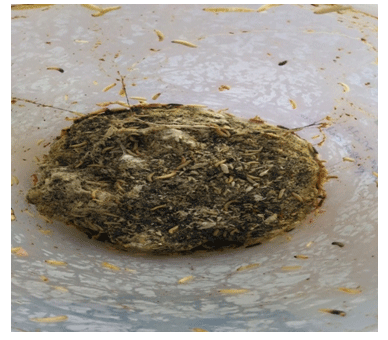
Figure 2: Medium preparation for Wax moth larvae mother culture
Fabrication of the Bio-Reactor
A complete and wholesome treatment facility is obligatory to
meet the goal of sustainability and integrated waste management
[Buiani 2015]. Thus, a treatment unit capable of addressing
wastewater and solid waste under a single platform named,
Integral Larval Grub Composting Reactor [ILGCR] was fabricated
and the schematic has been portrayed in [Figure 3].

Figure 3: Schematics of the Pilot Scale ILGCR
The reactor consists of two major working elements namely,
waste conversion/maturation element and liquid circulation
and recirculation unit. Rest of the subordinate units is there to
support the fundamental working procedure. [Figure 4] shows
the overview of the bioreactor. It comprises two upper-head tanks
with the flow regulators, a sprayer, a grub composting area, pupal
segregation and removal bucket, leachate drain with stopper,
and a leachate collection tank with a recirculation system. Two
peristaltic pumps are required in order to run the operation in
continuous mode.

Figure 4: Indexed ILGCR schematic
Working Mechanism of ILGCR
Initially, the waste got introduced into the active composting
zone, where larvae were working upon it and decompose the
waste. Near to the top opening four hinges has been provided
to captivate the entry of larvae in unwanted zones and regulates
the larval movement only towards the pupal segregation bucket.
A leachate drain has been provided with a regulation system to
drain the percolated bio-leachate from the system. A slope of
200 has been provided with the horizontal towards the drain
opening. Pupal segregation bucket segregates the pre-pupae
from the juvenile larvae and it comprises an exit hole to take out
the same. A fall down slot of 1.5-inch length has to be given on
both of the corners of the reactor. The upper-head tank placed
in the top left corner of the reactor is meant for bio-leachate
supply, which has a flow regulator in order to control the inflow
volume. The other upper-head tank placed on the top right-hand
side of the reactor is meant for sewage supply. The similar kind
of flow regulating provision has been given to it. The moisture
supplied from the upper-head tanks finally reach the sprayer and
get uniformly distributed over the solid sample. A bio-leachate
collection tank with influent flow regulator is placed near the
bottom of the reactor. The inflow regulator only opened once in
three days, once the leachate gets thickened. At the junction of
the reactor and the leachate drain pipe, a fine mesh needs to be
used to arrest the entry of larvae into the drain pipe. Two nos. of
the peristaltic pump has been attributed to the system to convey
the bio-leachate and sewage from the bottom tanks to the upperhead
tanks. Altogether, the commercialization of the bioreactor
may create a revolution in integrated waste management facilities
and open new economic niche for small-scale entrepreneurship.
Segregation of the Solid Waste
The heterogeneous and unsegregated solid waste was initially
screened with the help of trammel, which has a 70mm permeate
size. The permeate was collected and manually segregated
for further treatment. The lumpy and inert materials such as
cardboard, glass, metals were segregated out from the system.
The rest of the mass which incorporates organic fraction and the
plastic waste was sent to the ILGCR.
Introduction of the Bio-Leachate and Sewage
The process leachate and the brown water was collected
from the HiMSW, Hyderabad and sorted in the upper head tanks.
Primarily the system was boosted only with the help of sewage
[i.e. 3days] and once the culture got acclimatized with the initial
concentration then the process leachate was supplied for the rest
of the period [i.e. 10 days]. Once the maturation period reached
the addition of moisture was completely restricted.
Drainage and Recirculation
The drainage facility was attributed with a gravity flow. A
chicken mesh with 1mm pore size was used to arrest the larval
movement into the drainage pipe. The drain pipe consists of a
control valve, which was opened once in three days to provide
ample period for quantity reduction and quality concentration.
Results and Discussion
Solid Waste Conversion
The major perspective of the present study was to identify
the feasibility of a symbiotic culture in heterogeneous waste
degradation and the minimization of the conversion period.
Biodegradable Waste Conversion
The biodegradable fraction of the waste mass was converted
and stabilized with the help of BSF larvae and an effective
microorganism culture [i.e. consists of six different organisms
namely, Pseudomonas fluorescence, Pseudomonas straiata,
Bacillus substillis, Bacillus pumillis, Lactobacillus, Bakers
yeast]. The study reveals that these voracious eaters initially
consumes the readily biodegradable fraction of the waste and
simultaneously goes for the other materials based on the stiffness
and hardness index of the material. The conversion rates observed
to be 280 mg/larvae/day which is slightly higher than the values
reported by Diener et al. [18] [Figure 5]. The phenomenon of
higher feeding rate was interpreted as the fusion of bio-leachate
and enzyme accelerates decomposition process and converts
the waste mass into easily digestible monomers which helps the
conversion agents to consume the substrate at an elevated rate.
In this context temperature found to play a significant role which
hugely influences the conversion rates as reported by Stefan et
al. [10]. The study indicated a sharp declination in the treatment
efficiencies once the temperature dropped near to 21°C [19].

Figure 5: Influence of temperature on the treatment efficiency
Plastic Waste Conversion
Greater wax moth caterpillar requires an initiation period of
5 days after emerging out of the hatched eggs. The polyethylene
consumption rates were found to be successively increased
until 30th days of the larval instar stage which rages approx
0.027g/larva/day [16] [Figure 6]. But, in absence of the primary
food resources, the consumption rates found to get depleted
simultaneously to a value of 0.009g/larva/day for 50 days old
larvae [Figure 7]. Thereafter, a constant absence of raw substrate
results in exoskeleton formation and pupal conversion.

Figure 6: Consumption of polyethylene by wax moth larvae

Figure 7: Variation in consumption rate with different stages of the larval
period
Liquid Waste Consumption
Liquid waste was supplied in the form of sewage and process
leachate to maintain the optimum moisture for enhanced
biodegradation. The supply of liquid waste, reached the active
decomposition zone was in three forms namely, solely sewage,
pure leachate, and a 50:50 proportionate mixture [20, 21, 22].
The quantity of liquid waste introduced to the system found to be
consumed at a rate of 69.75% at utmost between an interval of 3
days [Figure 8].
Optimization of Moisture Content
Maintaining a specific level of moisture in the system found
to be correlated with the treatment efficiencies and body mass
index of the larvae. The present research work has undertaken the
influence of the moisture level on the behavioural characteristics
of the larvae and as a major breakthrough prolongation of the
targeted larval instar stage was recorded with an optimum
moisture level of 68% [Figure 9]. Any further increment in the
moisture level impacted negatively and accelerated the mortality

Figure 8: Leachate inflow and outflow rates

Figure 9: Optimization of the moisture level
rate. The maximum prolongation [i.e. 29 days] attributed to
optimum moisture level found to be approx 81% higher than the
normal larval period of 16 days. This prolongation of the larval
period also resulted positively with the body mass index of the
larvae and the larvae used in ILGCR as operational agent found to
grow almost double than a normal BSF larva [Figure 10; 11] [19].

Figure 10: Increment in body weight content with prolongation of the
larval period

Figure 11: Variation in larval size before and after treatment with ILGCR
Conclusion
The research work explicitly revealed that the symbiotic
culture is utmost feasible for the treatment of unsegregated
heterogeneous mass. The stipulated treatment period and
minimal energy input make this treatment a pertinent option as
per the societal need. Furthermore, the newly fabricated novel
reactor successfully prolongs the larval instar stage of the BSF
and thus maximized the body growth factor which contributed
positively towards the synthesis of value-added co-products
from the system. Ultimately, the research yields a wholesome
treatment system with zero environmental interventions which
can solely resolve the waste processing and disposal issues in
lower and middle-income nations.
ReferencesTop
- Ahmed N and Zurbrugg C. Urban organic waste management in Karachi, Pakistan. In: 28th WEDC Conference on Sustainable Environmental Sanitation and Water Services. Kolkata, India. 2002;
- Ali A. Managing the scavengers as a resource. In: Gu¨nay Kocasoy, T.A., Nuhog˘lu, I˙. (eds.) Appropriate Environmental and Solid Waste Management and Technologies for developing countries. International Solid Waste Association, Bogazici University, Turkish National Committee on Solid Waste. 2002;
- Ghughuskar MM. Recovery of nutrients from organic waste by using black soldier fly prepupae for sustainable waste disposal and production of animal feed. Global Online Electronic International Interdisciplinary Research Journal. 2012;1:128-137.
- Ritika P, Satyawati S, Rajendra P. Study on occurrence of black soldier fly larvae in composting of kitchen waste. International Journal of Research in Biosciences. 2015;4(4):38-45.
- Gayatri RG and Madhuri KP. Occurrence of Black Soldier Fly Hermetia illucens (Diptera: Stratiomyidae) in Biocompost. Research Journal of Recent Sciences. 2013;2(4):65-66.
- Richard NM. High value organic waste treatment via black soldier fly bioconversion. Master of Science thesis, Royal institute of technology, Stockholm. 2015;
- Alvarez L. The role of black soldier fly, Hermetia illucens (l.) (diptera: stratiomyidae) in sustainable waste management in northern climates. Dissertation, University of Windsor. 2012;
- Trinh TXN, Jeffery KT, Sherah V. Ability of Black Soldier Fly (Diptera: Stratiomyidae) Larvae to Recycle Food Waste. Environ Entomol. 2015;44(2):406-410. Doi: 10.1093/ee/nvv002
- Heidi MM, Jeffery KT, Barry DL, David K. Development of Black Soldier Fly (Diptera: Stratiomyidae) Larvae Fed Dairy Manure. Environmental Entomology. 2008;37(1):11-15. Doi: org/10.1093/ee/37.1.11
- Stefan D, Nandayure MSS, Floria RG, Christian Z, Klement T. Biological treatment of municipal organic waste using black soldier fly larvae. Waste Biomass Valor. 2011;2(4):357-363. Doi: 10.1007/s12649-011-9079-1
- Stefan D, Christian Z, Klement T. Conversion of organic material by black soldier fly larvae: establishing optimal feeding rates. Waste Management & Research. 2009;27(6):603-610. Doi:10.1177/0734242X09103838
- Myers HM, Tomberlin JK, Lambert BD, Kattes D. Development of black soldier f ly (Diptera: Stratiomyidae) larvae fed dairy manure.Environ Entomol. 2008;37(1):11-15.
- RoyChoudhury A, Ashok KN, Arutchelvan V. A review on anaerobic treatment in decentralized and source-separation-based sanitation concepts: applicability in developing countries. International journal of trend in scientific research and development. 2017;1(6):553-559.
- Hang W, Zhijian Z, George FC, Mari KHW, JianGuo Z. A full-scale house fly (Diptera: Muscidae) larvae bioconversion system for value-added swine manure reduction. Waste Management & Research. 2013;31(2):223-231. Doi:10.1177/0734242X12469431
- Tschirner M and Simon A. Influence of different growing substrates and processing on the nutrient composition of black soldier fly larvae destined for animal feed. Journal of Insects as Food and Feed. 2015;1(4):249-259. Doi: 10.3920/JIFF2014.0008
- Bombelli P, Howe CJ, Bertocchini F. Polyethylene bio-degradation by caterpillars of the wax moth Galleria mellonella. Curr Biol. 2017;27(8):292-293. Doi:10.1016/j.cub.2017.02.060
- Weber C, Pusch S, Opatz T. Polyethylene bio-degradation by caterpillars? Curr Biol. 2017;27(15):744–745. Doi: 10.1016/j.cub.2017.07.004
- Diener S, Zurbrugg C, Tockner K. Conversion of organic material by black soldier fly larvae: establishing optimal feeding rates. Waste Management and Research. 2009;27(6):603-610. Doi:10.1177/0734242X09103838
- Dortmans BMA, Diener S, Verstappen BM, Zurbrügg C. Black Soldier Fly Biowaste Processing: A Step-by-Step Guide (pp. 1-87). Switzerland: Eawag – Swiss Federal Institute of Aquatic Science and Technology. 2017;
- Ateng S, Robert M, Rizkita RE, Ramadhani EP. Growth of black soldier larvae fed on cassava peel wastes, an agriculture waste. Journal of Entomology and Zoology Studies. 2016;4(6):161-165
- Ian JB, Walter TG, Mary MC. Growth rates of black soldier fly larvae fed on fresh human faeces and their implication for improving sanitation. Tropical Medicine and International Health. 2014;19(1):14-22. Doi:10.1111/tmi.12228
- Radu P and Terrence RG. Using black soldier fly larvae for processing organic leachates. Journal of Economic Entomology. 2012;105(2):374-378. Doi:10.1603/EC11192

