


2Toronto Western Hospital, University of Toronto, Toronto, Canada
Methods: Surgeons implanting SNM were surveyed using an Internet-based program between November and April of 2016. The survey was posted on the included a questionnaire.
We used a questionnaire that covered various clinical aspects involved in the delivery of SNM. The questionnaire was posted on-line via Survey Monkey for a period of 5 months. The entire process was under the auspices of the Neurourology Promotion Committee of the International Continence Society (ICS).
Results: 49 surgeons who are involved in SNM implant filled out the survey. We searched the literature about the best practices in those areas of interest in the delivery of SNM. We found a discrepancy in the surgical approach for SNM. Based on the results of the survey, we found discrepancies in the following areas: preoperative evaluation: voiding diary, X-ray of sacrum, uroflowmetry, urodynamic study and cystoscopic evaluation. Screening: percutaneous nerve evaluation versus stage implant. Surgical technique: anesthesia used position of electrode in sacral foramina, type of stylet and number of optimum electrodes used for stimulation. Postoperative: duration of antibiotic and number of programs given to the patient. Those differences were not based on any scientific basis in the literature rather on individual practice.
Conclusion: In the current manuscript, we described the different nuances in the standard of practice for surgeons involved in the delivery of SNM therapy.
As evidenced by the discrepancy in the responses, we think that this is the initial step in the preparation for a guideline describing the best policy to deliver the SNM.
Key words: Sacral Neuromodulation
Prospective, retrospective, and post-approval studies demonstrate that Sacral Neuromodulation for Bladder Control (delivered by the InterStim® System) is safe and effective [3,4]. It has superior efficacy and greater quality of life compared to medication [3]. It has 12-months clinical success and 5-year study shows sustained efficacy [4].
The mechanism of action for SNM is not fully understood. It is likely work by alters of sacral afferent inflow on storage and emptying reflexes at the spinal level [5]. Also, it appears to restoring brainstem auto-regulation [6]. However, there have been several innovations in its surgical techniques methodology since the initial FDA approval in 1997 [1]. At the time of the initial FDA approval, there were very few surgeons who possessed versatile surgical techniques in this field in North America and Europe. Due to high success rate (60%-70%) from earlier randomized studies followed by studies with confirmatory results, these surgeons started proctoring any interested physician or surgeon in delivering the therapy for the subsequent 3-4 years that followed the initial FDA approval [7-10]. Every proctor was teaching the technique to the best of their knowledge to their surgeon colleagues. However to date, there has been no standard guidelines to help the surgeons to consistently maximize the benefit for the patients who require implantations.
Therefore, it is expected that there are subtle differences among all implanters when delivering the therapy.
In the current work, we polled surgeons involved in SNM therapy with questions describing their methodology for the delivery of the therapy. We present the results of the poll in an attempt to propose a guideline that describes the minimal requirements for proper implantation of SNM.
Question |
Options |
Initials |
|
Center |
|
City |
|
Country |
|
Period of experience of implanter: |
|
Who cover the device cost? (you can choose more than one) |
|
Number of sacral neuromodulation (SNM)(internal pulse generator) annually? |
|
Indication of SNM? (you can choose more than one) |
|
I am using voiding diary from Medtronic for preoperatively evaluation? |
|
I am doing a routine sacral x-ray preoperatively? |
|
I am doing routinely simple uroflowmetry and post void residual? |
|
I am doing routinely Urodynamic study? |
|
I am doing Cystoscopy routinely |
|
Factors to choose the battery size (you can choose more than one) |
|
For screening, due do (as beginning) |
|
What are you doing for PNE/stage I |
|
Fluoroscopy used routinely: |
|
I am doing a routine sacral x-ray to evaluate the electrode position at follow up after PNE? |
|
Indication of good position: (you can choose more than one) |
|
Anesthesia used (you can choose more than one) |
|
Prophylactic antibiotic (Abx) used (you can choose more than one) |
|
Type of Abx preoperative (you can choose more than one) |
|
Duration of Abx |
|
Surgical site preparation |
|
For localization of S3 foramen, due you use: (you can choose more than one) |
|
Position of electrode in the foramen: |
|
stylet used: |
|
Minimal number of electrode stimulation requirement for good position: |
|
Postoperative Antibiotics |
|
Time of programming |
|
How many program to be done at a beginning |
|
Do you do a routine postoperative sacral x-ray to document the electrode position |
|
What are the factors you are looking for during routine follow up (you can choose more than one) |
|
Do you have any special indication to use monopolar or bipolar program, indicate please |
|
In case of pain at the site of battery, due you do (you can choose more than one) |
|
What do you do for salvage treatment (you can choose more than one) |
|
Other Comments |
|
Approximately 69.39% (34/49) of implanters had experience with InterStim® for more than 5 years. The number of annual implant varied between the responders, with 35.42% (17/48) of implanters who had implanted less than 10 devices per year Because SNM is a costly procedure, the government and insurance companies usually cover the cost of the surgical implant.
There was several investigation tools used to evaluate the patients before SNM implants. It was found that 42.86% of implanters used the voiding diary published by Medtronic Inc., and 57.14% used other diaries (either validated or their own diary) (Figure 2). Routine preoperative sacral X-ray, simple uroflowmetry, multichannel urodynamic study and Cystoscopy done by implanter are 67.35%, 72.92%, 79, 17% and 40, 43% respectively. The factors implicated in the choice the battery size were surgeon preference (51.22%), body characteristic (39.02%), patient preference (21.92%), cost (14.63%), indication (12.2%) and age (9.76%).
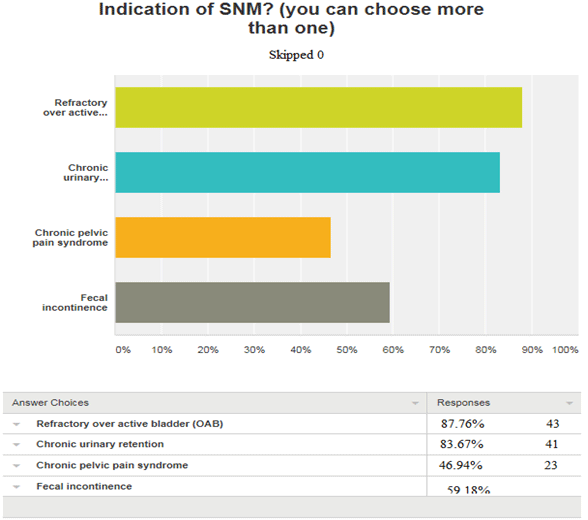

Regarding the side chosen for the screening test, it was found that 71.74% of the responders were performing unilateral sacral nerve stimulation for screening. The location of the wire electrode was guided under fluoroscopy for PNE in 75% of the responders; moreover, fluoroscopy was used for indication of good electrode position by 48.84% implanters. The indication of an appropriate electrode position depended on sensory and motor response for 67.44% and 79.07% of the implanters, respectively.
Local anesthesia with or without sedation was used for electrode implant by most implanters (85.1%), and 34.88% of implanters performed a routine sacral X-ray after PNE.
Most of implanters activated the device immediately after implant, and 47.73% assigned the patient with one program at the start.
A little over half of the responders (56.52%) performed a routine sacral X-ray during the follow-up.
About a quarter of the responders (26.09%) preferred bipolar mode of stimulation, especially in the case of pain at the battery site.
In case of failure of the SNM to produce the desired clinical benefit, almost half of the implanters (46.67%) had to remove the device. In order to manage the patient’s symptoms, other options depended on the indication, and included intravesical Botox injection, anticholinergics, beta agonists, bladder augmentation, percutaneous tibial nerve stimulation, revision of electrode or screening the contralateral side, and pudendal nerve stimulation.
Preoperative evaluation was variable between the implanters. Clinical assessment, including history and physical examination, should be done for every patient. Other tests used by the implanters before SNM implant included cystoscopy, uroflowmetry, an urodynamic study, and sacral X-ray, with no evidence supporting their approach.
Infection of the device is an uncommon (6.1%) complication [14]. To decrease the risk of infection, implanters who used different types of prophylactic antibiotics most commonly used cephalosporine (84.78%), either one dose or multiple doses, for 1-14 days. Most of the implanters gave one dose of prophylactic antibiotic (73.91%). Also, the surgical site preparation differed between implanters. While some implanters asked the patients to take a shower before surgery, others performed washing with diluted povidone, or a preparation using a povidone or a chlorhexidine-based solution.
Unilateral stage implant is the most commonly used approach for screening. PNE was described as a blind procedure, but 75% of the implanters in this survey were performing it under fluoroscopic guidance.
Implantation of the electrode varied between the implanters. Sensory, levator ani and foot/big toe movement were used to indicate an appropriate electrode position. Number of electrodes per stimulation at stage implant did not make a difference in the outcome, despite a higher voltage needed for a < 4 electrode stimulation [15]. Most of the implanters in this survey consider a 2-4 electrode position as being required for a good position. Most of the implanters tried to implant the electrode in the upper medial aspect of S3 foramen. Although usage of a curved stylet may increase the battery life, it is only being utilized by 36.17% of the responders [16].
Most of the implanters initiated the activation the device immediately after the implant, and half of the implanters did a routine sacral X-ray, although it is usually unhelpful. In a postoperative follow-up, implanters have to evaluate the patients’ symptoms, wound healing, and do programming if needed [17].
If the patient experiences pain at the battery site, choosing bipolar is an appropriate initial step. The options to manage battery site pain include program manipulation to bipolar, daily oral analgesic, local analgesia injection, battery relocation, referral to pain clinic, and removal of the device [18].
Salvage treatment can be done with or without SNM, including oral medication (anticholenergic, beta 3 agonist), intravesical Botox injection, percutaneous tibial nerve stimulation, unilateral or contralateral revision of electrode, and pudendal nerve stimulation or bladder augmentation [19].
The strength of this survey that it was distributed to SNM implanters worldwide through ICS and covers all major aspects of SMN implantation. We are aware of some limitation in this study, small number of responders, few responders skipped some questions, and the demographic summary was not reported in this presentation.
As evidenced by the discrepancy in the responses, we think that this is the initial step in the preparation for a guideline describing the best policy to deliver the SNM.
- Thompson JH, Sutherland SE, Siegel SW. Siegel. Sacral neuromodulation: Indian J Urol. 2010;26(3):379-384. doi: 10.4103/0970-1591.70576
- Health Quality Ontario. Sacral nerve stimulation for urinary urge incontinence, urgency-frequency, urinary retention, and fecal incontinence: an evidence-based analysis. Ont Health Technol Assess Ser. 2005;5(3):1-64.
- Siegel S, Noblett K, Mangel J, Griebling TL, Sutherland SE, Bird ET, et al. Results of a prospective, randomized, multicenter study evaluating sacral neuromodulation with InterStim therapy compared to standard medical therapy at 6-months in subjects with mild symptoms of overactive bladder. Neurourol Urodyn. 2015;34(3):224-230. doi: 10.1002/nau.22544
- Medtronic-sponsored research. InterStim Therapy Clinical Summary 2014.
- Siegel SW, Moeller SE. Sacral Neuromodulation for the Treatment of Overactive Bladder (OAB) In: Raz S, Rodriquez L, editors. Female Urology. 3rd ed. Philadelphia: WB Saunders Company; 2008. pp. 266–76. Ch. 22.
- Sutherland SE, Siegel SW. Sacral nerve stimulation for overactive bladder symptoms. In: Kreder K, Dmochowski R, editors. The Overactive Bladder Evaluation and Management. London: Informa HealthCare; 2007. pp. 303–18. Ch 26.
- Schmidt RA, Jonas U, Oleson KA, Janknegt RA, Hassouna MM, Siegel SW, et al. Sacral nerve stimulation for treatment of refractory urinary urge incontinence. Sacral Nerve Stimulation Study Group J Urol. 1999;162(2):352-357.
- Hassouna MM, Siegel SW, Nÿeholt AA, Elhilali MM, van Kerrebroeck PE, Das AK, et al. Sacral neuromodulation in the treatment of urgency-frequency symptoms: a multicenter study on efficacy and safety. J Urol. 2000;163(6):1849-1854.
- Jonas U, Fowler CJ, Chancellor MB, Elhilali MM, Fall M, Gajewski JB, et al. Efficacy of sacral nerve stimulation for urinary retention: results 18 months after implantation. J Urol. 2001;165(1):15-19.
- Pettit PD, Thompson JR, Chen AH. Sacral neuromodulation: new applications in the treatment of female pelvic floor dysfunction. Curr Opin Obstet Gynecol. 2002;14(5):521-255.
- Seif C, Eckermann J, Bross S, et al. Findings with bilateral sacral neuromodulation. Neuromodulation.2004;7:141–145.
- Maher CF, Carey MP, Dwyer PL, Schluter PL. Percutaneous sacral nerve root neuromodulation for intractable interstitial cystitis. J Urol. 2001;165(3):884-846.
- Whitmore KE, Payne CK, Diokno AC, Lukban JC. Sacral neuromodulation in patients with interstitial cystitis: a multicenter clinical trial. Int Urogynecol J Pelvic Floor Dysfunct. 2003;14(5):305-308. doi: 10.1007/s00192-003-1080-1
- Siegel SW, Catanzaro F, Dijkema HE, Elhilali MM, Fowler CJ, Gajewski JB, et al. Long-term results of a multicenter study on sacral nerve stimulation for treatment of urinary urge incontinence, urgency-frequency, and retention. Urology. 2000;56(6 Suppl 1):87-91.
- Gilleran JP, Killinger K, Boura J, Peters KM. Number of active electrodes at time of staged tined lead interstim implant does not impact clinical outcomes. Neurourol Urodyn. 2016;35(5):625-629. doi: 10.1002/nau.22766
- Jacobs SA, Lane FL, Osann KE, Noblett KL. Randomized prospective crossover study of interstim lead wire placement with curved versus straight stylet. Neurourol Urodyn. 2014;33(5):488-492. doi: 10.1002/nau.22437
- Gaynor-Krupnick DM, Dwyer NT, Rittenmeyer H, Kreder KJ. Evaluation and management of malfunctioning sacral neuromodulator. Urology. 2006;67(2):246-249. doi: 10.1016/j.urology.2005.08.055
- Brazzelli M, Murray A, Fraser C. Efficacy and safety of sacral nerve stimulation for urinary urge incontinence: a systematic review. J Urol. 2006;175(3 Pt 1):835-841. doi:10.1016/S0022-5347(05)00326-5
- Truzzi JC, Gomes CM, Bezerra CA, Plata IM, Campos J, Garrido GL, et al. Int Braz J Urol. 2016;42(2):199-214. doi: 10.1590/S1677-5538.IBJU.2015.0367

