


Case Report
Open Access
Development of Drug-Induced Cutaneous Vasculitis in a Patient
with Relapsed Angioimmunoblastic T-cell Lymphoma Treated
with Novel Bortezomib and Panobinostat Combination: A
Possible Surrogate Marker of Response
Yuh Shan Lee1, Leonard Tan2, Choon Chiat Oh3, Yuen Li Ng4, Yeow Tee Goh1 and Daryl Tan1*
1
Department of Hematology, Singapore General Hospital, Singapore
2Department of Pathology, Singapore General Hospital, Singapore
3Department of Dermatology, Singapore General Hospital, Singapore
4Department of Radiology, Singapore General Hospital, Singapore
*Corresponding author: Daryl Tan, Department of Hematology, Academia, level 3 Singapore General Hospital, College Road, Singapore 169856, Republic
of Singapore, Fax : 65-62250210 ; E-mail:
@
Received: April 08, 2014; Accepted: June 09, 2014;; Published: June15, 2014
Citation: Lee YS, Tan L, Oh CC, Ng YL, Goh YT, Tan D (2014) Development of Drug-Induced Cutaneous Vasculitis in a Patient
with Relapsed Angioimmunoblastic T-cell Lymphoma Treated with Novel Bortezomib and Panobinostat Combination: A Possible
Surrogate Marker of Response. Cancer Sci Res Open Access 1(2): 1-4. DOI: http://dx.doi.org/10.15226/csroa.2014.00109
Introduction Top
Relapsed/refractory angioimmunoblastic T-cell lymphoma
(AITL) after conventional chemotherapy carries an extremely
poor prognosis, and there is currently no recognized effective
treatment available. There is hence, an unmet need for novel
agents in salvaging patients with relapsed/refractory AITL.
Bortezomib exerts pleotropic anti-tumor effects, including
inhibition of the NF-кB pathway, leading to cell apoptosis
and it has shown promising activity in a variety of lymphoid
malignancies [1-4 ]. Panobinostat, a pan-histone deacetylase
(HDAC) inhibitor which targets epigenetic and multiple oncogenic
pathways has demonstrated potent anti-tumour activity in a
variety of malignancies, including T‑cell lymphoma [5-6]. In
vitro and in vivo studies have demonstrated potent synergistic
cytotoxicity of the combination of bortezomib with panobinostat.
Inhibition of HDAC6 by panobinostat abrogates bortezomibinduced
protective aggreosome formation and accentuates
bortezomib induced endoplasmic reticulum stress, leading to
further apoptosis [7-9]. Collectively, these data provide a strong
rationale for the first clinical trial of this novel combination in
T-cell lymphoma.
The development of a vasculitic rash has been reported with the use of bortezomib and this has been associated to portend a favorable response to the drug among patients with B-cell non- Hodgkin lymphoma treated in clinical trials [10]. Among most cases reported, a perivascular leukocytoclastic vasculitis with no evidence of a systemic vasculitis or hypersensitivity reaction was reported. Herein, we report on a patient with relapsed AITL who responded favourably to the above described combination and developing a typical bortezomib-induced rash after 2 cycles of treatment.
The development of a vasculitic rash has been reported with the use of bortezomib and this has been associated to portend a favorable response to the drug among patients with B-cell non- Hodgkin lymphoma treated in clinical trials [10]. Among most cases reported, a perivascular leukocytoclastic vasculitis with no evidence of a systemic vasculitis or hypersensitivity reaction was reported. Herein, we report on a patient with relapsed AITL who responded favourably to the above described combination and developing a typical bortezomib-induced rash after 2 cycles of treatment.
Case Report Top
A 50 year old male presented with fever, tonsillar enlargement and cervical lymphadenopathy of 1 month duration.
A lymph node biopsy done revealed the presence of a neoplastic
T-lymphocytic infiltrate which stained positively for CD3, CD2
and CD7, but weakly for CD5. The association with proliferation
of high endothelial venules, eosinophilia and CD21 marking
the expanded but disrupted follicular dendritic cell meshwork
confirmed the diagnosis AITL. A staging positron emission
tomography (PET) scan and bone marrow trephine biopsy
demonstrated extensive FDG avid lymphadenopathy above and
below the diaphragm, and the absence of marrow involvement
by lymphoma respectively. He was commenced on 21-day CHOP
(cyclophosphamide, adriamycin, vincristine, prednisolone)
chemotherapy for treatment of the stage IIIB AITL. He attained a
PET complete response after 4 cycles of CHOP chemotherapy. The
response was consolidated with 2 cycles and ICE (ifosfamide,
cyclophosphamide and etoposide) regimen, followed by high dose
therapy (HDT) with BEAM (carmustine, etoposide, cytarabine
and melphalan) conditioning and autologous stem cell support.
His response was however, short-lived and 6 months post-HDT, he
had a biopsy-proven relapse with involvement of supra and infradiaphramatic
lymph nodes, including the cervical and inguinal
regions (Figures 1a and 2a). This was also accompanied by bone
marrow disease and peripheral blood hypereosinophilia. He was
subsequently enrolled into clinical trial NCT00901147 which
explores the combination of bortezomib (1.3 mg/m2 on days 1,
4, 8, 11) and panobinostat 20mg (3 times per week for 2 weeks)
given in a 21-day cycle in relapsed/refractory T-cell lymphoma.
Upon completion of the second cycle of the study combination,
he developed scattered erythematous papular rash localised to
the neck, upper trunk and forearms which were mildly pruritic
(Figure 3).He did not have fever, prurisy and autoimmune
manifestation. A skin biopsy performed on the lesion over his right
forearm demonstrated perivascular lymphoid infiltrates with
dyskeratosis of overlying epidermal keratinocytes, consistent

Figure 1: Post therapy.
* White arrows show submental lymph nodes at baseline and after completion of treatment.
Figures 1a and 1b: Axial CT neck; (a) shows submental lymphadenopathy which significantly improved on the post therapy CT (b).
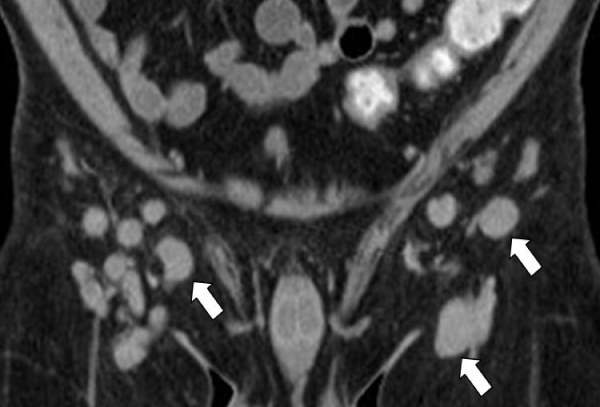
Figure 2: Coronal CT pelvis; (a) shows bilateral inguinal lymphadenopathy (the arrows indicating the 3 largest nodes), which significantly
improved on the post-therapy CT (b).
* White arrows show the inguinal lymph nodes at baseline and after completion of treatment.
Figure 3:

Figure 3: Skin lesions of patient with bortezomib induced rash. Skin lesions of patient with bortezomib induced rash
with a non-necrotizing cutaneous vasculitis (Figure 4). There was
no evidence of lymphoma infiltration or hypersensitivity reaction.
The peripheral hypereosinophilia resolved upon commencement
of the study drugs. An interim computed tomography (CT)
scan done at this juncture demonstrated a partial response by
Cheson criteria, with significant interval reduction in size of the
lymphadenopathy (Figures 1b, 2b). The rash was self- limiting
and resolved spontaneously. A milder eruption of a similar rash occurred with the subsequent administration of the study drugs.
The patient continues to respond further.
DiscussionTop
The causal association of the rash with bortezomib is apparent
by the pattern of resolving and recurring rash following cessation
and re-introduction of the drug. Development of a rash has not
been commonly described as an adverse event with the use of

Figure4:Skin biopsy of patient from right forearm.
* Black arrows showing perivascular lymphoid infiltrates in skin biopsy
* Black arrows showing perivascular lymphoid infiltrates in skin biopsy
panobinostat [6]. There was no evidence of a hypersensitivity
reaction and on the contrary, the commencement of the novel
combination suppressed the peripheral blood hypereosinophilia,
a surrogate of disease activity in AITL. In addition, the skin
biopsy excluded the possibility of lymphomatous involvement
of the skin, a common occurrence with AITL. To the best of our
knowledge, this is the first reported case of bortzomib-induced
rash occurring in T-cell non-Hodgkin lymphoma. The first
reports of bortezomib-induced rash were among bortezomibtreated
patients with multiple myeloma, with reported incidence
in clinical trials ranging from 8 to 18% [11-13]. In myeloma,
the correlation between rash and response to treatment could
not be further ascertained because glucocorticoids, an integral
component of myeloma therapy could dampen the immune
response in patients. Although the exact pathogenesis of the rash
is unknown, it is likely to be immune-mediated as cutaneous
vasculitis is seen in autoimmune condition such as ulcerative
colitis. Kim et al. [14] suggest that the pathogenesis of the rash
may be related to the overproduction of pro-inflammatory
cytokines such as IL-6 and TNF-a. Similar cytokines are also
proposed to be the pathogenesis behind bortezomib induced
lung injury [15]. Maruyama et al. [16] suggest that the origin of
cytokines in bortezomib-treated patient is from bone marrow
stromal cells.
Based on results of 3 phase II studies on bortezomib in patients with B-cell non-Hodgkin lymphoma, Gerecitano and colleagues were able to demonstrate a statistically significant positive predictability of response to bortezomib among patients developing the rash, prompting the current recommendation that therapy with bortezomib should not be discontinued in such patients, but rather, continued treatment through the rash with symptomatic relief is to be encouraged [10].
Despite AITL being associated with a dismal median overall survival of less than 3 years, the optimal therapeutic approach for AITL is still unknown as various strategies including intensive chemotherapeutic combinations and stem cell transplantation have not significantly improved survival outcomes. Clearly, novel approaches exploring synergistic combinations are needed. Published work now suggests that targeting both proteasomedependent pathways with bortezomib and the aggresome pathway in tumour cells with HDAC inhibitors induces greater accumulation of polyubiquitinated proteins resulting in increased cell stress and apoptosis [7-9]. Both bortezomib and panobinostat have modest single-agent activity in T-cell lymphoma. The clinical combination of both drugs will help determine if the abundant preclinical data of proteasome inhibitor/HDAC inhibitor synergism could translate into improved clinical outcomes for patients with T-cell lymphoma. This novel treatment combination for AITL is promising and results of our trial in the future will hopefully fill the emergent need for improved treatment strategies in these patients.
Based on results of 3 phase II studies on bortezomib in patients with B-cell non-Hodgkin lymphoma, Gerecitano and colleagues were able to demonstrate a statistically significant positive predictability of response to bortezomib among patients developing the rash, prompting the current recommendation that therapy with bortezomib should not be discontinued in such patients, but rather, continued treatment through the rash with symptomatic relief is to be encouraged [10].
Despite AITL being associated with a dismal median overall survival of less than 3 years, the optimal therapeutic approach for AITL is still unknown as various strategies including intensive chemotherapeutic combinations and stem cell transplantation have not significantly improved survival outcomes. Clearly, novel approaches exploring synergistic combinations are needed. Published work now suggests that targeting both proteasomedependent pathways with bortezomib and the aggresome pathway in tumour cells with HDAC inhibitors induces greater accumulation of polyubiquitinated proteins resulting in increased cell stress and apoptosis [7-9]. Both bortezomib and panobinostat have modest single-agent activity in T-cell lymphoma. The clinical combination of both drugs will help determine if the abundant preclinical data of proteasome inhibitor/HDAC inhibitor synergism could translate into improved clinical outcomes for patients with T-cell lymphoma. This novel treatment combination for AITL is promising and results of our trial in the future will hopefully fill the emergent need for improved treatment strategies in these patients.
ReferencesTop
- O’Connor OA, Wright J, Moskowitz C, Muzzy J, MacGregor-Cortelli B, Stubblefield M, et al. Phase II clinical experience with the novel proteasome inhibitor bortezomib in patients with indolent non- Hodgkin’s lymphoma and mantle cell lymphoma. J Clin Oncol. 2005; 23(4):676-684.
- Cavo M, Tacchetti P, Patriarca F, Petrucci MT, Pantani L, Galli M, et al. Bortezomib with thalidomide plus dexamethasone compared with thalidomide plus dexamethasone as induction therapy before, and consolidation therapy after, double autologous stem-cell transplantation in newly diagnosed multiple myeloma: a randomised phase 3 study. Lancet. 2010; 376(9758):2075-2085. doi: 10.1016/ S0140-6736(10)61424-9.
- Harousseau JL, Attal M, Avet-Loiseau H, Marit G, Caillot D, Mohty M, et al. Bortezomib plus dexamethasone is superior to vincristine plus doxorubicin plus dexamethasone as induction treatment prior to
- San Miguel JF, Schlag R, Khuageva NK, Meletios A. Dimopoulos, Ofer Shpilberg, Martin Kropff, et al. Bortezomib plus melphalan and prednisone for initial treatment of multiple myeloma. N Engl J Med. 2008; 359:906–917. doi: 10.1056/NEJMoa0801479.
- Ellis L, Pan Y, Smyth GK, George DJ, McCormack C, Williams-Truax R, et al. Histone deacetylase inhibitor panobinostat induces clinical responses with associated alterations in gene expression profiles in cutaneous T-cell lymphoma. ClinCancer Res. 2008; 14(14):4500– 4510. doi: 10.1158/1078-0432.
- Ottmann OG, Spencer A, Prince HM, H. Miles Prince, Bhalla K.N, Fischer T, et al. Phase IA/II study of oral panobinostat (LBH589), a Novel Pan-Deacetylase Inhibitor (DACi) Demonstrating Efficacy in Patients with Advanced Hematologic Malignancies. Blood. 2008; 112: Abstract 958.
- Hideshima T, Bradner JE, Wong J, Chauhan D, Richardson P, Schreiber SL, et al. Small-molecule inhibition of proteasome and aggresome function induces synergistic antitumor activity in multiple myeloma. Proc Natl Acad Sci. USA. 2005; 102:8567–8572.
- Catley L, Weisberg E, Kiziltepe T, Tai YT, Hideshima T, Neri P, et al. Aggresome induction by proteasome inhibitor bortezomib and alphatubulin hyperacetylation by tubulin deacetylase (TDAC) inhibitor LBH589 are synergistic in myeloma cells. Blood. 2006; 108(10):3441– 3449. doi: 10.1182/blood-2006-04-016055.
- Bhalla S, David K, Mauro L, Prachand S, Sirisawad M, Balasubramanian S, et al. Histone Deacetylase Inhibitor (HDACi) PCI-24781 and Bortezomib Result in Synergistic Apoptosis in Hodgkin Lymphoma (HL) and Non-Hodgkin’s Lymphoma (NHL) Cell Lines: Investigation of Cell Death and NFKB-Mediated Pathways. Blood. 2007; 110: Abstract 3589.
- J Gerecitano, A Goy, J Wright, MacGregor-Cortelli B, Neylon E, Gonen M, et al. Drug-induced cutaneous vasculitis in patients with non- Hodgkin lymphoma treated with the novel proteasome inhibitor bortezomib: a possible surrogate marker of response? Br J Haematol. 2006; 134(4):391–398.
- Richardson PG, Sonneveld P, Schuster MW, Irwin D, Stadtmauer EA, Facon T, et al. Assessment of Proteasome Inhibition for Extending Remissions (APEX) Investigators. Bortezomib or high-dose dexamethasone for relapsed multiple myeloma. N Engl J Med. 2005; 352(24):2487-2498.
- Wu KL, van Wieringen W, Vellenga E, Zweegman S, Lokhorst HM, Sonneveld P. Analysis of the efficacy and toxicity of bortezomib for treatment of relapsed or refractory multiple myeloma in community practice. Haematologica. 2005; 90(7):996-997.
- Richardson PG, Barlogie B, Berenson J, Singhal S, Jagannath S, Irwin D, et al. A phase 2 study of bortezomib in relapsed, refractory myeloma. N Engl J Med. 2003; 348(26):2609-2617.
- Min C-K, Lee S, Kim Y-J, Eom KS, Lee JW, Min WS, et al. Cutaneous leucoclastic vasculitis (LV) following bortezomib therapy in a myeloma patient; association with pro-inflammatory cytokines. Eur J Haematol. 2006;76(3):265–268.
- Kazutake Y, Harumi Y.M, Michiko M, Makiko Miyao,Yoshimasa Ogawa, Kazuma Ohyashik, et al. Bortezomib therapy-related lung disease in Japanese patients with multiple myeloma: Incidence, mortality and clinical characterization. Cancer Science. 2014; 105(2):195-201. doi: 10.1111/cas.12335.
- Maruyama D, Watanabe T, Heike Y, Nagase K, Takahashi N, Yamasaki S, et al. Stromal cells in bone marrow play important roles in proinflammatory cytokine secretion causing fever following bortezomib administration in patients with multiple myeloma. Int J Hematol. 2008; 88(4):396-402. doi: 10.1007/s12185-008-0194-0.

