


Keywords: Myodocopa; Oceanic; Mesozooplankton; OMZ; Zoogeography; Halocyprida; Cypridina;
Conversely during the Northeast Monsoon (December to February) the winds are light and are blow in a direction that is unfavourable for coastal upwelling. Sea surface temperatures warm and the ecosystem in the wind-mixed become oligotrophic. Evaporation rates are high and keep the sea surface temperatures relatively cool. The neighbouring land is very arid and in the absence of rainfall and freshwater run-off sea surface salinities increase, so the density of the surface waters increases so that they sink (Naqvi, et al., 2003). This sinking of the surface waters lowers the base of the oxygen minimum zone (OMZ) to around 1000 m (Morrison et al., 1999).
Prior to 1990 the little that was known about the deep pelagic fauna of the Arabian Sea was mainly based on the transits of the early exploratory oceanographic voyages, such as by the Tiefsee and the Dana. The existence of the OMZ was only recognized during the John Murray Expedition (1933–1934), and report series of this expedition includes a short paper on the handful of planktonic ostracod species collected (Cannon, 1940). Further data on the ostracods was published by George (1969) in a preliminary analysis of the plankton samples collected during the International Indian Ocean Expedition (1959–1965) (IIOE). The IIOE was a multi-vessel expedition during which the biological sampling was extensive geographically and seasonally, but was mostly restricted to sampling the upper 200 m. George’s (1969) summarised data from 1223 standardised samples collected in vertical hauls of the Indian Ocean Standard Net (0.32mm mesh) from 200-0m. George reported that in the North Arabian Sea abundances of halocyprid ostracods peaked during the Northeast monsoon. Leveau (1967) also reported on a collection of halocypids from the Arabian Sea, and there have been a few follow-up studies of the halocyprids (James, 1975, George and Nair 1980, Nair and Madhupratap, 1984). Information about the region’s planktonic ostracod assemblages remained sparse until Drapun and Smith (2012) published their excellent monograph summarising the halocyprid results from the 1995 JGOFS Indian Ocean Experiment (Smith and Madhuptratap, 2005). Their sampling using a MOC1 sampler was limited to the upper 1000m, but their geographical coverage was extensive.
In 1994 a study of the cross-slope relationships between the biological populations in the euphotic zone and the oxygen minimum zone off the coast of Oman was undertaken during the Southwest Monsoon (Herring et al., 1998). Detailed observations were made on the vertical distributions of micronektonic species at three cross-shelf stations close to 19°N 59°E, and the sampling was supplemented with profiles of backscatter intensity from an Acoustic Doppler Current Profiler (ADCP) (Roe et al., 1996). This samplng revealed exceptionally large, but species-poor populations of micronekton (fish, decapods and euphausiids). Many of the micronektonic species were undertaking diel migrations moving from daytime depths within the OMZ up into the epipelagic zone to feed at night (Herring et al., 1998). At the time there were large swarms of the predatory swimming crab Charybdis smithii (Van Couwelaar, et al., 1997); the crabs were entirely restricted to the upper well-oxygenated waters in the wind-mixed layer. The ADCP surveys revealed strong acoustic backscatter from within the OZM during the day, but at night it became totally devoid of sound-scatterers. All of the back scatterers had migrated up into the wind-mixed layer above 70 m (see figure 13 in Herring et al., 1998). Unfortunately during this cruise, heavy seas and technical problems with the nets prevented complete sampling of mesozooplankton profiles
In 1997 during the “Scheherazade” cruise aboard the RRS Charles Darwin (Herring et al, 1999), another attempt was made to characterise the mesoplanktonic populations and biological processes during the post-upwelling regime of the Northeast Monsoon in the Gulf of Oman. The cruise had the two main aims -
1.To describe quantitatively and qualitatively the structure of the pelagic assemblages.
2.To assess the impact of the OMZ has on the pelagic assemblages and their diel vertical migrations.
In this paper we report on the data gathered for the halocyprid ostracods, on how the changes in total ostracod abundances are related to the gradients of the physico-chemical parameters, and how the species composition of the assemblages change with depth. Comparisons are made between similar bathymetric profiles of planktonic ostracods from comparable latitude in the Northeast Atlantic, which demonstrates the severity of the restrictions the OMZ poses on the ostracod populations.

The sampling protocol was to subdivide the upper 200m of the water column into 50m depth horizons and from 200–1200 m into 100m horizons, and below 1200 m into 200 m horizons. Most tows were of one hour duration, during which approximately 2500 m3 of water would have been filtered. However, since the daytime sample in the upper 150m were so massive, the durations of the night time tows were reduced to 30 minutes. Below 1200 m the tow durations were increased to two hours.
The samples were initially preserved in buffered 5% seawater formalin for 24 h, before being transferred into Steadman’s preserving fluid (0.5% propylene phenoxetol, 4.5% propylene glycol, 5%formalin seawater solution) for long term storage. Several months later the samples were transferred to the Natural History Museum, London, where prior to sorting the Steadman’s preserving fluid was replaced with 80% industrial methylated ethanol.
The halocyprids were generally sorted from the complete samples under a stereoscopic microscope. After the night sample from 150-100m yielded over 19,000 individuals, the remaining shallow samples were subsampled using a Folsom splitter. Identifications were made using a Wild M5 stereomicroscope at x50 magnification. Each species was separated into males, females and juvenile instars, before being counted and measured.
Depth range(m) |
Mean salinity(‰) |
Mean Temperature(°C) |
Mean oxygen concentration (ml.l-1) |
0-50 |
36.48 |
23.14 |
204.4 |
50-100 |
36.29 |
21.89 |
117.3 |
100-150 |
36.03 |
19.43 |
3.3 |
150-200 |
36.11 |
18.45 |
2.5 |
200-300 |
36.23 |
17.04 |
2.8 |
300-400 |
36.16 |
15.27 |
2.7 |
400-500 |
35.92 |
13.61 |
1.5 |
500-600 |
35.74 |
12.33 |
1.9 |
600-700 |
35.66 |
11.53 |
3.1 |
700-800 |
35.60 |
10.78 |
5.2 |
800-900 |
35.54 |
10.05 |
6.5 |
900-1000 |
35.47 |
9.28 |
7.6 |
1000-1100 |
35.39 |
8.49 |
8.9 |
1100-1200 |
35.30 |
7.70 |
11.4 |
1200-1400 |
35.18 |
6.58 |
19.6 |
1400-1600 |
35.07 |
5.41 |
35.5 |
1600-1800 |
34.95 |
4.13 |
58.8 |
1800-2000 |
34.88 |
3.31 |
76.7 |

Day
Haul number |
Depth (m) |
Water |
Fraction |
Number |
Total in |
Number/ |
% of total |
#27 |
0-50 |
1279* |
½ |
1345 |
2690 |
2103 |
8 |
#26 |
50-100 |
1172* |
¼ |
2244 |
8976 |
7659 |
29 |
#25 |
100-150 |
1276* |
⅛ |
1689 |
13512 |
10589 |
40.1 |
#03 |
150-200 |
2589 |
1 |
12608 |
12608 |
4970 |
18.8 |
#02 |
200-300 |
2306 |
1 |
1026 |
1026 |
445 |
3.4 |
#01 |
300-400 |
2449 |
1 |
101 |
101 |
41 |
0.3 |
#15 |
400-500 |
2665 |
1 |
13 |
13 |
5 |
0.03 |
#14 |
500-600 |
2549 |
1 |
13 |
13 |
5 |
0.04 |
#13 |
600-700 |
2486 |
1 |
2 |
2 |
1 |
0.01 |
#12 |
700-800 |
2789 |
1 |
6 |
6 |
2 |
0.02 |
#11 |
800-900 |
2325 |
1 |
9 |
9 |
4 |
0.03 |
#10 |
900-1000 |
2389 |
1 |
95 |
95 |
40 |
0.3 |
#24 |
1000-1100 |
2614 |
1 |
231 |
231 |
88 |
|
#23 |
1100-1200 |
2343 |
1 |
79 |
79 |
34 |
|
#22 |
1220-1400 |
4818† |
1 |
84 |
84 |
17 |
Night
Haul number |
Depth (m) |
Water |
Fraction |
Number |
Total in |
Number |
% of total |
#21 |
0-50 |
2574 |
½ |
3868 |
7736 |
3005 |
13.0 |
#20 |
50-100 |
2307 |
¼ |
5563 |
22252 |
9645 |
41.7 |
#19 |
100-150 |
2575 |
1 |
19425 |
19425 |
7544 |
32.7 |
#06 |
150-200 |
2746 |
1 |
6831 |
6831 |
2488 |
10.8 |
#05 |
200-300 |
2511 |
1 |
23 |
23 |
9 |
0.1 |
#04 |
300-400 |
1647 |
1 |
371 |
371 |
140 |
1.2 |
#18 |
400-500 |
2704 |
1 |
3 |
3 |
1 |
0.01 |
#17 |
500-600 |
2525 |
1 |
3 |
3 |
1 |
0.01 |
#16 |
600-700 |
2644 |
1 |
2 |
2 |
1 |
0.01 |
#09 |
700-800 |
2654 |
1 |
74 |
74 |
28 |
0.2 |
#08 |
800-900 |
2378 |
1 |
43 |
43 |
18 |
0.2 |
#07 |
900-1000 |
2468 |
1 |
29 |
29 |
12 |
0.1 |
#31 |
1400-1600 |
5117† |
1 |
1706 |
1706 |
333 |
|
#30 |
1600-1800 |
4973† |
1 |
1123 |
1123 |
225 |
|
#29 |
1800-2000 |
5253† |
1 |
697 |
697 |
133 |
|
† two hour tow

Table 2 lists the estimated percentages of the total halocyprid population in the upper 1000 m occurring within each sampling stratum. These profiles suggest that there was a slight upward migration at night - the median depth of the halocyprid population in the upper 1000 m rose from 108m by day to 92 m at night. There was a small increase in numbers at 300–400 m at night, suggesting some species may have been undertaking a reverse migration, moving deeper into the OMZ at night.
1 |
Alacia alata (Müller, 1906) |
|
2 |
Archiconchoecia striata Müller,1906 |
|
3 |
Archiconchoecissa cucullata (Brady, 1902) |
|
4 |
Bathyconchoecia georgei (Kornicker and Rudjakov, 2004) † |
|
5 |
Bathyconchoecia n.sp. † |
|
6 |
Clausoecia pusilla (Müller, 1906) |
|
7 |
Conchoecetta giesbrechti (Müller, 1906) |
|
8 |
Conchoecia hyalophyllum Claus, 1890* |
|
9 |
Conchoecia n. sp. † |
|
10 |
Conchoecissa plinthina (Müller, 1906) |
|
11 |
Conchoeciisa symmetrica (Müller, 1906) |
|
11 |
Deeveyoecia arcuata (Deevey, 1978) † |
|
13 |
Discoconchoecia aff. elegans (Sars, 1866) |
|
14 |
Euconchoecia hormuzensis Graves, 2011* |
|
15 |
Euconchoecia omanensis Graves, 2011* |
|
16 |
Fellia dispar (Müller, 1906) † |
|
17 |
Gaussicia subedentata (Gooday, 1976)* |
|
18 |
Halocypretta striata (Müller, 1906) † |
|
19 |
Loricoecia ctenophora (Müller, 1906)* |
|
20 |
Loricoecia aff. acutimarginata (Chavtur, 1977) † |
|
21 |
Macroconchoecia macroreticulata (Ellis, 1984) † |
|
22 |
Metaconchoecia acuta (Gooday, 1981) * |
|
23 |
Mamilloecia indica (Graves, 2012) * |
|
24 |
Metaconchoecia inflata (Gooday, 1981) * |
|
25 |
Metaconchoecia subinflata (Gooday, 1981) * |
|
26 |
Mikroconchoecia acuticosta (Müller, 1906) * |
|
27 |
Mikroconchoecia stigmatica (Müller, 1906) |
|
28 |
Mollicia minki Poulsen, 1973 † |
|
29 |
Muelleroecia macromma (Müller, 1906) |
|
30 |
Muelleroecia glandulosa (Müller, 1906) † |
|
31 |
Orthoconchoecia atlantica (Lubbock, 1856) |
|
32 |
Paraconchoecia cophopyga (Müller, 1906) |
|
33 |
Paraconchoecia oblonga (Müller, 1906) form A |
|
34 |
Paraconchoecia oblonga (Müller, 1906) form B |
|
35 |
Paramollicia dichotoma (Müller, 1906) |
|
36 |
Paramollicia distans (Müller, 1906) † |
|
37 |
Porroecia parthenoda (Müller, 1906) |
|
38 |
Porroecia porrecta (Claus, 1980) |
|
39 |
Proceroecia brachyaskos (Müller, 1906) |
|
40 |
Paraconchoecia decipiens Müller, 1906) |
|
41 |
Proceroecia procera (Müller, 1894) |
|
42 |
Pseudoconchoecia concentrica (Müller, 1906) |
|
Myodocopa |
||
43 |
Cypridina aff. dentata (Müller, 1906) * |
|
|
Euconchoecia omanensis |
Porroecia porrecta |
Cypridina aff. dentata |
Proceroecia procera |
Discoconchoecia aff. elegans |
Metaconchoecia acuta |
Archiconchoecia striata |
Metaconchoecia subinflata |
Conchoecetta giesbrechti |
Pseudoconchoecia concentric |
Euconchoecia hormuzensis |
Paraconchoecia oblonga |
Proceroecia decipiens |
Metaconchoecia inflata |
Orthoconchoecia atlantica |
Alacia alata |
Mikroconchoecia acuticosta |
Gaussicia subedentata |
Conchoecissa plinthina |
Conchoecissa symmetrica |
Muelleroecia macromma |
Deeveyoecia arcuata |
Paraconchoecia cophopyga |
Macroconchoecia macroreticulata |
Paramollicia distans |
Mamilloecia indica |
Proceroecia brachyaskos |
0-50 |
136 335 1279 |
32.9 12.5 196 |
82.9 |
15.6 7.8 9.4 |
4.7 6.3 21.9 |
4.7 1.6 17.2 |
11.0
|
1.6 1.6 1.6 |
- 1.6 3.1 |
- - 3.1 |
|
|
|
|
|
|
|
|
|
|
|
|
|
|
|
|
|
50-100 |
670 1532 3143 |
526 444 560 |
734 |
120 205 34.1 |
6.8 6.8 51.2 |
3.4 10.2 3.4 |
17.1 3.4 |
- 17.1 10.2 |
3.4 - 6.8 |
71.7 61.4 130 |
6.0 |
3.4 |
|
|
|
|
|
|
|
|
|
|
|
|
|
|
|
100-150 |
12.5 31.4 75.2 |
6.3 43.9 75.2 |
4897 |
784 345 144 |
583 339 2978 |
552 1016 1015 |
1285 |
|
81.5 100 1072 |
6.3 12.5 25.1 |
|
|
- 6.3 |
- - |
|
|
|
|
|
|
|
|
|
|
|
|
|
150-200 |
7.3 3.1 2.7 |
0.8 |
0.8 |
0.4 24.7 |
1679 465 2231 |
13.1 21.2 28.6 |
43.3 |
|
14.7 7.7 317 |
- - 0.4 |
|
|
3.5 - |
2.7 2.3 0.8 |
0.8 |
- - 0.4 |
|
|
|
|
|
|
|
|
|
|
|
200-300 |
0.9 0.4 0.9 |
0.4 - 0.4 |
0.9 |
0.9 - |
5.2 1.7 8.7 |
|
|
|
12.1 13.4 95.4 |
0.4 0.4 |
|
|
|
113 54.6 134 |
|
- - 0.9 |
|
|
|
|
|
|
|
|
|
|
|
300-400 |
2.5
|
- - 1.6 |
4.5 |
- 0.8 0.4 |
1.2 0.8 2.5 |
|
|
|
7.4 1.2 0.4 |
|
|
|
|
8.6 3.7 9.0 |
|
- - 1.2 |
|
|
|
|
|
|
|
|
|
|
|
400-500 |
0.4 |
0.4 0.4 |
1.1 |
- - 0.4 |
|
|
|
|
1.9 |
|
|
|
|
1.1 - 0.4 |
|
|
|
|
|
|
|
|
|
|
|
|
|
500-600 |
- 0.4 0.8 |
- 0.4 0.8 |
1.6 |
|
0.8 |
- 0.4 - |
|
|
0.4 - 0.4 |
|
|
|
|
- 0.4 0.4 |
|
|
|
|
|
|
|
|
|
|
|
|
|
600-700 |
- 0.4 |
|
0.8
|
|
|
|
|
|
- - 0.4 |
|
|
|
|
|
|
|
|
|
|
|
|
|
|
|
|
|
|
700-800 |
- - 0.8 |
- - 0.8 |
2.3 |
|
|
|
|
|
|
|
|
|
|
- - 0.8 |
|
|
|
|
|
|
|
|
|
|
|
|
|
800-900 |
- - 1.3 |
|
6.5 |
|
|
|
|
|
|
|
|
|
|
- - 2.6 |
|
|
|
|
|
|
|
|
|
|
|
|
|
900-1000 |
- - - |
|
0.8 |
- 0.4 - |
5.4 1.3 21.8 |
0.8 1.7 0.4 |
|
|
2.5 - 2.1 |
|
|
|
|
0.4 - - |
1.7 - - |
- - 0.8 |
- 0.4 - |
- 0.4 - |
|
|
|
|
|
|
|
|
|
1000-1100 |
1.9 3.1 14.2 |
- 2.3 3.1 |
62.4 |
- 1.2 0.4 |
14.2 5.0 18.0 |
0.8 1.2 - |
0.4 |
3.4 0.4 - |
- - 0.8 |
- 0.4 1.2 |
|
|
|
- 1.5 15.3 |
|
|
- 1.1 - |
|
|
|
|
|
|
|
|
|
|
1100-1200 |
- - - |
- - 4.3 |
67.4
|
- - 2.1 |
- 0.4 2.6 |
|
10.2 |
|
|
|
|
|
|
0.4 0.4 3.8 |
|
|
|
|
|
|
- - 1.3 |
|
|
|
|
|
|
1200-1400 |
|
|
3.3 |
|
0.2 0.2 - |
|
0.2 - - |
- 0.2 - |
1.3 0.6 0.2 |
|
|
|
|
|
- - 5.0 |
|
- - 1.0 |
|
0.4 - 0.8 |
0.2 1.7 1.0 |
- - 0.6 |
0.2 0.2 - |
- 0.4 0.4 |
- 0.2 - |
- 0.8 - |
- - 1.0 |
- 0.2 - |
Depth strata m |
Euconchoecia omanensis |
Discoconchoecia aff. elegans |
Proceroecia procera |
Psuedoconchoecia concentrica |
Porroecia porrecta |
Archiconchoecia striata |
Metaconchoecia acuta |
Metaconchoecia subinflata |
Conchoecetta giesbrechti |
Paraconchoecia decipiens |
Conchoecia hyalophyllum |
Porroecia parthenoda |
Euconchoecia hormuzensis |
Metaconchoecia inflata |
Cypridina aff. dentata |
0- 50 |
573 582 1335 |
163 3.1 137 |
97.9 6.2 1.6 |
24.1 21.8 12.4 |
2.3 2.3 13.2 |
14.0 - - |
4.7 2.3 2.3 |
- 0.8 - |
- - 3.9 |
- - - |
- 0.8 0.8 |
0.8 - - |
- - - |
- - - |
2605 |
50- 100 |
575 704 1522 |
211 20.8 303 |
1564 607 414 |
13.9 22.5 64.2 |
541 477 1905 |
603 - - |
6.9 - - |
23 6.9 - |
1.7 5.2 1.7 |
12.1 5.2 - |
- - 2.8 |
- - - |
17.8 15.6 - |
- - - |
420 |
100-150 |
4.3 2.3 9.3 |
1198 218 1391 |
435 656 111 |
17.9 16.3 36.1 |
157 161 48.2 |
1135 - - |
788 309 376 |
1.6 0.4 0.4 |
116 148 164 |
9.3 14.4 3.9 |
0.4 6.2 2.8 |
1.2 0.8 - |
- - - |
- - - |
45.8 |
150-200 |
1.5 1.1 0.4 |
854 503 832 |
2.6 52 - |
- - - |
- - - |
52.4 - - |
20 16 22 |
- - - |
6.2 4.7 111 |
- - - |
- - - |
- - - |
- - - |
1.5 - - |
2.5 |
200-300 |
- - 0.4 |
0.4 - - |
0.4 - - |
- - - |
- - - |
- - - |
- - - |
- - - |
- - 0.4 |
- - - |
- - - |
- - - |
- - - |
0.4 2.8 4.0 |
1.2 |
300-400 |
1.5 - - |
1.9 0.4 - |
- - 0.4 |
- - - |
0.4 - 0.4 |
0.4 - - |
- - - |
- - - |
2.3 0.4 0.4 |
- - - |
- - - |
- - - |
- - - |
27.2 40.8 61.6 |
3.4 |
400-500 |
- - - |
- - - |
- - - |
- - - |
0.4 - 0.7 |
- - - |
- - - |
- - - |
- - - |
- - - |
- - - |
- - - |
- - - |
- - - |
0.7 |
500-600 |
- - - |
- - 0.4 |
- - 0.4 |
- - - |
- 0.4 - |
- - - |
- - - |
- - - |
- - - |
- - - |
- - - |
- - - |
- - - |
- - 0.4 |
2.4 |
600-700 |
- - 0.4 |
- - - |
- - - |
- - - |
- - - |
- - - |
- - - |
- - - |
- - - |
- - - |
- - - |
- - - |
- - - |
- - 0.4 |
2.3 |
700-800 |
- 0.4 2.6 |
- 0.8 12.4 |
- 1.5 - |
- - - |
- - - |
7.2 - - |
- - - |
- - - |
- - 0.8 |
- - - |
- - - |
- - - |
- - - |
0.8 1.1 0.4 |
4.1 |
800-900 |
1.3 0.8 0.4 |
- - 1.3 |
- 0.4 1.3 |
- - - |
0.4 - 0.8 |
1.3 - - |
- - - |
- - - |
- - 1.3 |
- - - |
- - - |
- - - |
- - - |
- 3.4 5.5 |
0.8 |
900-1000 |
- 0.4 2.4 |
0.8 1.2 2.8 |
- - - |
- - - |
- - - |
0.4 - - |
- - - |
- 2.4 - |
0.8 - 0.4 |
- - - |
- - - |
- - - |
- - - |
- - - |
0.8 |
|
|
|
|
|
|
|
|
|
|
|
|
|
|
|
|
1400-1600 |
0.4 0.4 1.2 |
0.2 1.8 14.3 |
0.4 - - |
0.2 - - |
0.6 - 26.2 |
0.4 - - |
0.8 0.4 0.4 |
- - - |
0.2 0.8 0.8 |
- - - |
- - - |
- - - |
- - - |
0.6 1.4 10.8 |
3.2 |
1600-1800 |
0.4 - 1.2 |
0.2 0.2 3.8 |
- 0.4 - |
- - - |
- - - |
- - - |
- - - |
- - - |
- - - |
- - - |
- - - |
- - - |
- - - |
4.0 0.2 36.2 |
8.4 |
1800-2000 |
- - - |
- 0.2 - |
- - - |
- - - |
- - - |
- - - |
- - - |
- - - |
- - - |
- - - |
- - - |
- - - |
- - - |
2.9 2.9 25.5 |
0.4 |
|
Clausoecia pusilla |
Conchoecia n.sp. |
Mamilloecia indica |
Paraconchoecia cophopyga |
Paramollicai dichotoma |
Proceroecia brachyaskos |
Fellia dispar |
Archiconchoecissa cucullata |
Mikroconchoecia stigmatica |
Conchoecissa plinthina |
Muelleroecia macromma |
Muelleroecia glandulosa |
Halocypretta striata |
Bathyconchoecia n.sp. |
Mollicia minki. |
Loricoecia acutimarginata |
Proceroecia brachyaskos |
Bathyconchoecia georgei |
Loricoecia ctenophora |
1400-1600 |
10.2 11.5 4.3 |
- - 4.3 |
68 30.5 40.1 |
2.0 3.3 3.7 |
3.9 1.6 6.1 |
- 0.2 2.2 |
0.2 2.2 3.3 |
0.2 - - |
1.2 1.6 22.7 |
4.7 4.7 - |
1.2 2.9 3.7 |
- - - |
- - - |
- 0.2 - |
- 0.2 - |
- - - |
- 0.2 2.2 |
0.2 - - |
0.2 - - |
1600-1800 |
1.8 7.6 35.2 |
5.6 3.4 31 |
6.0 7.0 12.3 |
3.4 5.8 10.7 |
0.6 0.2 12.1 |
- - - |
- - - |
- - - |
1.2 2.2 0.6 |
- 0.4 - |
- - - |
13.1 1.0 1.4 |
0.8 3.4 36.2 |
- - 0.2 |
- 0.4 - |
|
- - - |
- - - |
- - - |
1800-2000 |
- - 1.7 |
4.6 2.5 55.4 |
0.2 - 1.3 |
1.3 0.8 2.1 |
- 0.2 1.7 |
- - - |
- - - |
0.2 - - |
1.3 1.3 0.6 |
- - - |
- - - |
4.6 2.3 1.7 |
0.8 1.1 15.6 |
0.4 - 0.4 |
0.6 1.0 0.4 |
|
- - - |
- - - |
- - - |
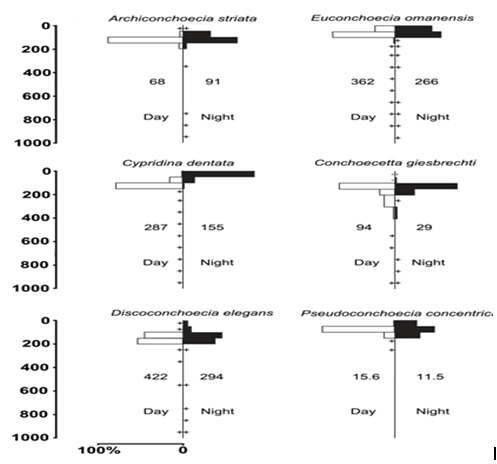
Three of the less abundant species, Euconchoecia hormuzensis, Conchoecia hyalophyllum and Porroecia parthenoda were only encountered at night, and the few specimens of Alacia alata sampled were only caught by day. Peak abundances of four species were at 100–200 m near the top of the OMZ - Discoconchoecia elegans, Archiconchoecia striata, Conchoecia giesbrechti and Metaconchoecia acuta. These species must have either been able to tolerate very low concentrations of oxygen, or were undertaking vertical migrations that were unsynchronised with the light cycle. At depths between 200 and 1000 m Metaconchoecia inflata was the only species that was relatively abundant. It is notable that between 300-1000m where there were very low ostracod abundances, there was a complete absence of any mesopelagic species; large mesopelagic assemblages are a characteristic feature of the ostracod populations in the North Atlantic (Angel et al 2007).
Comparing the profile of oxygen concentration with the profiles of the halocyprid abundances (Table 1 and Figure 2), it can be seen that Euconchoecia omanensis was almost entirely restricted to the well-oxygenated water (Figure 4). Cypridina dentata and Archiconchoecia striata were migrating across the oxycline at ~100m (Figure 4). Several species were restricted to below 100 m where the oxygen concentrations were low i.e. Conchoecetta giesbrechti, Discoconchoecia elegans and the two Metaconchoecia species (Figures 4 and 5). These species occur in much deeper water in the Atlantic, so why, if they are tolerant of such low oxygen conditions, are they absent from deeper water in the Gulf of Oman? This absence of a mesopelagic ostracod assemblage was not characteristic of the copepod populations reported on by Wishner et al. (2008) who showed the copepods were partitioning the whole of the OMZ in the waters outside the Gulf. Predation is unlikely to be the factor limiting the abundances of ostracods, because the micronektonic predators that occupy these depths by the day are not feeding (Herring et al, 1998). A possible fac- tor that cannot be ruled out is that high concentrations of sulphide ions generated by the anaerobic decomposition may have attained levels that are toxic to the halocyprids, but no measurements of sulphide ion concentrations were made.

There are also differences resulting from taxonomic interpretations. Graves (2011) critically examined the Euconchoecia species from these samples describing them as two novel species and showing them to be are distinct from the Atlantic species. This casts doubts on the accuracy of many of the published records of E. chierchiae and E. aculeata certainly from regions outside the Atlantic. Euconchoecia is a taxonomically difficult genus of small species that is in drastic need of revision. Ecologically, it is important genus particularly at low latitudes in the Indo-Pacific, where it is often numerically dominant in inshore plankton assemblages. Drapun and Smith (2012) reported three Euconchoecia species.
Similarly the taxonomy of the genus Cypridina is in a chaotic state (Kornicker, 1991). The species that occurs in the Gulf of Oman has been identified as Cypridina dentata (e.g. Daniel and Jothinayagam 1979), but until the genus has been re-assessed the identity of the species recorded here remains uncertain. Drapun and Smith (2012) did not include it in their study as it is a myodocopid. However, the total number they collected in all their samples was just 25 (Drapun, personal communication). So, either it is predominantly an inshore species, or its swarms are episodic (Daniel and Jothinayagam 1979).
We have recorded only a single species of Discoconchoecia that we have tentatively referred to as D. aff. Elegans. Drapun and Smith (2012) record three species ― D. discophora (Müller, 1906), D. aff. Elegans and D. tamensis (Poulsen, 1973). D. discophora was not present in the Gulf of Oman, but both the other two species may have been present. Poulsen’s (1973) original description of D. tamensis is incomplete and is based on a single male specimen from 7° 46’S 131° 22’W (Poulsen, 1973). Drapun and Smith (2012) provide comprehensive descriptions of their species, but their identification of D. tamensis can only be verified by re-examining the unique type specimen. In the Gulf of Oman the shallow specimens we have identified as D.aff. Elegans match Drapun and Smith’s description of D. tamensis notably in carapace size. The deeper specimens match their description of D. aff. Elegans. The ‘elegans’ species complex is globally widespread but its taxonomy needs to be resolved. Stepien et al., (2015) have recently made an important first step in re-described D. elegans from its type locality near the Lofoten Islands off Norway and high latitudes in the Arctic.
Chavtur and Stovbun (2003) when establishing several sibling species previously ascribed to A, striata, suggested that Archiconchoecia striata sensu George (1979) from the Northwest Indian Ocean, which is the form present in our samples, should be regarded as a novel species.
Graves (2012) described a novel genus and species Mamilloecia indica from the Gulf of Oman. This species that is identical to Paraconchoecia mamillata sensu Drapun and Smith (2012) (see their Figure 48A). Graves (2012) gives a detailed description of Paraconchoecia spinifera, which is the designated type species for the genus and shows that the species in the mamillata are markedly different, and so classifies Conchoecia mamillata sensu Müller 1906 and Conchoecia nanomamillata sensu Deevey and Brooks 1970 in her new genus.
Metaconchoecia is another problematic halocyprid genus. Drapun and Smith (2012) did not attempt to identify their specimens, and the recent revision of Metaconchoecia (Chavtur and Angel, 2011) did not include any species previously reported from the Indian Ocean. Thus our specimens of M. inflata need reevaluation.
Otherwise most of the species recorded by Drapun and Smith (2012) that were absent from our Gulf of Oman samples, belong to the mesopelagic assemblage that was absent from the OMZ in the Gulf of Oman.
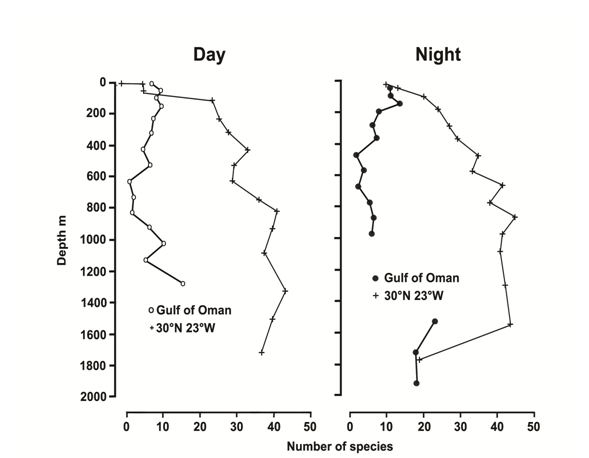
In the Atlantic many halocyprid species undertake diel vertical migration, and very few specimens and/or species are caught in the upper 50 m by day. But at night vertical migrations result in substantial increases in both species richness and abundances of halocyprids. In the Gulf of Oman the near-surface densities of the ostracods were higher by day than by night; so some of the species were undertaking reverse migrations, possibly in response to the large influx of migratory micronektonic predators. There is another possible alternative explanation for the night-time catches being relatively low. The Cypridina species that was so abundant in the upper 100m is brightly luminescent. Its luminescence will have brightly illuminated the net brightly, increasing net avoidance. However, one characteristic of halocyprids is their lack of eyes, but this does not preclude them from having a general sensitivity to light; indeed the fact that several species undertake diel vertical migrations synchronised with the light cycle does imply they have an ability to detect light levels.
There is a marked contrast between the ostracod assemblages in the upper 100 m between the two oceans. In the Gulf, the near-surface assemblage is dominated by species that brood their embryos within the carapace (viz Euconchoecia spp and Cypridina dentata). In the Atlantic all the halocyprids broadcast their eggs freely into the water, and brooders, like the myodocopids, are either absent or rare (although a Euconchoecia species is abundant in the inshore waters along the south-east coast of the North America (Baker, 1975; Baker et al.. 1977)). In the eastern North Atlantic the niche occupied by Euconchoecia species is occupied by Porroecia spinirostris (Claus, 1874), Mikroconchoecia curta (Lubbock, 1860), M. echinulata (Müller 1906), and Halocypris inflata Dana 1849. All four of these species occur in the Indian Ocean outside regions where there is an OMZ (Drapun and Smith (2012).
Figure 6 illustrates the marked contrast between the abundances and species richness of the ostracods between the two oceans. In the North Atlantic abundances and species numbers are very low in the upper 25 m by day, but increase substantially at night as a result of upward migration predominantly from daytime depths of 200–400 m. Whereas in the Gulf of Oman total ostracod abundances were much higher in the upper 200 m, but decreased dramatically in the OMZ below 200 m. Below 1000m the abundances began to increase as the dissolved oxygen levels increased; at the deepest depths sampled the abundances were equivalent to, or maybe began to exceed those in the Atlantic, possibly as a result of higher organic fluxes.
Figure 7 illustrates the striking differences between that the profiles of species richness in the two oceans. In the Atlantic species richness increases steadily with depth and only shows some signs of a decline at the greatest depth sampled, 1500–2000 m. Below the OMZ in the Gulf of Oman species richness showed the first signs of increase below 1200m and at 1800–2000 m had risen to become similar to that in the North Atlantic
Thus, the presence of the strong OMZ results in an impoverished halocyprid fauna in the Gulf of Oman, although the low oxygen concentrations may not have been the only limiting factor. Striking absentees from the Gulf include the large myodocopid species of Gigantocypris and Macrocypridina. Canon (1940) described Gigantocypris dracontovalis from the John Murray Expedition’s collections, but this is a species that is abyssopelagic or benthopelagic in the Atlantic occurring at depths >3000m (Angel 2010).
Elsewhere in the Arabian Sea Wishner et al., (2008) have demonstrated that calanoid copepods partition the OMZ into three zones (300–500 m, 500–700 m and 700–1000 m); But we found no equivalent zonation in our halocyrid data from the Gulf of Oman.

Several novel and poorly-known species were present. There are fewer species in common between the Gulf and the Atlantic faunas than had been expected. The epipelagic ostracod assemblage is dominated by species with females that brood their eggs and early juveniles stages within their carapaces.
- Angel MV. Planktonic ostracods from the Canary Island region: their depth distributions, diurnal migrations, and community organisation. Journal of the Marine Biological Association of the United Kingdom. 1969;49(2):515–553.
- Angel MV. Studies on Atlantic halocyprid ostracods: their vertical distributions and community structure in the central gyre region along latitude 30°N from off Africa to Bermuda. Progress in Oceanography. 1979;8(1-2):3-124.
- Angel MV. The diel migrations and distributions within a mesopelagic community in the North-east Atlantic. 3. Planktonic ostracods, a stable component in the community. Progress in Oceanography. 1984;13(3-4):319–351.
- Angel MV. Towards a full inventory of planktonic Ostracoda (Crustacea) for the subtropical Northwestern Atlantic Ocean. Deep-Sea Research part II. 2010;57(24-26):2173–2188.
- Angel MV. Planktonic ostracods (Myodocopa: Halocyprididae) from abyssopelagic depths in the Atlantic, North Pacific and Gulf of Oman: Chavturia abyssopelagica (n. gen., n. sp.), Halocypretta profunda (n. sp.), Halocypretta parvirostrata Chavtur and Stovbun, 2008 and Halocypretta striata (Müller, 1906). Zootaxa. 2013;3709:401-431.
- Angel MV, Hargreaves P, Kirkpatrick P, Domanski P. Low variability in planktonic and micronektonic populations at 1000m depth in the vicinity of 42°N 17°W; evidence against diel vertical migratory behavior in the majority of species. Biological Oceanography.1982;1(3):287–319.
- Angel MV, Fasham MJR. SOND Cruise 1965: Factor and cluster analyses of the plankton results, a general summary. Journal of the Marine Biological Association of the United Kingdom. 1973;53(1):185–231.
- Angel MV, Fasham MJR. SOND Cruise 1965: Further factor analyses of the plankton data. Journal of the Marine Biological Association of the United Kingdom. 1974;54(04):879–894. doi:10.1017/S0025315400057635
- Angel MV, Fasham MJR. Analysis of the vertical and geographic distribution of the abundant species of planktonic ostracods in the North-east Atlantic. Journal of the Marine Biological Association of the United Kingdom. 1975;55(3): 709–737.
- Angel MV, Blachowiak-Samolyk K, Drapun I, Castillo R. Changes in the composition of planktonic ostracod populations across a range of latitudes in the North-east Atlantic. Progress in Oceanography. 2007;73(1):60–78.
- Baker JH. (1975) Distribution, Ecology and Life Histories of Selected Cypridinacea (Myodocopida, Ostracoda) from the Southern California Mainland Shelf. PhD Thesis, Department of Biology, University of Houston, Houston, Texas.
- Baker JH, Jones TL, Salinas J. Occurrence of Euconchoecia chierchiae Müller 1890 (Ostracoda, Halocyprididae) in Cedar Bayou, Cambers County, Texas. Chesapeake Science. 1977;18(4):394. doi:10.2307/1350597
- Boos WR, Emanuel KA. Annual intensification of the Somali jet in a quasi-equilibrium framework: Observation composites. Quarterly Journal of the Royal Meteorological Society. 2009;135(639):319–335. doi:10.1002/qj.388
- Cannon HG. (1940) Ostracoda. Reports of the John Murray Expedition 1933–1934, 6, 319–325.
- Chavtur VG, Angel MV. Revision of Metaconchoecia (Ostracoda: Halocyprididae) and the designation of two new tribes Conchoeciini and Metaconchoeciini. Zootaxa. 2011;2857:1–87.
- Chavtur VG, Stovbun GG. Revision of pelagic ostracods of the subfamily Archiconchoecinae. Publications of the Seto Marine Biological Laboratory. 2003;39(4/6):139–219.
- Daniel A, Jothinayagam JT. Observations of the nocturnal swarming of the planktonic ostracod Cypridina dentata (Müller) for mating in the Northern Arabian Sea. Bulletin of the Zoological Survey of India. 1979;2(1):25–28.
- Drapun I, Smith S. (2012) Halocyprid Ostracods of the Arabian Sea Region, Sultan Qaboos University, Muscat, Oman.
- Fasham MJR, Angel MV. The relationship of the zoogeographic distributions of the planktonic ostracods in the North-east Atlantic to the water masses. Journal of the Marine Biological Association of the United Kingdom. 1975;55(3): 739–757.
- George J. (1969) A preliminary report on the distribution and abundance of planktonic ostracods in the Indian Ocean. Bulletin of the National Institute of Science India, 38, 641–648.
- George J. Redescription of Archiconchoecia striata Muller (Ostracoda, Halocyprididae) and its distribution in the Northern Indian Ocean. Crustaceana. 1979;36(2):123–128. doi:10.1163/156854079X00302
- George J. Nair VR. Planktonic ostracods of the Northern Indian Ocean. Mahasagar Bulletin of the National Institute of Oceanography. 1980;13(1):29–44.
- Graves CD. Redescription of Euconchoecia chierchiae Müller, 1890 and Euconchoecia aculeata (Scott, 1894) (Halocyprididae: Ostracoda) from the Atlantic, and descriptions of two novel species of Euconchoecia Müller 1890, from the Gulf of Oman. Journal of Natural History. 2011;45(31-32):1937–1981.
- Graves C. Mamilloeciaindica (Halocyprididae: Ostracoda) a new genus and species from the Northwest Indian Ocean. Journal of Natural History. 2012;46(9-10):517–556.
- Herring PJ, Fasham MJR, Weeks AR, Hemmings JCP, Roe HSJ, Angel MV. Across-slope relations between the biological populations, the euphotic zone and the oxygen minimum layer off the coast of Oman during the southwest monsoon (August, 1994). Progress in Oceanography. 1998;41(1):69 - 109.
- Herring, P.J., Howell, P.R. and Pugh, P.R. (1999) Scheherazade – an interdisciplinary study of the Gulf of Oman, Strait of Hormuz and southern Arabian Gulf, Charles Darwin Cruise 104, 12 Feb–30 Apr 1997. No 16, Fish, decapod shrimps and siphonophores: abundances and size data. Leg 1, 12 Feb–Mar 1997 (Unpublished manuscript).
- James, C.M. (1975) Studies on the Ostracoda of the Indian Ocean. PhD Thesis, University of Kerala, India.
- Kornicker, L.S. (1991) Myodocopid Ostracoda of Enewetak and Bikini Atolls. Smithsonian Contributions to Zoology, 505, 1–140.
- Leveau, M. (1967) Ostracodes pélagique du sud-ouest de l’Océan Indien (Région de Tuléar). Recueil des travaux de la Station Marine d’Endoumme-Marseille (Fax. hors. série. suppl.), 6, 63–70.
- Morrison JM, Codispoti LA, Gaurin S, Jones B, Magnhnani V, Zheng Z. Seasonal variation of hydrographic and nutrient fields during the US JGOFS Arabian Sea Process Study. Deep Sea Research Part II: Topical Studies in Oceanography. 1998;45(10-11):2053–2101.
- Morrison JM, Codispoti LA, Smith SL, Wishner K, Flagg C, Gardner WD, et al. The oxygen minimum zone in the Arabian Sea during 1995. Deep Sea Research Part II: Topical Studies in Oceanography. 1999;46(8-9):1903–1931.
- Nair VR, Madhupratap M. Latitudinal range of epiplanktonic Chaetognatha and Ostracoda in the Western tropical Indian Ocean. Hydrobiologia. 1984;112(3):209-216.
- Naqvi, S.W.A., Naik, H. and Narvekar, P.V. (2003) the Arabian Sea. In Biogeochemistry of Marine Systems, Black, E and Shimmield, G (eds) Biological Sciences Series, 157–207.
- Naqvi SWA, Moffet JW, Gauns MU, Narvekar PV, Pratihary A, Naik H, et al. The Arabian Sea as a high-nutrient, low-chlorophyll region during the late Southwest Monsoon. Biogeosciences. 2010;7(7):2091–2100.
- Padmavati G, Haridas P, Nair KKC, Gopalkrishnan TC, Shiney P, Madhuptratap M. Vertical distribution of mesozooplankton in the central and eastern Arabian Sea during the winter monsoons. Journal of Plankton Research. 1998;20(2):343–354.
- Poulsen EM. Ostracoda-Myodocopa. Part 3b. Halocypriformes-Halocypridae. Conchoecinae. Dana Report. 1973;84:1-223.
- Rixen T, Ittekkot V. Nitrogen deficits in the Arabian Sea, implications from a three component mixing analysis. Deep Sea Research Part II: Topical Studies in Oceanography. 2005;52(14-15):1879–1891.
- Roe HSJ, Shale DM. A new multiple rectangular midwater trawl (RMT1+8) and some modifications to the Institute of Oceanographic Sciences’ RMT1+8. Marine Biology. 1979;50(3):283–288.
- Roe HSJ, Baker Ade C, Carson RM, Wild R, Shale DM. Behaviour of the Institute of Oceanographic Sciences’ rectangular midwater trawls: theoretical aspects and experimental observations. Marine Biology. 1980;56(3):247–259.
- Roe HSJ, Griffiths G, Hartman M, Crisp NA. Variability in biological distribution and hydrography from concurrent acoustic Doppler current profiler and SeaSoar surveys. ICES Journal of Marine Science. 1996;53(2):131-138.
- Smith SL. The northwestern Indian Ocean during the monsoons of 1979: distribution, abundance, and feeding of zooplankton. Deep Sea Research part A. Oceanographic Research Papers. 1982;29(11):1331–1353.
- Smith S, Roman M, Wishner K, Gowing M, Codispoti LA, Barber R, et al. Seasonal response of zooplankton to monsoonal reversals in the Arabian Sea. Deep Sea Research Part II: Topical Studies in Oceanography. 1998;45(10-11): 2369–2403.
- Smith SL, Madhupratap M. Mesoplankton of the Arabian Sea: Patterns influenced by seasons, upwelling and oxygen concentrations. Progress in Oceanography.2005;65(2-4):214–239.
- Stępien A, Blachowiak-Samolyk K, Angel MV. A re-description of Discoconchoeciaelegans(Sars, 1865) (Ostracoda: Halocyprididae) from high latitudes in the North Atlantic. Zootaxa. 2015;3995:66-77. doi.10.11646/zootaxa.3995.1.9
- Van Couwelaar M, Angel MV, Madin LP. The distribution and biology of the swimming crab Charybdis smithii McLeay, 1838 (Crustacea; Brachyura; Portunidae) in the NW Indian Ocean. Deep-Sea Research Part II: Topical Studies inOceanography. 1997;44(6-7):1251-1280.
- Verheye HM. Short-term variability during an anchor station study in the southern Benguela upwelling system: Abundance, distribution and estimated production of mesozooplankton with special reference to Calanoides carinatus (Krøyer, 1849). Progress in Oceanography. 1991;28(1-2):91–199.
- Wishner KF, Gelfmann C, Gowing MM, Outram DM, Rapien M, Williams RL. Vertical zonation and distributions of calanoid copepods through the lower oxycline of the Arabian Sea oxygen minimum zone. Progress in Oceanography. 2008;78(2):163–191.

