


Research Article
Open Access
Identification of Four Different Chlorophyll Allomers of
Nostoc Sp. by Liquid Chromatography-Mass Spectrometer
Bahareh Nowruzi1* and Jouni Jokela2
1Department of Biology, Science and Research Branch, Islamic Azad University, Tehran, Iran
2Division of Microbiology, Department of Food and Environmental Sciences, University of Helsinki, Finland
2Division of Microbiology, Department of Food and Environmental Sciences, University of Helsinki, Finland
*Corresponding author: Bahareh Nowruzi, Department of Biology, Science and Research Branch, Islamic Azad University, Tehran, Iran; E-mail:
@
Received: April 23, 2019; Accepted: May 14, 2019; Published: May 16, 2019
Citation: Nowruzi B, Jouni J (2019) Identification of Four Different Chlorophyll Allomers of Nostoc Sp. by Liquid Chromatography- Mass Spectrometer (LC-MS) Int J Plant Stu. 2(1): 1-4.
AbstractTop
Cyanobacteria (Blue Green Algae) differ from other types of
bacteria in that they have chlorophyll a, which other photosynthetic
bacteria don’t have. In this study, liquid chromatography-mass
spectrometer (LC-MS) has been used for identification of the four
different allomers of chlorophyll (Chlorophyll α, HO-chlorophyll α,
HO-lactone-chlorophyll α and MeO-lactone-chlorophyll a) from Nostoc
sp. The differences in mass spectrometric fragmentation of Extracted
ion chromatogram can be used as a diagnostic tool for the assignment
of the configuration of four different chlorophyll allomers. This case is
the first documented of identification of four different chlorophyll a
allomers from Nostoc sp. in Iran.
Keywords: chlorophyll α; allomers; Nostoc; liquid chromatographymass spectrometer;
Keywords: chlorophyll α; allomers; Nostoc; liquid chromatographymass spectrometer;
IntroductionTop
All plants, algae, and cyanobacteria which photosynthesize
contain chlorophyll “α”. Cyanobacteria contain only one form of
chlorophyll, chlorophyll a, a green pigment. In addition, they contain
various yellowish carotenoids, the blue pigment phycobilin, and,
in some species, the red pigment phycoerythrin. The combination
of phycobilin and chlorophyll produces the characteristic bluegreen
color from which these organisms derive their popular
name. Because of the other pigments, however, many species are
actually green, brown, yellow, black, or red [1]. The oxidation of
the chlorophyll molecule by molecular triplet oxygen in alcoholic
solutions causes the replacement of the atom of hydrogen of C-13
located in the isocyclic ring by oxygen or an oxygen-containing
species [2]. This reaction named allomerization may occur by
both enzymatic and chemical pathways, forming MeO-Lacton chla,
OH-chlα and MeO-chla as major products [3]. The acid hydrolysis
of the phytol alcohol in the chlorophyll molecule is accompanied
by the loss of Mg and products pheophorbides. The excision of
phytol without separation from Mg is a specific reaction catalysed
by the endodogenous enzyme chlorophyllase and which results
in chlorophyllides [4, 5]. In Iran, algological studies are still
scarce and limited to phylogenetic of genes encoding proteins
involved in bioactive compounds biosynthesis in paddy fields
and fresh water regions [6., 7, 8, 9, 10, 11, 12, 13, 14, 15, 16, 17
and 18], Therefore, The objectives of this study was to develop
a liquid chromatography-mass spectrometer )LC-MS) method
for determination of Chlorophyll a and its derivatives in Nostoc
sp. moreover we extend the use of MS/MS2 in the designation of
allomers of chlorophyll a configuration to identification of four
different allomers during the methanolic allomerisation reactions
of chlorophyll α.
Experimental MethodsTop
Strain cultivation and preparation of extract
Nostoc sp. ASN studied in this research was collected from
paddy fields in Golestan province of Iran in 2010. It was grown at
a photon irradiance of 15 μmol m-2 s-1 in modified Z8IX medium
for 21 days (Figure 1). The cells were harvested by centrifuge
for 10 min at 10,000 g. After being lyophilized, the biomass was
used for identification of the four different chlorophyll allomers
of chlorophyll a. The extract for the chlorophyll a analysis was
prepared from 1 ml of frozen culture. The microtube containing
the culture was placed in a water bath (room temperature, 23°C),
allowing the culture to thaw. Subsequently, it was supplemented
with 300 mg of glass beads (disruptor beads, 0.5 mm, Scientific
Industries) and 2 μl of 50% (v/v) formic acid (Fluka, Sigma-
Aldrich) (final concentration of 0.1% (v/v) formic acid). Proper
cell disruption was achieved by placing the microtube into a
homogeniser (FastPrep®-24 instruments, MP Biomedicals) for 15
s at a speed of 6.5 ms-1. The homogenised mixture was centrifuged
at 10 000 G for 5 min. Twenty micro litres of the supernatant
were diluted with 9 volumes of acetonitrile (E CHROMASOLV®,
Sigma-Aldrich), equalling to a final volume of 200 μl. The extract
was analysed subsequently. For the preparation of methanol
extracts, 236 mg of wet biomass were freeze-dried (Edwards’s
lyophilisator). The dry cell mass was measured to be 7.3 mg. A
microtube containing the latter amount of dried cells, 300 mg of
glass beads (disruptor beads, 0.5 mm, Scientific Industries) and
1 ml of methanol (LC-MS grade, Fischer Scientific) was placed
into a homogeniser (FastPrep®-24 instrument, MP Biomedicals)
for 15 s at a speed of 6.5 ms-1. The mixture was centrifuged as
described above. The supernatant was stored refrigerated at 4°C
until chemical analyses were performed [19].
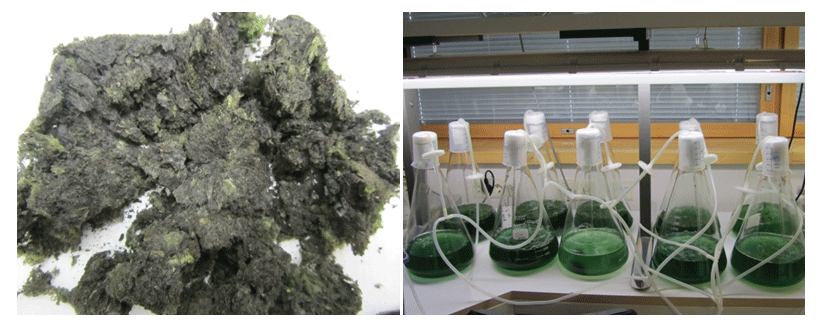
Figure 1:Cultivation of Nostoc sp. ASN in modified Z8IX medium (right fig) and freeze-dried biomass (left fig).
Chemical Analysis
Nostoc sp. ASN cell extracts were analysed by liquid
chromatography mass spectrometry (LC-MS) using an Agilent
1100 Series LC/MSD Trap XCT Plus System (Agilent Technologies).
The sample was injected into the Luna C18 column (150X10
mm, 5 mm, Phenomenex) in batches (1 ml). The mobile phase
A consisted of formic acid (0.1 percent) (Fluka, Sigma Aldrich,
Steinheim, Germany) and mobile phase B consisted of Isopropyl
alcohol. The injection volume of each sample was 10 μl. Setting of
parameters for LC-MS has been shown as a (Table 1).
Table 1:LC-MS/MS Instrument Parameter and Feature Details.
Dry Temp (°C) |
350 |
Dry Gas (l/min) |
8 |
Nebulizer (psi) |
30 |
Capillary (V) |
-5000 |
Skimmer (V) |
85 |
Cap Exit (V) |
300 |
Oct DC (V) |
11.5 |
Oct 2 DC (V) |
4.1 |
Trap Drive |
144 |
Oct RF (Vpp) |
300 |
Lens 1 (V) |
-6.4 |
Lens 2 (V) |
-76.4 |
Scan Range (m/z) |
200-2200 |
Polarity (pos/neg) |
Pos |
Auto MS2 |
on |
M/MS frag Ampl (V) |
0.7 |
Results and DiscussionsTop
The results of analysis by LC-MS showed the allomerization of
chlorophyll a by forming MeO-Lacton chl a, OH-chl a and MeO-chl
an as major products. The acid hydrolysis of the phytol alcohol in
the chlorophyll molecule is accompanied by the loss of Mg and
produces chlorophyllides (Figure 2) (Table 2). chromatogram
in (Figure 3) showed mass spectrum of Total ion chromatogram
(TLC) and Extracted ion chromatogram (EIC) of chlorophyll a
molecule after separating of magnesium ion. The results of MS/
MS2 fragmentation pattern of two times protonated chlorophyll
a allomers showed that in addition to magnesium, the phytol
structure of chlorophyll molecule a has been isolated (Figure 4).
Mass-to-charge (m/z) ratios is according to ionizing molecules
and then sorting and identifying the ions (Figure 4).

Figure 2:The structure of chlorophyll a molecule without magnesium
ion (right fig) and hydrolysis of the phytol tail in the chlorophyll molecule
(left fig).
Table 2:molecular weight of protonated molecular ion’ (MH+) of
different chlorophyll a allomers before and after of separation of
magnesium ion.
Molecular weight in natural condition |
Molecular weight of Mg |
Molecular weight without of magnesium ion |
|
Chlorophyll a |
893 |
22 |
871 |
HO-chlorophyll a |
909 |
22 |
887 |
HO-lactone-chlorophyll a |
925 |
22 |
903 |
MeO-lactone-chlorophyll a |
939 |
22 |
917 |

Figure 3:Total ion chromatogram (TLC) and Extracted ion chromatogram (EIC) of different chlorophyll α allomers (1, Chlorophyll α 871.6 m/z); (2,HO-chlorophyll a 887.6 m/z); (3, HO-lactone-chlorophyll α 903.6 6/903 m/z) and (4, MeO-lactone-chlorophyll α 917.6 m/z) of the ASN_M strain. The
x-axis represents retention time (min), and the y-axis represents signal intensity. Intensity is measured in counts per second (cps).

Figure 4:MS/MS2 fragmentation pattern of protonated chlorophyll a allomers (chlorolhyll α; 872 m/z), (HO-chlorophyll α; 8882.2 m/z); (HO-lactonechlorophyllα; 903.9 m/z) and (MeO-lactone-chlorophyll α; 1/918 m/z) of the ASN_M strain. m/z= Mass-to-charge ratios, The intensity of the ion on
the y-axis is given as counted ions per second (cps) and the mass-to-charge ratio (m/z) on the x-axis
Liquid chromatography is a fundamental separation
technique in the life sciences and related fields of chemistry.
Unlike gas chromatography, which is unsuitable for nonvolatile
and thermally fragile molecules, liquid chromatography can
safely separate a very wide range of organic compounds, from
small-molecule drug metabolites to peptides and proteins. Mass
spectrometers work by ionizing molecules and then sorting and
identifying the ions according to their mass-to-charge (m/z)
ratios. Two key components in this process are the ion source,
which generates the ions, and the mass analyzer, which sorts the
ions. Several different types of ion sources are commonly used
for LC/MS. Each is suitable for different classes of compounds.
Several different types of mass analyzers are also used [20].
ConclusionTop
Here, we employed LC-MS to separate and identify the
allomers of chlorophyll a produced in the Nostoc strain. Moreover,
we extend the use of MS/MS2 in the designation of allomers of
chlorophyll a configuration to identification four different
allomers during the methanolic allomerisation reactions of
chlorophyll a. This research is the first documented of isolation
four different chlorophyll a allomers of Nostoc sp. by liquid
chromatography-mass spectrometer )LC-MS) in Iran.
AcknowledgementsTop
This study was designed and performed in Department
of Biotechnology, Tehran, Iran and University of Helsinki,
Department of Biology, Science and Research Branch. The authors
would like to thank to Dr. David Fewer and Dr. Leo Rouhiainen of
the Department of Food and Environment Sciences, University
of Helsinki, for their helpful discussion, and also wish to thank,
Lyudmila Saari for her/his helpful assistance.
ReferencesTop
- Airs RL, Temperton B, Sambles C, Farnham G, Skill SC and Llewellyn CA. Chlorophyll f and chlorophyll d are produced in the cyanobacterium Chlorogloeopsis fritschii when cultured under natural light and near-infrared radiation. FEBS letters. 2014 16;588(20):3770-3777.
- Ritchie RJ. Universal chlorophyll equations for estimating chlorophylls a, b, c, and d and total chlorophylls in natural assemblages of photosynthetic organisms using acetone, methanol, or ethanol solvents. Photosynthetica. 2008;46(1):115-126.
- Frei YF. The derivative absorption spectra of chlorophyll in algae and leaves at low temperatures. Biochimica et biophysica acta. 1962;57(1):82-87.
- Boekema EJ, Hifney A, Yakushevska AE, Piotrowski M, Keegstra W and Berry S, et al. A giant chlorophyll–protein complex induced by iron deficiency in cyanobacteria. Nature. 2001;412(6848):745-748.
- Louda JW, Li J, Liu L, Winfree MN, Baker EW. Chlorophyll-degradation during cellular senescence and death. Organic geochemistry. 1998;29(5-7):1233-1251.
- Liu L, Jokela J, Wahlsten M, Nowruzi B, Permi P and Zhang YZ, et al. Nostosins, trypsin inhibitors isolated from the terrestrial cyanobacterium Nostoc sp. strain FSN. Journal of natural products. 2014;77(8):1784-1790.
- Nowruzi B, Ahmadimoghadam A. Two new records of heterocystus cyanobacteria (Nostocaceae) from paddy fields of Golestan Province. Iran. Journ. Bot. 2006;11(2):170-173.
- Nowruzi B, Khavari-Nejad RA, Sivonen K, Kazemi B, Najafi F and Nejadsattari T. Phylogenetic and morphological evaluation of two species of Nostoc (Nostocales, Cyanobacteria) in certain physiological conditions. African Journal of Agricultural Research. 2012 17;7(27):3887-3897.
- Nowruzi B, Khavari-Nejad RA, Sivonen K, Kazemi B, Najafi F, Nejadsattari T. A gene expression study on strains of Nostoc (Cyanobacteria) revealing antimicrobial activity under mixotrophic conditions. African Journal of Biotechnology. 2012;11(51):11296-11308.
- Nowruzi B, Khavari-Nejad RA, Sivonen K, Kazemi B, Najafi F and Nejadsattari T. Identification and toxigenic potential of a Nostoc sp. Algae. 2012;27(4):303-313.
- Nowruzi B, Khavari-Nejad RA, Sivonen K, Kazemi B, Najafi F and Nejadsattari T. Optimization of cultivation conditions to maximize extracellular investments of two Nostoc strains. Algological Studies. 2013;142(1):63-76.
- Nowruzi B, Khavari-Nejad RA, Sivonen K, Kazemi B, Najafi F, Nejadsattari T. Identification and toxigenic potential of a cyanobacterial strain (Stigomena sp.). Progress in Biological Sciences. 2013;3(1):79-85.
- Nowruzi B, Khavari-Nejad RA, Nejadsattari T, Sivonen K, Fewer D. A proposal for the unification of two cyanobacterial strains of Nostoc as the same species. Rostaniha. 2017;17(2):161-172.
- Nowruzi B, Fahimi H, Ordodari N, Assareh R. Genetic analysis of polyketide synthase and peptide synthase genes of cyanobacteria as a mining tool for new pharmaceutical compounds. Journal of Pharmaceutical & Health Sciences. 2017;5(2):139-150.
- Nowruzi B, Fahimi H, Ordodari N. Molecular phylogenetic and morphometric evaluation of Calothrix sp. N42 and Scytonema sp. N11. Agriculture research education and extension organization. 2017;18(2):210-221.
- Nowruzi B, Haghighat S, Fahimi H, Mohammadi E. Nostoc cyanobacteria species: a new and rich source of novel bioactive compounds with pharmaceutical potential. Journal of Pharmaceutical Health Services Research. 2018;9(1):5-12.
- Nowruzi B, Blanco S. In silico identification and evolutionary analysis of candidate genes involved in the biosynthesis methylproline genes in cyanobacteria strains of Iran. Phytochemistry Letters. 2019;29:199-211.
- Nowruzi B, Nehadsattari T, Jokela J. Characterization of a New Peptide-Aldehyde Compound from the Terrestrial Cyanobacterium Nostoc sp. Bahar_M by LC. -MS and Marfey’s analysis. Iranian Journal of Biotechnology. 2019;17(2):1563.
- Walker JS, Jie C, Keely BJ. Identification of diastereomeric chlorophyll allomers by atmospheric pressure chemical ionisation liquid chromatography/tandem mass spectrometry. Rapid communications in mass spectrometry. 2003;17(11):1125-1131.
- Heftmann E, editor. Chromatography: Fundamentals and applications of chromatography and related differential migration methods-Part B: Applications. Elsevier; 2004.

