
Research Article
Open Access
Treatment of Benign Melanocytic Hyperplasia of Nail
Apparatus with Dr. Hoon Hur’s Golden Parameter
Therapy
Hoon Hur1*, Jae Seong Joo1, Duck Taik Shim1, Yu Ri Kim1, Jong Il Park1 and Suk Jin Choi1
1Choice Dermatology Clinic, Pyeongchon, Korea
*Corresponding author: Hoon Hur, Choice Dermatology Clinic, Pyeongchon, Korea, Tel: 82-31-383-7533,
E-mail: @
Received: May 30, 2023; Accepted: June 06, 2023; Published: July 03, 2023
Citation: Hoon Hur, Jae Seong Joo, Duck Taik Shim (2023). Treatment of Benign Melanocytic Hyperplasia of Nail apparatus with Dr. Page 2 of 5
Hoon Hur’s Golden Parameter Therapy. Clin Res Dermatol Open Access 10(1): 1-5. 10.15226/2378-1726/10/1/001153
Abstract
Background: Benign melanocytic hyperplasia (BMH) of nail apparatus may be caused by a lentigine in the nail matrix. Traditional treatment
modalities including surgical excision and CO2 laser ablation may cause a severe scar of nail apparatus.There is no clear treatment for BMH of nail
apparatus.
Objectives: This study was performed to investigate the efficacy and safety of Dr. Hoon Hur’s Golden Paramter Therapy (GPT) with a high fluence 1064nm Q-switched Nd:YAG laser (QSNL) for treating BMH of nail apparatus .
Study design: The medical records of 52 Korean patients (age range: 21 to 60 year-old, mean age: 38.6 year-old) diagnosed with BMH of nail apparatus were reviewed retrospectively.
Methods: All patients were treated with a 1064nm QSNL, on a weekly basis for 10-15 treatment sessions of Dr. HoonHur’s GPT. The parameters were a spot size of 7mm, a fluence of 2.2J/cm² and a pulse rate of 10Hz with three passes by a sliding technique (sliding GPT) and one pass by a pulse stacking technique (pulse-stacking GPT) over the BMH of nail apparatus.
Results: At the time of the final treatment, all patients with BMH showed the complete removal of pigmented lesions without any side effects, such as purpura, crust, post-inflammatory hyperpigmentation (PIH), nail dystrophy and scarring. No recurrences were observed in any of the patients after a follow-up of 3-12 months.
Conclusion: We suggest that Dr. Hoon Hur’s GPT with a high fluence 1064nm QSNL is a safe and effective new treatment for BMH of nail apparatus without side effects and recurrences.
Keywords: Benign Melanocytic Hyperplasia; Nail;1064-nm ND:YAG laser;Dr. Hoon Hur’s GPT
Objectives: This study was performed to investigate the efficacy and safety of Dr. Hoon Hur’s Golden Paramter Therapy (GPT) with a high fluence 1064nm Q-switched Nd:YAG laser (QSNL) for treating BMH of nail apparatus .
Study design: The medical records of 52 Korean patients (age range: 21 to 60 year-old, mean age: 38.6 year-old) diagnosed with BMH of nail apparatus were reviewed retrospectively.
Methods: All patients were treated with a 1064nm QSNL, on a weekly basis for 10-15 treatment sessions of Dr. HoonHur’s GPT. The parameters were a spot size of 7mm, a fluence of 2.2J/cm² and a pulse rate of 10Hz with three passes by a sliding technique (sliding GPT) and one pass by a pulse stacking technique (pulse-stacking GPT) over the BMH of nail apparatus.
Results: At the time of the final treatment, all patients with BMH showed the complete removal of pigmented lesions without any side effects, such as purpura, crust, post-inflammatory hyperpigmentation (PIH), nail dystrophy and scarring. No recurrences were observed in any of the patients after a follow-up of 3-12 months.
Conclusion: We suggest that Dr. Hoon Hur’s GPT with a high fluence 1064nm QSNL is a safe and effective new treatment for BMH of nail apparatus without side effects and recurrences.
Keywords: Benign Melanocytic Hyperplasia; Nail;1064-nm ND:YAG laser;Dr. Hoon Hur’s GPT
Introduction
Benign melanocytic hyperplasia (BMH) of nail apparatus is
characterized by activation and proliferation of melanocytes. It
can be caused by a lentigine in the nail matrix. Brown pigmented
longitudinal band is seen in both the nail matrix and the nail plate
without cytological atypia [1,2]. Treatment of BLM is necessary
because of cosmetic concerns. But successful treatment of
BLM without side effects, such as nail dystrophy, scarring and
recurrences, is still challenging and difficult [2,3]. The surgical
treatment of BMH of nail apparatus may provoke a severe scar,
therefore we do not recommend it. In the previous study, authors
already reported the effect of GPT in treatment of cafe au lait spot,
partial unilateral lentiginosis, Becker’s nevus, Ota’s nevus, Hori’s
nevus, congenital melanocytic nevus, Riehl’s melanosis, erythema
ab igne and PIH of prurigopigmentosa[4 -16]. In this paper, we
suggest a new powerful treatment of BMH of nail apparatus using
Dr. Hoon Hur’s Golden parameter Therapy (GPT) with a high
fluence 1064nm Q-switched Nd:YAG laser (QSNL) without side
effects including nail dystrophy and scarring, and recurrences.
Materials and Methods
The medical records of 52 Korean patients with BMH of nail
apparatus (32 men and 20 women, age range: 21 to 60 year-old,
mean age: 38.6 year-old) were reviewed retrospectively at the
Choice Dermatology Clinic from January 2012 to December 2021.
All patients with BMH of nail apparatus were diagnosed by clinical
features and dermoscopic findings [Figure 1(A),2(A),3(A),4(A)].
They had no significant medical or familial history. Written
informed consents were obtained from all of the 52 patients
before proceeding into treatment. Topical anestheic was not used
before the laser treatment. And all patients were received 10-
15 sessions of Dr. HoonHur’s GPT using a high fluence 1064nm
QSNL (QX-MAX or StarWalker, Fotona, Slovenia) at a one-week
interval with a spot size of 7mm, a fluence of 2.2J/cm² and a pulse
rate of 10Hz using three passes by a sliding technique over the
pigmented lesion of nail plate and one pass by a pulse stacking
technique over the nail matrix. The moving speed of handpiece
using a sliding technique (sliding GPT) was 2-3 shots overlapping
irradiation on the same lesion and a pulse-stacking technique (pulse-stacking GPT) was 30 shots/3 seconds overlapping irradiation on the same lesion. After the laser treatment, cooling with
icepacks was performed but the patients did not use a broad spectrum sunscreen. The number of treatment sessions was adjusted to
the clinical response. The treatment was terminated when the investigators and the patients agreed with complete resolution of BMH of
nail apparatus. Photographs were taken on the day of treatment, and an evaluation was carried out by standardized digital photography
using a digital camera (Canon Camera 100D, Great Britain). The physician’s clinical assessment of the degree of improvement of the
patients (mean score of two investigators who did not attend the treatment) was also carried out 4 weeks after the laser treatment
session and reported as percentage resolution as follows: poor (0-25% clearance), fair (26-50% clearance), good (51-75% clearance),
excellent (76-95% clearance) and complete (96-100% clearance) by analyzing the clinical photographs of patients. The patients were
asked to report any side effects, pain or discomfort during the treatment.
Table 1: The demographic data of 52 patients with BMH of nail apparatus
Variable |
|
Age |
|
Age range |
21-60 year-old |
Mean age |
38.6 year-old |
Gender |
|
Male |
32 |
Female |
20 |
Family history |
Non-remarkable |
Location of finger nail |
|
Thumb |
11/52, (21%) |
Index finger |
15/52, (29%) |
Middle finger |
14/52, (27%) |
Ring finger |
8/52, (15%) |
Table 2: The result of treatment with Dr. Hoon Hur‘s GPT
Treatment response |
Number of patients |
Poor (0-25% clearance) |
0 |
Fair (26-50% clearance) |
0 |
Good (51-75% clearance) |
0 |
Excellent (76-95% clearance) |
0 |
Complete (96-100% clearance) |
52 (100%) |

Figure 1A :BMH of nail apparatus (before treatment), B:A complete clearance of BMHof nail apparatus (after treatment with Dr. Hoon Hur’s GPT).

Figure 2A : BMH of nail apparatus (before treatment), B: A complete clearance of BMH of nail apparatus (after treatment with Dr. Hoon Hur’s GPT).

Figure1c, 3A:: BMH of nail apparatus (before treatment), B: A complete clearance of BMH of nail apparatus (after treatment with Dr. Hoon Hur’s GPT).
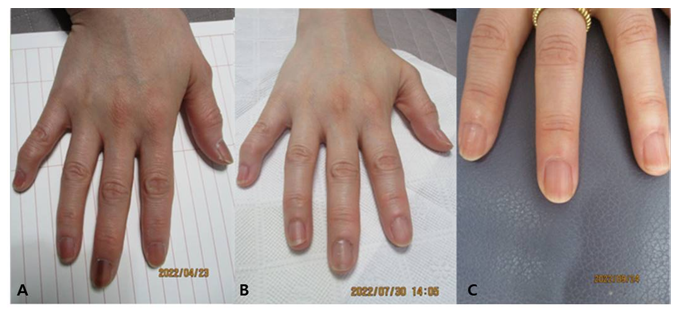
Figure1c, 4A:: BMH of nail apparatus (before treatment), B: A complete clearance of BMH of nail apparatus (after treatment with Dr. Hoon Hur’s GPT), c
: There is no recurrence at 3 months’ follow-up.
Results
Fifty-two Korean patients with BMH of nail apparatus were
included in this study [Table 1 and Table 2]. All of the 52 patients
were achieved complete clearance of the pigmented lesions
[Figure 1B,2B,3B,4B]. None of the patients reported severe
pain or discomfort during the laser treatment, and there were
no side effects reported, such as purpura, crust, PIH, mottled
hypopigmentation, nail dystrophy and scarring except mild pain.
No recurrences have been detected after a follow-up of 3-12
months [Figure 4C].
Results
Benign melanocytic hyperplasia (BMH) of nail apparatus is
characterized by activation and proliferation of melanocytes and
may be caused by a lentigine in the nail matrix. The lentigine in
the nail matrix is more common and is present in about 9% of all
longitudinal melanonychia cases in adults [1,2]. Macroscopically,
the lesion shows a brown pigmented longitudinal band on
the proximal nail fold and nail plate. And the nail dystrophic
change is not seen in both the nail plate and the periungual area
[2,3]. Cytologically, melanocytes have a normal appearance,
and atypical melanocytes and nests of nevus cells are not
observed[3]. BMH of nail apparatus has no malignant potential
because there are no nevus cells. An increase in the number of
melanocytes can be demonstrated by Fontana-Masson stain and
immunohistochemical stain with S-100, Melan-A, and HMB-45
stains [1,3]. BMH of nail apparatus is a common cosmetic problem
in the dermatologic fields [1,2]. The surgical procedures of BMH
of nail apparatus may provoke a severe scar, therefore we do not
recommend it. There is still no effective treatment for BMH of nail
apparatus. Treating BMH of nail apparatus with traditional laser
therapy may end up in failure because of possible several reasons.
First, the 532 nm wavelength of Q-Switched Nd:YAG laser, the
694nm wavelength of Ruby laser, the 755nm wavelength of
alexandrite, and the 515-755nm wavelength of IPL absorb much
more melanin compared to 1064nm wavelength of Q-Switched
Nd:YAG laser. Thus, fluence that destroys melanocytes injuries
the surrounding keratinocytes, and the damaged keratinocytes
secrete endothelin-1, alpha-melanocyte stimulating hormone,
vascular endothelial growth factor, prostaglandin (PGE2, PGF2a)
and nitric oxide which can activate melanocytes and increase
melanin synthesis in the melanosomes [1,4,5]. Second, the
keratinocytes secrete urokinase type plasminogen activator
(U-type PA) that converts plasminogen to plasmin. This plasmin
stimulates the keratinocytes to secrete basic fibroblast growth
factor (bFGF) that activates the melanocytes and increases
melanin synthesis, therefore causing PIH and worsening
pigmented lesions of BMH of nail apparatus [1,4,7]. Third, the
traditional laser energy which is so strong enough to damage nail
matrix and causes nail dystrophy and scarring and damage to
fibroblasts, mast cells, lymphocytes, macrophages and vascular
endotheliums simultaneously. The damaged fibroblasts secrete
bFGF, stem cell factor (SCF), and hepatocyte growth factor (HGF)
to cause PIH [1,4,8]. Finally, reactive oxygen species, such as
superoxide and nitric oxide, generated from damaged nail matrix
activates melanocytes and increases melanin synthesis in the
melanosomes [1,6,7]. To avoid the side effects including purpura,
crust, PIH, nail dystrophy and scarring, the authors introduced a
new treatment using the Dr. Hoon Hur’s GPT with a high fluence
1064nm QSNL (QX-MAX or StarWalker, Fotona, Slovenia), a spot
size of 7mm, a fluence of 2.2J/cm², a pulse of 10Hz using three
passes by a sliding technique over the pigmented lesion of nail
plate and one pass by a pulse stacking technique over the nail
matrix. The mechanism of Dr. Hoon Hur’s GPT is to minimize the
epidermal damage and destroys melanosomes in the epidermal
melanocytes, which are changed into ghost cells due to the loss
of the function [4,6,7]. Then, weekly Dr. Hoon Hur’s GPT destroys melanocytes completely, accelerates apoptotic melanocyte cell
death, thus removing the increased epidermal melanocytes [4,
7]. The advantage of Dr. HoonHur’s GPT is that it minimizes the
epidermal damage without purpura, crust, PIH, nail dystrophy
and scarring. Because Dr. Hoon Hur’s GPT is less absorbed by
epidermal melanin, it transmits energy without destroying
normal background tissue, and destroys epidermal melanocytes
[4-8]. Two cases of longitudinal melanonychia treatment (LMT)
with 1064nm picosecond laser, and one case of LMT with 532nm
picosecond laser have been reported with successful results[17,
18]. But previous studies of LMTwith laser are very limited. In
our study,all of the 52 patients with BMH with nail apparatus
were achieved complete clearance of the pigmented lesions. All
patients with Dr. Hoon Hur’s GPT using a high fluence 1064nm
QSNL were satisfied with the results. There is no recurrence at
3-12 months’ follow-up. And we think that further randomized
controlled prospective studies will be required.
Conclusion
Dr. Hoon Hur’s GPT using a high fluence 1064nm QSNL
can completely remove the pigmented lesions of BMH of nail
apparatus without side effects including purpura, crust, PIH, nail
dystrophy and scarring and recurrences. Therefore, we suggest
Dr. Hoon Hur’s GPT is a new, safe and good option for treating
BMH of nail apparatus.
- Singal A, Bisherwal K. Melanonychia: Etiology, Diagnosis, and Treatment. Indian DermatolOnline J. 2020;11(1):1-11. doi: 10.4103/idoj.IDOJ_167_19.
- Haneke E, Baran R. Longitudinal melanonychia. Dermatol Surg. 2001;27:580–584.
- Gunes P, Goktag F. Melanocytic Lesions of the Nail Unit. J Dermatopatho(Basel). 2018;5(3):98-107. doi: 10.1159/000490557.
- Hur H. The Treatment of Café Au Lait Spot Using Dr. HoonHur’s Golden ParameterTherapy. J DermatolTher. 2016;1:1-4.
- Hur H, Baek JO, Park IJ, Lee KR,Ryu HR, Kim JS, et al. High-fluence 1064-nm Q-Switched Nd:YAG laser: Safe and effective treatment of café-au-lait macules in Asian patients. J CosmetDermatol. 2018;17(3):380-384.doi: 10.1111/jocd.12432.
- Hur H, Kim JH, Park IJ, Park CH, Shim DT, et al. The New Treatment of Café Au Lait Spot Using Dr. HoonHur’s Golden Parameter Therapy With a High Fluence 1064nm Q-Switched Nd:YAG Laser. Int J Cur Res. 2018;10(4):68082-68086.
- Hur H, Shim DT, Song SE, Kim PS, Hyun DN, Kim YR. The Treatment of InfantileCafé Au Lait Spot Using Dr. HoonHur’s Golden Parameter Therapy with a HighFluence 1064 nm Q-Switched Nd:YAG Laser. J Clin Res Dermatol. 2020;7(1):1-5.
- Hur H, Kim YR, Shim DT. The Treatment of Café Au Lait Spot, Partial UnilateralLentiginosis and Becker's Nevus Using a High Fluence 1064nm Q-swithedNd:YAGLaser. J Clin and CosmetDermatol. 2017;1:1-4.
- Hur H, Choi YJ, Cheon MS, Kim YR. The New Treatment of Partial Unilateral Lentiginosis Using Dr. HoonHur’s Golden Parameter Therapy With a High Fluence 1064nm Q-Switched Nd:YAG Laser Without Side Effects. Int J Cur Res. 2017;9(12):63456-63460.
- Hur H, Kim JH, Shim DT, Choi SJ, Kim PS, Kim RU. The Treatment of Becker’snevus by Combination Therapy: Dr.HoonHur’s Golden Parameter Therapy andDr.HoonHur’s Optimal Melanocytic Suicide-1 Parameter Therapy. J Surg. 2021;9(1):16-21.
- Hur H, Park CH, Kim YR, Hyun DN. Treatment of Ota’s Nevus Using Dr. HoonHur’s Golden Parameter with a High Fluence 1064nm Nd:YAG Laser without Side Effects. J Dermatol Res and Ther. 2017;3:1-4. Doi: 10.23937/2469-5750/1510047.
- Hur H, Kim YR. The Treatment of Hori’s Nevus by New Combination Treatment without Side Effects: Dr. HoonHur’s Golden Parameter Therapy and Dr. HoonHur’s Optimal Melanocytic Suicide-2 Parameter Therapy. J Clin Res Dermatol. 2017;4:1-5.
- Hur H, Park CH, Kim YR, Kim PS. Treatment of a Congenital Melanocytic Nevus by New Combination Therapy: Intense Pulse Light Therapy and Dr. HoonHur’s Golden Parameter Therapy. J Dermatol Ther. 2017;1:12-16.
- Hur H, Lee GH, Kim PS, Hyun DN, Kim YR. The Treatment of Riehl’s Melanosis Using Dr. HoonHur’s Golden Parameter Therapy With a High Fluence 1064nm Q-Switched Nd:YAG Laser Without Side Effects. Int J Cur Res. 2018;10(2):65103-65108.
- Hur H, In SI, Cheon MS, Choi YJ, Lee DH, Kim YR. The Treatment of Erythema Ab Igne Using Dr. HoonHur’s Golden Parameter Therapy With a High Fluence 1064nm Q-Switched Nd:YAG Laser. Int J Cur Res. 2018;10(10):74218-74221.
- Hur H, Shim DT, Cheon MS, Kim PS, Hyun DN, Kim YR. The Treatment of Postinflammatoty Hyperpigmentation Due to PrurigoPigmentosa Using Dr. HoonHur’s Golden Parameter Therapy With a High Fluence 1064nm Q-Switched Nd:YAG Laser. Int J Cur Res. 2019;11(3):2491-2494.
- Kwei LL, Wen CT. Picosecond Laser as a Promising Treatment Option for Longitudinal Melanonychia Caused By Melanocytic Activation: Report of Two Case. J PhotodermatolPhotoimmunolPhotomed. 2020;36(2):163-165.
- Fritz K. Alghamdi M. Salavastru C. Treatment of a LongitudinalMelanonychia in a One Session with a 532nm Picosecond Laser. J Clinical Cases in Melanoma. 2020: 9-11.