


2DDS, PhD, ASD, Dental Clinic, Pesaro, Italy
Methods: Twenty-four participants with moderate chronic periodontitis were enrolled in our randomised, placebo-controlled trial. The control group (CG=12) was treated with SRP and given a placebo; the treatment group (TG=12) was treated with SRP and dietary supplementation of 3g daily of alphalife (Freia Farmaceutici Srl). Probing depth (PD), clinical attachment level (CAL), bleeding on probing (BOP) and modified sulcus bleeding index (SBI) were recorded at baseline and after 6 months.
Results: CAL, PD, BOP and SBI were significantly improved in both groups after 6 months (p< 0.001). After 6 months CAL improved significantly better in the test than in the control group (p< 0.001), also PD in the tendency (p = 0.1). BOP improved better in the test group after 6 months (p = 0.065). Conclusion: Our results suggest PUFAs can significantly reduce periodontal parameters following SRP. Therefore, dietary supplementation may have potential benefits in the treatment of patients with chronic periodontitis.
Keywords
α-linolenic acid (ALA);Adjuvant treatment;Chronic periodontitis;Dietary Supplements;Omega-3;Polyunsaturated fatty acids (PUFAs).
PUFAs: Polyunsaturated Fatty Acids
SRP: Scaling and Root Planing
CG: Control Group
TG: Test Group
PD: Probing Depth
CAL: Clinical Attachment Level
BOP: Bleeding on Probing
SBI: Sulcus Bleeding Index
EPA: Eicosapentaenoic Acid
DHA: Docosahexaenoic Acid
ARA: Arachidonic Acid

- minimum number of teeth ≥ 20;
- chronic untreated periodontitis;
- age between 18 to 70 years;
- absence of systemic pathologies that could compromise the physiological healing processes (type 2 diabetes, oncological and immunosuppressive diseases, bone turnover pathologies);
- smoke;
- state of pregnancy or breastfeeding;
- antibiotic and anti-inflammatory therapies taken within 6 months.
Patients, once the study was carefully explained, signed an informed consent form. Six patients did not meet the inclusion criteria and were excluded from the study. Finally, thirty patients were randomized into the test and control group to be received for 6 months:
- 3g per day of alphalife (FreiaFarmaceuticisrl) (n = 15, test group);
- 3g / day of placebo (n = 15, placebo).
At the first visit, a systemic medical history was performed on all patients (with a focus on pathologies that could compromise the physiological healing processes and on any pharmacological therapies performed). A complete dental examination was then performed, with periodontal chart, radiographic examinations

Table 1: Demographics of subject population and baseline periodontal parameters |
|||
|
Test |
Control |
p Value |
Age |
50.4 ± 5.9 |
50.8±6.7 |
|
Men |
7 |
6 |
|
Women |
5 |
6 |
|
PD |
3.2±0.4 |
3.2±0.5 |
0.967 |
CAL |
3.4±0.3 |
3.4±0.4 |
0.948 |
BOP (%) |
16.6±4 |
16.7±5.6 |
0.726 |
SBI (%) |
18.6±6.4 |
18.2±5.5 |
0.870 |
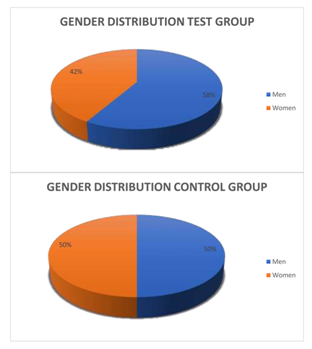
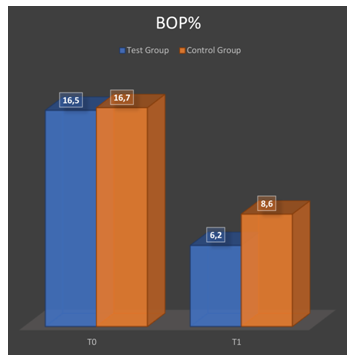
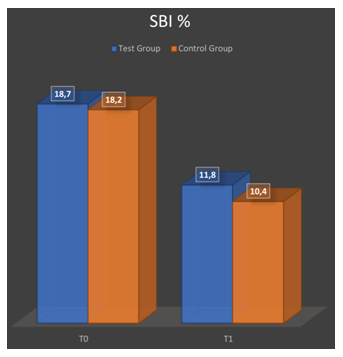
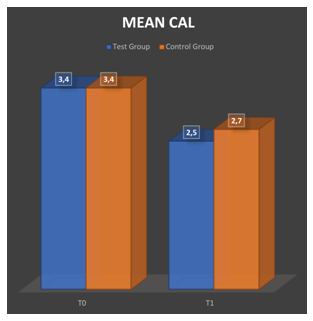
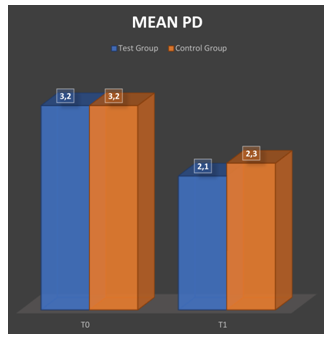
Table 2: Full-mouth values for periodontal measurements at baseline (T0), and after treatment (T1). |
|||
BoP (%) |
Baseline (T0) |
6 Months (T1) |
Differences (T0-T1) |
Test |
16.5 ± 4.2 |
6.2 ± 3.1 |
10.3 ± 3.2 |
Control |
16.7 ± 5.4 |
8.6 ± 3.6 |
8.1 ± 4.1 |
SBI (%) |
|
||
Test |
18.7 ± 6.4 |
11.8 ± 4.3 |
6.8 ± 5.1 |
Control |
18.2 ± 5.5 |
10.4 ± 4.2 |
7.7 ± 5.4 |
Mean PD (mm) |
|
||
Test |
3.2 ± 0.4 |
2.1 ± 0.2 |
2.2 ± 0.3 |
Control |
3.2 ± 0.5 |
2.3 ± 0.4 |
2.3 ± 0.4 |
Mean CAL (mm) |
|
||
Test |
3.4 ± 0.3 |
2.5 ± 0.3 |
2.6 ± 0.1 |
Control |
3.4 ± 0.4 |
2.7 ± 0.3 |
2.8 ± 0.3 |
Table 3:Studies on dietary supplementation of PUFAS included in the discussion |
||||
Authors |
Sample size |
PUFAs dosage |
Study duration |
Clinical Outcomes |
Sharkawyet al. |
Test group 40 |
900 mg (EPA/DHA 30%) and 100 mg wheat-germ oil and 81 mg of aspirin |
Daily for 26 weeks |
Significant reduction in probing depths and a significant attachment gain after 3 and 6 months in the group test compared to baseline and the control group. |
Kujuret al.
|
Test group 48 |
500 mg (concentration of EPA 180 / DHA120) |
Daily for 12 weeks |
Significance reduction in probing depth, clinical attachment level and gingival index at 1 and 3 months, respectively, in test group compared to baseline and control group. |
Keskineret al. |
Test group 15 |
6.25 mg EPA and |
Twiceadaybythepatientsfor |
Both groups showed significant changes in clinical parameters in response to treatment compared to baseline with no significant difference between groups. |
Martinez et al. |
Test group 10 |
900 mg EPA and DHA (180 mg |
Daily for 16 weeks |
PUFAs dietary supplementation had no effect on the clinical outcome of the treatment, since periodontal parameters were not significantly different between the test and placebo groups at baseline. |
Deoreet al. |
Test group 30 |
300 mg of ω-3 PUFAs (180 mg and 120 mg of EPA and DHA) |
Daily for 12 weeks |
A significant reduction in the gingival index, sulcus bleeding index, pocket depth, and clinical attachment level was found in the TG compared to the CG at a 12-week period. |
Standoet al. |
Test group 20 |
2.6 g of EPA, 1.8 g of DHA, |
Daily for 12 weeks |
A statisticallysignificanthigherpercentage of closedpockets (probingdepth ≤ 4 mm without BOP) wasachieved in the test group vs. control groupafterthreemonths of treatment. |
- Papapanou PN, Sanz M, Buduneli N, Dietrich T, Feres M, Fine DH et al. Periodontitis: Consensus report of workgroup 2 of the 2017 World Workshop on the Classification of Periodontal and Peri-Implant Diseases and Conditions. J Periodontol. 2018;89Suppl 1:S173-S182.
- Aspriello SD, Zizzi A, Tirabassi G, Buldreghini E, Biscotti T, Faloia E et al. Diabetes mellitus-associated periodontitis: differences between type 1 and type 2 diabetes mellitus. J Periodontal Res. 2011;46(2):164-169.
- Tonetti MS, Jepsen S, Jin L, Otomo-Corgel J. Impact of the global burden of periodontal diseases on health, nutrition and wellbeing of mankind: A call for global action. J Clin Periodontol. 2017;44(5):456-462.
- Hajishengallis G, Chavakis T, Lambris JD. Current understanding of periodontal disease pathogenesis and targets for host-modulation therapy. Periodontol 2000. 2020;84(1):14-34.
- Aspriello SD, Zizzi A, Lucarini G, Rubini C, Faloia E, Boscaro M, Tirabassi G, Piemontese M. Vascular endothelial growth factor and microvessel density in periodontitis patients with and without diabetes. J Periodontol. 2009;80(11):1783-9.
- Van Dyke TE, Sima C. Understanding resolution of inflammation in periodontal diseases: Is chronic inflammatory periodontitis a failure to resolve? Periodontol. 2020;82(1):205-213.
- Lucarini G, Zizzi A, Aspriello SD, Ferrante L, Tosco E, Lo Muzio, L et al. Involvement of vascular endothelial growth factor, CD44 and CD133 in periodontal disease and diabetes: an immunohistochemical study. J Clin Periodontol. 2009;36(1):3-10.
- Bastendorf KD, Strafela-Bastendorf N, Lussi A. Mechanical Removal of the Biofilm: Is the Curette Still the Gold Standard? Monogr Oral Sci. 2021;29:105-118.
- Dental Scaling and Root Planing for Periodontal Health: A Review of the Clinical Effectiveness, Cost-effectiveness, and Guidelines. Ottawa (ON): Canadian Agency for Drugs and Technologies in Health. 2016.
- Biloklytska G, Braun I. Combined Usage of Diode Laser "Granum" and "Emdogain" (Straumann) During Surgical Phase in Treatment of Generalized Periodontitis. J Dent Oral DisordTher; 2014;2(3):1-7.
- Kothiwale S, Kella M, Hombal L, Rathore A. Evaluation of sodium bicarbonate as an adjunct to non surgical periodontal therapy and its effect on oxidative stress: A clinico-biochemical study. J Dent Oral DisordTher. 2014;2(2):5.
- Mykytenko AO, Yankovskiy DS, Dyment GS, Beregova TV, Neporada KS. "Simbiter Omega" Multiprobiotic: A New Aid in Treatment of Generalized Chronic Periodontitis. J Dent Oral DisordTher. 2015;3(1):1-6.
- Farjana HN, Anand, Chandrasekaran SC. “Resolvins: A novel theraputic approach in treating periodontal disease. Indian J Multidiscip Dent. 2015;5:10-4
- Innes JK, Calder PC. Omega-6 fatty acids and inflammation. Prostaglandins LeukotEssent Fatty Acids. 2018;132:41-48.
- Van Dyke TE. Pro-resolving mediators in the regulation of periodontal disease. Mol Aspects Med. 2017;58:21-36.
- Chiang N, Serhan CN. Specialized pro-resolving mediator network: an update on production and actions. Essays Biochem. 2020;64(3):443-462.
- Vardar-Sengul S, Buduneli E, Turkoglu O, Buduneli N, Atilla G, et al. The effects of selective COX-2 inhibitor/celecoxib and omega-3 fatty acid on matrix metalloproteinases, TIMP-1, and laminin-5gamma2-chain immunolocalization in experimental periodontitis. J Periodontol. 2008;79(10):1934-41.
- Román GC, Jackson RE, Gadhia R, Román AN, Reis J. Mediterranean diet: The role of long-chain ω-3 fatty acids in fish; polyphenols in fruits, vegetables, cereals, coffee, tea, cacao and wine; probiotics and vitamins in prevention of stroke, age-related cognitive decline, and Alzheimer disease. Rev Neurol (Paris). 2019;175(10):724-741.
- Saini RK, Keum YS. Omega-3 and omega-6 polyunsaturated fatty acids: Dietary sources, metabolism, and significance - A review. Life Sci. 2018 ;203:255-267.
- Reddy MS, Geurs NC, Gunsolley JC. Periodontal host modulation with antiproteinase, anti-inflammatory, and bone-sparing agents. A systematic review. Ann Periodontol. 2003;8(1):12-37.
- Salvi GE, Lang NP. Host response modulation in the management of periodontal diseases. J Clin Periodontol. 2005;32Suppl 6:108-29.
- Joseph A, Nalini HE, Kumar PA, Devi R. Pharmacotherapy for host modulation in periodontal disease: A review. J Indian Acad Dent Spec Res. 2015;2:35-39.
- Tribulova N, Bacova B, Benova T, Knezl V, Barancik M, Slezak J. Omega-3 Index and Anti-Arrhythmic Potential of Omega-3 PUFAs. Nutrients. 2017;9(11):1191.
- Wall R, Ross RP, Fitzgerald GF, Stanton C. Fatty acids from fish: the anti-inflammatory potential of long-chain omega-3 fatty acids. Nutr Rev. 2010;68(5):280-289.
- Calder PC. Omega-3 fatty acids and inflammatory processes: from molecules to man. BiochemSoc Trans. 2017 ;45(5):1105-1115.
- Serhan CN, Chiang N, Van Dyke TE. Resolving inflammation: dual anti-inflammatory and pro-resolution lipid mediators. Nat Rev Immunol. 2008;8(5):349-61.
- Ajith TA, Jayakumar TG. Omega-3 fatty acids in coronary heart disease: Recent updates and future perspectives. Clin ExpPharmacol Physiol. 2019;46(1):11-18.
- Endo J, Arita M. Cardioprotective mechanism of omega-3 polyunsaturated fatty acids. J Cardiol. 2016;67(1):22-7.
- Ferguson B, Bokka NR, Maddipati KR, Ayilavarapu S, Weltman R, Zhu L, et al. Distinct Profiles of Specialized Pro-resolving Lipid Mediators and Corresponding Receptor Gene Expression in Periodontal Inflammation. Front Immunol. 2020;11:1307.
- Colussi G, Catena C, Novello M, Bertin N, Sechi LA. Impact of omega-3 polyunsaturated fatty acids on vascular function and blood pressure: Relevance for cardiovascular outcomes. NutrMetabCardiovasc Dis. 2017;27(3):191-200.
- Burckhardt M, Herke M, Wustmann T, Watzke S, Langer G, Fink A. Omega-3 fatty acids for the treatment of dementia. Cochrane Database Syst Rev. 2016;4(4):CD009002
- Song C, Shieh CH, Wu YS, Kalueff A, Gaikwad S, Su KP. The role of omega-3 polyunsaturated fatty acids eicosapentaenoic and docosahex aenoic acids in the treatment of major depression and Alzheimer's disease: Acting separately or synergistically? Prog Lipid Res. 2016;62:41-54.
- Ajith TA. A Recent Update on the Effects of Omega-3 Fatty Acids in Alzheimer's Disease. Curr Clin Pharmacol. 2018;13(4):252-260.
- Sharkawy H, Aboelsaad N, Eliwa M, Darweesh M, Alshahat M, Kantarci A, et al. Adjunctive treatment of chronic periodontitis with daily dietary supplementation with omega-3 Fatty acids and low-dose aspirin. J Periodontol. 2010;81(11):1635-1643.
- Kujur SK, Goswami V, Nikunj AM, Singh G, Bandhe S, Ghritlahre H. Efficacy of omega 3 fatty acid as an adjunct in the management of chronic periodontitis: A randomized controlled trial. Indian J Dent Res. 2020;31(2):229-235.
- Deore GD, Gurav AN, Patil R, Shete AR, Naiktari RS, Inamdar SP. Omega 3 fatty acids as a host modulator in chronic periodontitis patients: a randomised, double-blind, palcebo-controlled, clinical trial. J Periodontal Implant Sci. 2014;44(1):25-32.
- Stańdo M, Piatek P, Namiecinska M, Lewkowicz P, Lewkowicz N. Omega-3 Polyunsaturated Fatty Acids EPA and DHA as an Adjunct to Non-Surgical Treatment of Periodontitis: A Randomized Clinical Trial. Nutrients. 2020;12(9):2614.
- Keskiner I, Saygun I, Bal V, Serdar M, Kantarci A. Dietary supplementation with low-dose omega-3 fatty acids reduces salivary tumor necrosis factor-α levels in patients with chronic periodontitis: a randomized controlled clinical study. J Periodontal Res. 2017;52(4):695-703.
- Martinez GL, Koury JC, Brito F, Fischer RG, Gustafsson A, Figueredo CM. The impact of non-surgical periodontal treatment on serum levels of long chain-polyunsaturated fatty acids: a pilot randomized clinical trial. J Periodontal Res. 2014;49(2):268-74.
- Aspriello SD, Murgia MS, Casu C, Coiana C, Fais S, Orrù G et al. Effect of 3 months dietary supplementation with omega-3 α -linolenic acid (ala) and polyunsaturated fatty acids (PUFAS) (AlphalifeFreiaFramaceuticiSrl) following scaling and root planing : a pilot study. Journal of Osseointegration. 2020;12:613–614.

